The majority of the Swiss population continues to oppose raising the retirement age.
Keystone-SDA
The Swiss pension system is showing signs of increasing fragility, according to a study published on Thursday by the consultancy firm VermögensZentrum (VZ). Public confidence in the state old-age pension scheme stands at roughly 25%.
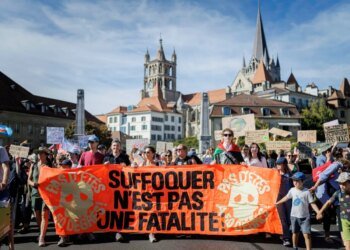
Expected pension benefits have fallen by 16% since 2002, equivalent to a reduction of CHF12,260 ($15,140) a year for an employee earning CHF120,000. The main reason for this decline is the sharp reduction in benefits paid out under the second pillar, which consists of occupational pension plans, whilst the state old-age pension has increased. Meanwhile, public distrust of the old-age pension system is growing, and the majority of the population continues to oppose raising the retirement age.
The report published on Thursday takes as an example a 55-year-old with an annual income of CHF120,000. At the age of 65, this worker will be able to count on an annual pension of CHF62,660. In 2002, the figure was significantly higher, at CHF74,920.
A key factor is the sharp decline in pension fund benefits, which have fallen by 40% over the same period. At the same time, the old-age pension has risen by a third, reaching CHF32,760, including the 13th monthly payment, which will be paid out for the first time at the end of 2026.
More

More
Record number of Swiss old-age pensions paid out
The reason for this imbalance lies in the contrasting trends of the two systems. Whilst the old-age pension scheme has been adjusted for inflation, the conversion rate used to calculate second-pillar pensions has been steadily reduced: the average rate has fallen from 6% a decade ago to the current 5.26%. Pension funds have lowered this rate to cope with rising life expectancy and persistently low interest rates, thereby stabilising their balance sheets, but at the expense of pension amounts for retirees.
The result is that pensions now cover an ever-smaller proportion of a person’s final salary. Someone earning CHF100,000 a year will now receive a pension amounting to around 51% of their final salary, compared with 62% in 2002.
The gap widens for higher earners: a worker on a salary of CHF150,000 will find that their pension covers just 42% of their final salary, compared with 58% 24 years ago. These figures – as the authors of the study point out – deviate significantly from the original objective of the three-pillar system, which envisaged that pensions from the first and second pillars would together guarantee 60% of final income.
Dipping public confidence in pension system
The study also highlights a decline in public confidence in the system. Only a quarter of those surveyed believe that old-age pensions will be secure in 20 years’ time, whilst confidence in pension funds stands at 30%. The main concerns for the future remain the rising costs of old-age care and long-term care, as well as the financial sustainability of the old-age pension scheme.
More
More
VAT to be increased to fund 13th Swiss pension payment
Despite these concerns, a clear majority (68%) rejects the idea of raising the standard retirement age. The Swiss government is banking on the 2030 old-age pension reform to find a solution, but the matter remains entirely in the hands of the political process.
Despite the climate of uncertainty, around 58% of those surveyed are confident that they will be able to maintain their standard of living in retirement thanks to a combination of the old-age pension scheme, their pension fund and personal assets.
Translated from Italian/reviewed by an English Department journalist