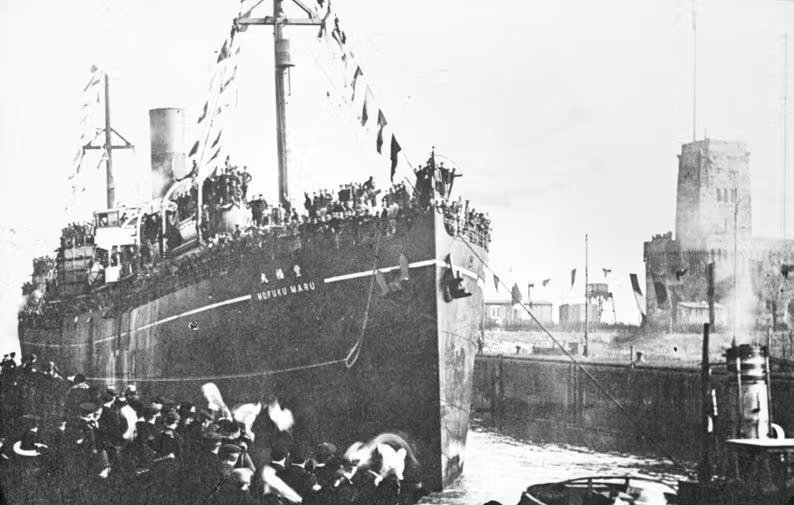
Japanese hellships were inhumane places. Most of them were converted freighters the Imperial Japanese Navy in World War II (1939-1945) prisoners of war were transported like cattle for forced labor. The conditions on board were brutal. Historians estimate that of around 125,000 Allied prisoners of war transported, 22,000 died on board due to exhaustion, malnutrition and disease. In total, Japan operated around 130 hellships, one of which has now been discovered.
A team of underwater archaeologists and historians was able to locate the wreck in January at a depth of 50 meters off the coast of Zambales province on the Philippine island of Luzon. The breakthrough came from newly discovered Japanese documents after the US organization Hellships Memorial Foundation had searched for the Hōfuku Maru for years without success.
“We were completely amazed that Japanese sources had information about where the convoy was attacked and which ships were hit – that was clear evidence,” Hellships Memorial Foundation founder Randy Anderson said, according to Heritage Daily. Using sonar and several dives, the researchers mapped the wreck and then compared the data obtained with the original plans of the Hōfuku Maru. This is how they were able to identify the wreckage.
Sunk during US attack
At the time of the Hōfuku Maru’s sinking, there were around 1,200 Allied prisoners of war on board. Most of them were members of the British or Dutch armed forces. Many of them had previously been forced to work on the infamous “Railroad of Death” in Thailand. Because of the inhumane working conditions Japan subjected its forced laborers to, the construction of the Thailand-Burma Railway is now considered a war crime.
On September 21, 1944 there was a fatal attack on the Hōfuku Maru. The hell ship was part of a military convoy of the Imperial Japanese Navy and was not recognizable as a prison ship. “Unfortunately, many of these prisoner transport ships were sunk by the Allies,” said expedition leader and American television presenter Josh Gates on Livescience.com. “The ships were painted to look like military ships and were within Japanese convoys – so the Allies considered them legitimate military targets.”
The site becomes a naval war grave
When U.S. fighter planes sighted the convoy, one of them dropped a torpedo that split the Hōfuku Maru in half. The ship sank in just three minutes. Since most of the prisoners of war were trapped, Only a few were able to swim to landwhere they were promptly recaptured by the Japanese. According to Gates, 1,040 prisoners of war died in the wreck of the Hōfuku Maru.
During the dives, the researchers also came across human remains. The wreck and the surrounding area are therefore considered a naval war grave that is under special international protection. This means that the Hōfuku Maru cannot be salvaged. The team now wants to contact the victims’ families and inform them of their research results.
Are you interested in history?
Subscribe to the knowledge push!
Subscribe to Knowledge Channel notifications in the 20-minute app. You will be informed about groundbreaking research findings and discoveries, explanations of current events and curious news from the wide world of science. You will also receive answers to everyday questions and tips for a better life.
This is how it works: Install the latest version of the 20 Minutes app. Tap on “Profile” at the bottom, then on the “Settings” gear and finally on “Push notifications”. Select the topics you want here.

Jean-Claude Gerber (jcg) has been working for 20 minutes since 2005. He has been head of the Knowledge, History and Digital department since 2013 and a Blattmacher since 2020.