April 16, 2026 – 20:22
Specialists from South Korea began a three-week period of technical work and training at Itaipú Binacional. The tasks focus on the high-voltage battery system and the operational updating of the units donated to the country, with the aim of strengthening the Sustainable Electric Mobility Pilot Plan.
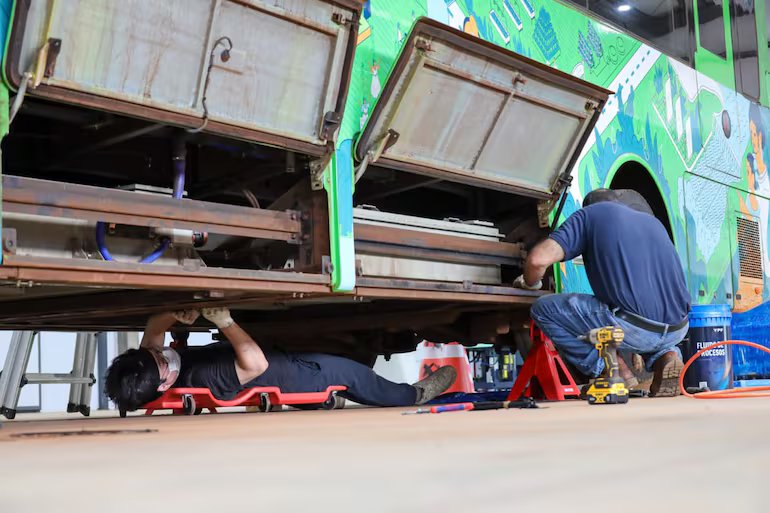
Within the framework of the project TASK Paraguay Auto Parts Center and of Sustainable Electric Mobility Pilot PlanSouth Korean technicians carry out maintenance on the five electric buses donated by the aforementioned Asian country. The work, which will last three weeks, includes training Itaipú staff in the care and repair of vehicles.
The work is headed by specialists Kong Hee Woon and Kim Sung Wonof KGM Commercial (KGMC) and Tw Enersys respectively, bus manufacturing companies. The professionals have the support and assistance of specialists from the Binacional and the Itaipu-Paraguay Technology Park (PTI-PY), the entity indicated.
The work is not limited only to mechanical inspection, but includes a strong component of Itaipu staff training and of Itaipu-Paraguay Technology Park (PTI-PY). Over the next few days, local professionals will receive direct instruction in the care and repair of these advanced technology units, ensuring the continuity and sustainability of the maintenance program. ecological transport in national territory.
Read more: Itaipu Foundation also put out to tender chargers for electric buses: data is still hidden
Technical intervention in 800V battery systems
One of the most critical points of the technical day is the disassembly and verification of the battery packs. According to the technical report, each unit has four packs: two installed on the roof of the bus and another two in the lower section. This system provides a 800 V voltage to the electric motor and has a energy capacity of 87 kWhwhich requires high precision manipulation.
The detailed process consists of reviewing the 15 modules that make up each pack, in turn composed of a set of cells. Once the verification is completed, the technicians will proceed to the systems reinstallation and the update of the operating software of each vehicle. Finally, a system of remote monitoring and control which will allow the performance of the five buses to be monitored in real time.
For the engineer Jens Krauchfrom the Electric Mobility Advisory of the Binacional, the results obtained so far with these units in Hernandarias and surroundings are encouraging. The professional highlighted that the accumulated experience shows that it is technically possible to project a large scale implementation of this type of transportation in the future, taking advantage of the country’s surplus hydroelectric energy.
Read more: Electromobility: the arrival of more than 60 multipurpose vehicles is expected
Currently, the deployment of these units sustainable mobility It is distributed to maximize its use in the following way: three buses provide service in the Municipality of Hernandariasone is assigned exclusively to the transfer of visitors within the complex of Itaipuand the fifth unit operates on the property of the PTI-PY. This scheme, operational since 2025, seeks to consolidate Paraguay as a regional benchmark in the use of clean energy applied to public transportation.