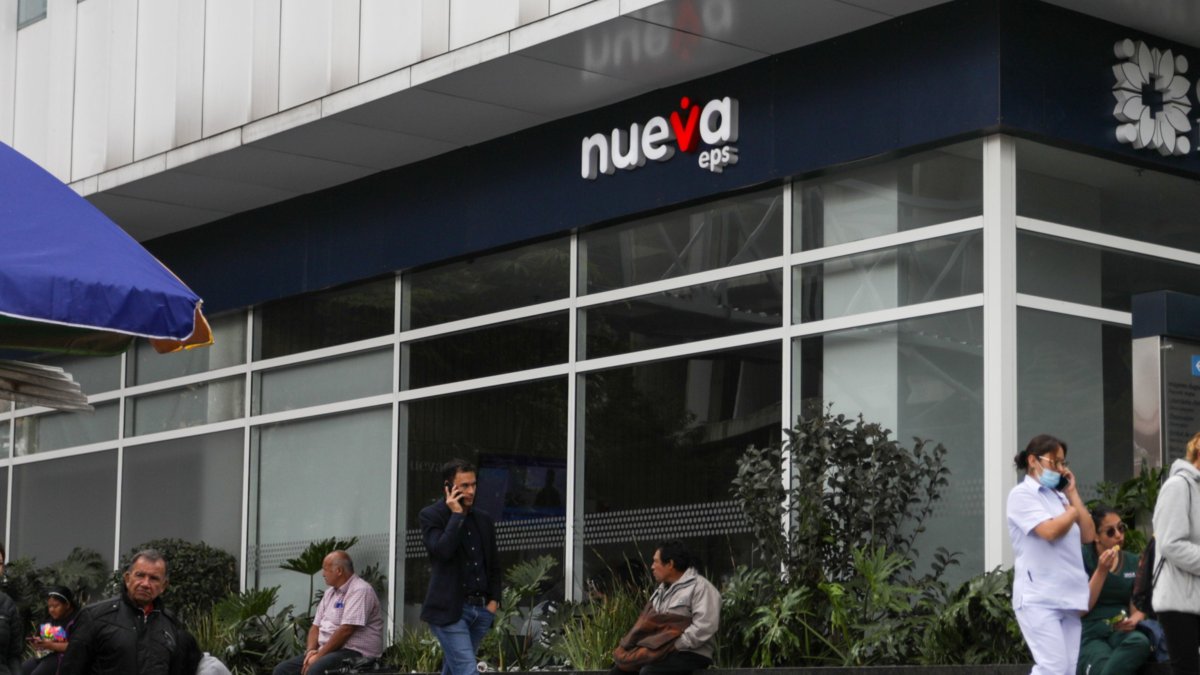
It took almost three years and a court order from the Administrative Court of Cundinamarca for The New EPS will finally report to the Superintendency of Health its financial statements for 2023 and 2024 (those for 2025 are not yet known, although all the other EPS have already reported the information). And what was known is very worrying. The deterioration of the finances of the country’s largest insurer, on which the health of 11 million members depends, is not only evident, but accelerated and of enormous proportions.
READ ALSO

According to the report revealed by the New EPS, at the end of 2024, the assets of the insurer amounted to $10.6 billion, while its liabilities, that is, its debts, were more than double, at $22.5 billion. This reflects a negative net worth of -$11.9 billion.
This is not a figure that should be overlooked, but, on the contrary, it portrays the magnitude of the entity’s crisis. And the last consolidated annual data that was known was for 2022, when the net worth of the New EPS was not even negative, but rather positive, of $0.49 billion pesos.
In other words, in just two years the insurer went from having positive numbers to having the worst indicators of the entire system, far surpassing the other EPSs with numbers in the red.
According to the former Minister of Health and director of the Así Vamos en Salud observatory, Augusto Galán, What happened with this EPS is not only alarming, but also shows that the intervention of the insurer by the Government, instead of helping the entity, plunged it into an enormous crisis: “We cannot forget that in the first months of 2024 (in April) the Nueva EPS intervention took place. And what these new data tell us is that the debacle of this insurer occurred just when this intervention measure began.”
And he added: “We cannot forget that a very big mistake was made with the interventions, which had already shown that they were not the appropriate mechanism to solve the problems of these entities. We insisted on it and today we see the results.”
READ ALSO

If the data is compared with the rest of the system, the situation is critical. By 2024, the negative liabilities of all other EPS were -$9.74 trillion pesos. This means that, by that time, with the -$11.9 billion just revealed, The New EPS had a negative equity greater than the accumulated value of all other insurers in the country. With that logic, by then the system actually had red numbers of more than -$21 billion pesos.
And according to experts consulted by EL TIEMPO, today the figure could be much higher. The most recent report from Así Vamos en Salud on the financial data of the system shows that all the EPSs in the country, without counting Nueva EPS, had a negative equity of more than -$18 billion pesos for the first quarter of 2026. Although Nueva EPS revealed the data for 2024, the totals for 2025 and the partial data for 2026 are still unknown, so the crisis in the system could be much greater than what is currently estimated.
At the end of 2024, the New EPS registered 11,548,495 members, 641,264 more than the previous year. Photo:Composition TIME
‘The insufficiency of the UPC is demonstrated’
One of the most striking data in the information revealed by the insurer has to do with the enormous difference between its income compared to its operating costs.
According to the entity, in 2024 it recorded ordinary income of $22.2 billion pesos, while the cost of providing health services was $26.4 billion. Likewise, administrative expenses were $0.5 billion, about 2.5% of ordinary income. In other words, that year Nueva EPS presented a loss of $4.8 billion. This same exercise represented a loss of $6.5 billion in 2023.
“That is what definitively shows, as we had repeated, that the UPC was miscalculated,” said Galán.
It should be remembered that the Capitation Payment Unit (UPC) is the money that the State sends to all EPSs for each of the users. This money comes from different sources, such as the General Budget of the Nation or the General Participation System. For years, the sector has claimed that the calculation that the Government of President Gustavo Petro has made annually to calculate its increase is not enough to cover the real costs of health in Colombia.
These losses in Nueva EPS are also evident in other financial indicators, such as its liabilities, which went from $5.43 billion in 2022 to $22.5 billion in 2024. A debt that, according to experts, ends up directly affecting patients.
He thinks so Ana María Vesga, executive president of Acemi, the insurance union: “There are more than 11 million members of the New EPS who are mainly affected by this financial situation. This is the entity where the greatest backlog of care is occurring, delays in assigning appointments, delivery of medications and in general, a very important impact on the delivery network.”
All this adds up to the fact that in 2025, at different times, several clinics and hospitals in the country interrupted or suspended their care for Nueva EPS users, motivated by the entity’s enormous debt.
Officials of the Comptroller’s Office, during the inspection process of the New EPS. Photo:Comptroller
Along the same lines, the Union of Institutions Providing Health Services of Colombia (UNIPS) pointed out that “Nueva EPS concentrates the attention of millions of members and maintains contractual relationships with a significant part of the country’s hospital and clinical network. Any deterioration in its payment capacity directly impacts the flow of resources that sustains the provision of health services.”
And he added: “For several years, the IPS have endured a growing portfolio, delays in payments, increased operational costs, increased labor obligations, inflationary pressures on supplies and medicines, and a structural insufficiency of the financial flow. The eventual deepening of the financial crisis of the country’s main EPS could trigger a systemic effect on the entire provider network.”
For the union, the consequences would not fall solely on health institutions. The greatest risk is for citizens: “Insufficient resources and difficulties in financial flow can also translate into access barriers, delays in care, interruption of treatments and loss of opportunity in the diagnosis, monitoring and control of diseases.”
“When a patient does not receive adequate and timely care, a pathology that could be kept under control can progress, become complicated and require interventions of greater complexity and cost, increasing the accident rate and putting additional pressure on available resources. A circle of deterioration is thus configured in which financial insufficiency affects the opportunity and continuity of care and, in turn, delayed or fragmented care can generate a greater burden of disease, greater use of highly complex services and greater costs for the system. Therefore, the discussion on the sufficiency of the UPC resources cannot be separated from the effective capacity to guarantee timely health risk management and adequate control of users’ pathologies,” UNIPS pointed out.
HEALTH EDITORIAL