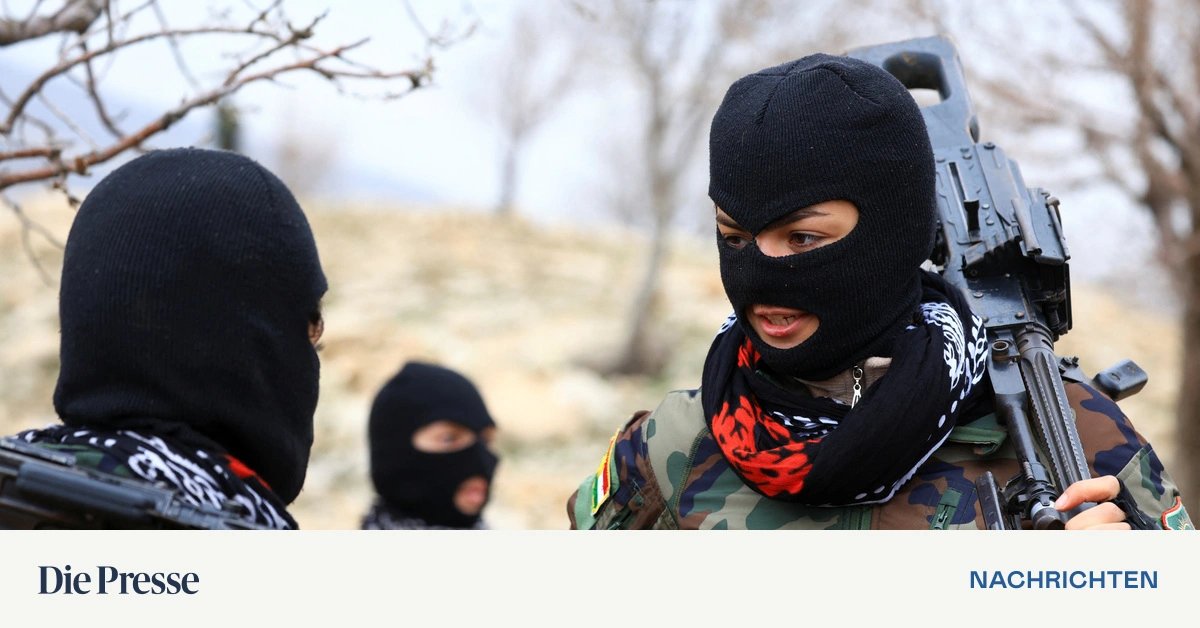
There has actually been a ceasefire between the USA and Iran in recent weeks. But all this time, Iran’s regime has continued the war on another front: it is specifically hunting down Kurdish opposition members who have retreated to neighboring Iraq. “Iran’s regime regularly bombs our camps. And it uses drones to attack private houses in the cities,” Mohammad Abdullahpour reports to the “Presse”. He is the representative of the Democratic Party of Kurdistan – Iran (PDKI) in Austria. She has been fighting for more rights for Kurds in Iran and against the mullahs’ regime for many decades. So far, the party’s armed Peshmerga fighters have held back. But the Kurds’ patience may soon run out given constant Iranian attacks, warns Abdullahpour.
In the city of Suleimaniya in northern Iraq’s autonomous Kurdish region, a drone hit a house where Kurdish opposition politicians lived, says the PDKI representative. To the northwest, in Koya, private houses, a Kurdish broadcaster and the PDKI camp were also targeted. “Not only our officials live in the camp, but also civilians,” says Abdullahpour. The camp has now been largely cleared.
“When it comes to the Kurds, Iran’s regime does not adhere to a ceasefire. The attacks continue all the time,” says the PDKI representative. The PDKI fighters have not carried out any attacks on Iran’s troops for now – but that could change. “The commander of our Peshmerga units, Kawa Bahrami, has made it clear: If the Iranian attacks do not stop, we are ready to take measures to defend ourselves,” says Abdullahpour. These would then be targeted strikes. However, this would not mean a large-scale entry into the conflict between the USA and Iran. “We were never part of this war,” explains Abdullahpour.
As the US and Israel launched their airstrikes on Iran’s regime, the question quickly arose: How will the Iranian Kurdish opposition groups and their armed forces behave? The main factions of the Iranian Kurds had formed an alliance before the war began. And they had made it clear: If the regime in Tehran began to collapse, the Kurds would try to take control of their settlement areas in Iran.
US media later reported that the CIA was supplying weapons to Iranian Kurdish fighters. But the big uprising never happened. Iran’s Kurdish parties waited. It stays that way for the time being. “We have made it clear that we are not a military instrument of the USA or Israel,” says the PDKI spokesman. “We want to be an equal political partner.”
The Kurdish parties demand a longer-term common strategy and security guarantees from the West. “So that after a few days we don’t get told: Thanks, we don’t need you anymore,” explains Abdullahpour. The PDKI representative assures that the goal of the Kurdish parties is not secession from Iran, but a common federal and democratic state that respects the rights of its minorities such as the Kurds.
But could the armed forces of the Iranian Kurds still strike across a broad front? “We are a political party that has its weapons for defense,” says the PDKI representative. “We will only take action if the situation calls for it. That means: if chaos breaks out in Iran or the regime collapses. Then we will bring the Kurdish parts of Iran under our control and protect the people there – and that will then be necessary,” says Abdullahpour.
Although the Iranian regime still appears to be firmly in the saddle despite the US-Israeli air strikes, Abdullahpour does not believe that it can hold on in the long term. The economic misery, made even worse by the war, could lead to internal resistance and mass protests again after some time. And open power struggles could break out within the regime, causing chaos and shaking up the system of the Islamic Republic of Iran. Abdullahpour makes it clear: “If that happens, we Kurds are prepared.”