Adam Schreck and Tala Ramadan
Updated ,first published
Dubai: The United Arab Emirates said it has come under attack by Iran for the first time since a fragile ceasefire took hold in early April.
The attacks appeared to be in response to US President Donald Trump’s latest efforts to reopen the Strait of Hormuz, a critical waterway for global energy.
The UAE Defence Ministry said Iran had launched four cruise missiles, with three shot down and one falling into the sea. Authorities in the eastern emirate of Fujairah said an Iranian drone sparked a fire at a key oil facility. The British military reported two cargo vessels ablaze off the UAE.
The attacks came after the US military said two American-flagged merchant ships had successfully transited the Strait of Hormuz after it launched a new initiative to restore traffic on Monday.
US Central Command (CENTCOM) said its forces were supporting President Donald Trump’s “Project Freedom”, which aims to “guide out” commercial ships stranded in the Gulf by the US-Israeli war on Iran, and were enforcing a blockade of Iranian ports.
The intervention appeared to raise the risk of a direct confrontation between the US and Iran in a waterway that usually carries a fifth of the world’s seaborne oil and gas but has been blocked for two months as a result of the war.
CENTCOM said two US-flagged merchant vessels had crossed through the strait as the US destroyers operated in the Gulf, adding: “American forces are actively assisting efforts to restore transit for commercial shipping.”
Earlier, Tehran said it had forced a US warship to turn back from the Strait of Hormuz, although CENTCOM quickly denied a report by Iran’s semi-official Fars news agency that two missiles had hit the ship near the Iranian port of Jask.
A senior Iranian official told Reuters Iran had fired a warning shot and that it was unclear whether the warship had been damaged.
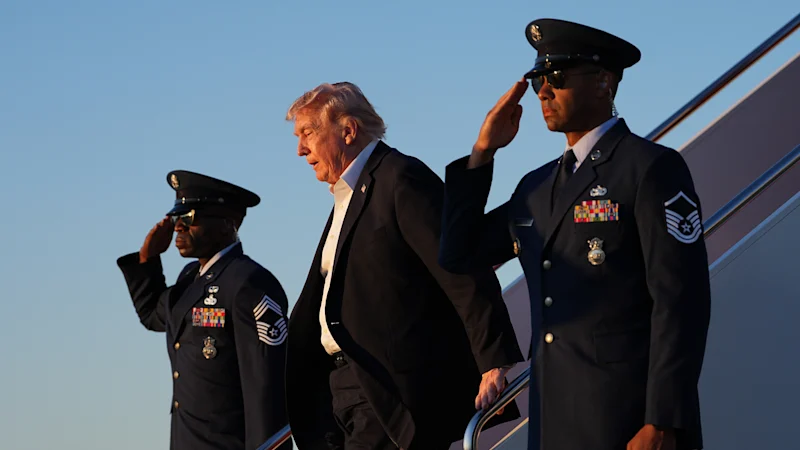
Trump gave few details of the plan to aid hundreds of ships and their crews that have been “locked up” in the vital waterway and are running low on food and other supplies more than two months since the conflict began.
“We have told these Countries that we will guide their Ships safely out of these restricted Waterways, so that they can freely and ably get on with their business,” Trump said in a post on his Truth Social site on Sunday (Washington time).
“Project Freedom” would begin on Monday morning in the Middle East, he said, adding that his representatives were having discussions with Iran that could lead to something “very positive for all”.
Trump, who has previously played down US responsibility for vessels stranded in the Gulf, described the operation as a humanitarian gesture but threatened that any interference would “be dealt with forcefully”.
The unified command of Iran’s armed forces responded by warning US forces to stay out of the strait.
It would “respond harshly” to any threat, it said, telling commercial ships and oil tankers to refrain from any movement in the absence of co-ordination with Iran’s military.
“We have repeatedly said the security of the Strait of Hormuz is in our hands and that the safe passage of vessels needs to be co-ordinated with the armed forces,” Ali Abdollahi, the head of the forces’ unified command, said in a statement. “We warn that any foreign armed forces, especially the aggressive US army, will be attacked if they intend to approach and enter the Strait of Hormuz.”
Iran’s effective closure of the strait, imposed after the US and Israel launched the war on February 28, has shaken global markets and sent energy prices soaring.
It was not immediately clear which countries the US operation would aid or how the operation would work.
The Joint Maritime Information Centre, a US-led maritime taskforce, said the US had set up an “enhanced security area” south of typical shipping routes and urged mariners to co-ordinate closely with Omani authorities “due to anticipated high traffic volume”. The strait sits between Iranian and Omani territory.
The centre warned that passing close to the usual routes, “should be considered extremely hazardous due to the presence of mines that have not been fully surveyed and mitigated”.
US Central Command said it would support the effort with 15,000 military personnel and more than 100 land and sea-based aircraft, along with warships and drones. But the operation would not necessarily include US Navy ships escorting commercial ships, Axios reporter Barak Ravid said in a post on X.
Earlier on Sunday (Washington time), a cargo ship near the Strait of Hormuz said it was attacked by multiple small craft, the British military’s United Kingdom Maritime Trade Operations centre reported, while another ship was hit by “unknown projectiles”. No injuries were reported.
They were the first reported attacks in the area since April 22.
The first ship was an unidentified cargo ship travelling north near Sirik, Iran, east of the strait, the British monitor said. Iran denied an attack, the semiofficial Iranian outlets Fars and Tabnak reported, and said a passing ship had been stopped for a document check as part of monitoring.
The second ship was a tanker that reported being struck on Sunday night while off Fujairah, United Arab Emirates.
Iran has been blocking nearly all shipping from the Gulf apart from its own for more than two months. Some vessels attempting to transit the strait have reported being fired on, and Iran seized several other ships.
Iranian officials have asserted that they control the strait and that ships not affiliated with the US or Israel can pass if they pay a toll, challenging the freedom of navigation guaranteed by international law. Last month, the US imposed its own blockade of ships from Iranian ports.
Despite a shaky four-week ceasefire, the threat level in the area remains critical.
Trump announced the operation in the strait hours after Iran said it was reviewing the US response to its latest proposal to end the war and made clear these were not nuclear negotiations.
Iran’s nuclear program and enriched uranium have long been the central issue in tensions with the US, but Tehran wants to delay talks on nuclear issues until a later phase.
Its 14-point proposal calls for the US lifting sanctions on Iran, ending the US naval blockade of Iranian ports, withdrawing forces from the region and ceasing all hostilities, including Israel’s operations in Lebanon, according to the semiofficial Nour News and Tasnim agencies, which have close ties to Iran’s security organisations.
Trump on Saturday expressed doubt that the proposal would lead to a deal.
Washington wants Tehran to give up its stockpile of more than 400 kilograms of highly enriched uranium, which the US says could be used to make a bomb.
Iran says its nuclear program is peaceful, although it is willing to discuss some curbs in return for the lifting of sanctions. It had accepted such curbs in a 2015 deal that Trump abandoned.
While repeating he is in no hurry, Trump faces domestic pressure to break Iran’s hold on the Strait of Hormuz, which has choked off 20 per cent of the world’s oil and gas supplies and driven up US petrol prices.
Trump’s Republican Party faces the risk of a voter backlash over higher prices in midterm congressional elections due in November.
AP, Reuters
Get a note directly from our foreign correspondents on what’s making headlines around the world. Sign up for our weekly What in the World newsletter.