Mr. Mäckler, your father won the competition for Terminal 1 at Frankfurt Airport in 1951. You are the architect of Terminal 3. What significance does the airport have for you?
The name Mäckler has been associated with Frankfurt Airport for around 70 years. As an architect, I had nothing to do with airports for a long time. It wasn’t until I had my own architectural office for years that I became involved in the renovation of Terminal 1. This gave me access to this fascinating architecture of terminal buildings. I worked in a working group with the then architectural firm Jo. Franzke completely renovated Pier A. My office later won the competition for the new Hall C and realized it. This collaboration with the then Fraport construction department over many years taught us what is really important about a terminal in the long term. A terminal must be sustainable, not fashionable, but planned in such a way that the next generations at Fraport can work well with it.
What was the biggest challenge in building Terminal 3?
The dimension. As an architect, you don’t build a building twice in your life that takes up the entire area of Frankfurt’s city center from the zoo to Opera Square. That was an enormous task. A project like this can only be achieved with a strong team that continues to make decisions and develop solutions on site over the years. And it requires a viable design concept that allows the client to make changes to the planning. During the planning process, changes always develop for functional reasons that a design concept must absorb.
In 2005 you won the international realization competition. Did you expect that?
No. We won it because we had a strong concept: The Growing Beetle. I recently had the competition plans back in my hand after 20 years: The basic idea was to design the building in such a way that it could be expanded at any time without having to set up construction sites inside the terminal that would disrupt ongoing operations.
How does this work exactly?
In the first construction phase, we built all the vertical access, i.e. stairs, escalators, shafts, elevators and so on. This means you can later expand the check-in hall or baggage hall laterally if necessary, without having to modify the existing building. We were able to apply this concept during the construction phase, for example when Fraport had to expand the security check on one side during the construction phase for functional reasons. The house is already enlarged at this point, not symmetrically, but growing to the east. The design concept from 2005 was already confirmed during construction.
Did this concept help Terminal 3 be completed on time and within budget?
Yes, certainly too. The modularity allowed many of the client’s later decisions to be integrated. But what was important was the so-called design freeze. For the Fraport departments, this meant above all that from this point onwards, no more requests for changes were permitted. We had already completely created the concept and the master and detailed planning in the first few years. You have to imagine that our architectural office alone created 50 linear meters of folders full of DIN A0 plans. The modular concept prevented the chaos that arises when fundamental changes are made late.
They say that a lot of high-tech has been installed in Terminal 3, but that it shouldn’t look like high-tech. Why?
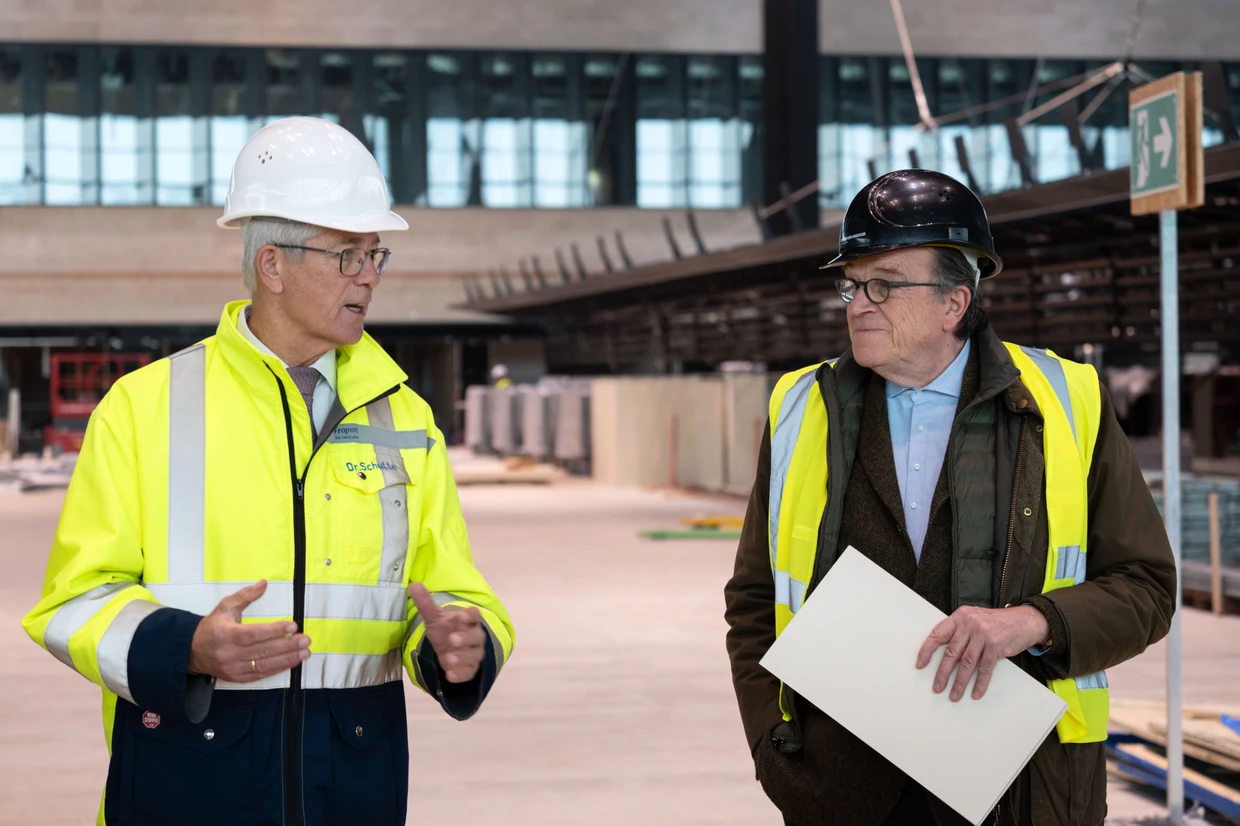
There are two levels. Firstly, the functionality of the technology. The building must function around the clock, today and in 50 years. But technology is the first thing to fail. Therefore it must be easy to replace. Steel technical bridges on which all air conditioning and ventilation devices are housed are clearly visible above the piers. You can exchange these without hindering the flow of passengers. There is no construction site in the building and this is, if you will, an invisible high-tech concept. The second, particularly important level is that of architectural space. The passenger must feel comfortable. You need the simplest routing on one level to get from the check-in hall to the plane without stress. And all of this in an atmosphere that doesn’t excite, that seems generous and at the same time natural. Naturalness and appropriateness should be the goal of architecture for public spaces. Sheet metal and fashionable high-tech optics are either liked or disliked. They tend to polarize, and we wanted to avoid that.
What experiences from Terminal 1 were incorporated into your planning for Terminal 3?
Through the renovations in Terminal 1, as well as other terminal planning, our architectural office has known the necessary functional processes of a terminal for many years. It was important to me to structure the routes in Terminal 3 and thus seemingly shorten them for the passengers. For this purpose, we have installed the so-called Pax boxes with toilets, retail areas, small cafés and lounges in the piers. This provides a distraction for the eye when walking almost a kilometer from the start of the check-in hall to the end of the gate. The crucial difference from the experience of Terminal 1: modifications during operation cause enormous disruptions there. Hence the modularity and the Growing Beetle in Terminal 3.

From the outside, the hall is clearly reminiscent of Mies van der Rohe’s New National Gallery.
Yes. The 2005 competition essentially required a large spatial structure to accommodate the crowds of people moving around within it. It could have been built in concrete, but that would have been much more time-consuming and, above all, not expandable. Our society loves reconstructions, and Mies van der Rohe is one of our great role models in architecture. I don’t see why a structure that is predestined for this task should not be used. If Ludwig Mies van der Rohe had had a check-in hall instead of a gallery as his building task at the time, he would certainly have been very happy. But if you take a closer look at the concept in Frankfurt, you will see that it is something different than the Nationalgalerie in Berlin.
What painful compromises did you have to make that you are upset about?
In the basic concept of the terminal, none. Our job is to build buildings in which people can live and work well. And I think we have achieved that, perhaps with the exception of the marketplace.
How come? Are you not convinced by the design of the marketplace?
This retail space was not created by us.
As with the installations for the shop operators? There were deviations from the design, in which the quiet islands with seating were actually designed as elevations. Now they have used ground floor parquet, which some say does not match the natural stone.
Everyone has to know how best to sell themselves. That’s not my architecture. But that’s not what interests me either. What interests me is that the user feels comfortable in the building and that the building will function excellently for the operator for decades.
Could Terminal 3 damage the reputation of Terminal 1? The terminal in the north is perceived by some as being built up.
No, I don’t see that. Terminal 1 is half a century old and has been further developed and renovated over the decades. The terminal was originally designed for twelve million passengers, but today it handles more than 60 million. That’s fantastic. With the relief provided by Terminal 3, the concept will continue to be viable. There can be no talk of “installed”.
How does Terminal 3 answer the question of sustainability in construction?
At its core, Growing Beetle is a sustainability concept: the technology is accessible, components can be replaced during operation. An example: We provided the piers with individual windows instead of large glass facades. If there is better glass in the future, for example with better insulation, individual windows will be replaced as in residential construction and operations will not be disrupted by replacing the entire facade. In addition, unlike the all-glass facade, the single window in the wall has a much lower heat input and thus contributes to significant energy savings. The floor and wall coverings are not concrete stones, but rather European natural stones, Jura or travertine stones, which can still be replaced in 200 years. I believe it is these simple things that define sustainability in our time today.
To person
Christoph Mäckler studied architecture in Darmstadt and Aachen. In 1981 he founded his own office in Frankfurt. Mäckler was a member of the Frankfurt urban development advisory board and chairman of the board of the Association of German Architects in Hesse; he has been a member of the International Building Academy Berlin since 2003. In addition to numerous guest professorships at home and abroad, Mäckler held the professorship for urban planning at the Technical University of Dortmund. He founded it in 2008 German Institute for Urban Architecture DIS. His work shapes Frankfurt: In addition to Terminal 3, his office is responsible for public buildings such as the Kunsthalle Portikus or high-rise buildings such as the Opera Tower, as well as Tower 185, commercial buildings such as the striking house at Goethestrasse 34 and also residential buildings such as those at the Westhafen or in the New Old Town.