THE Iran attacked cargo ships in Strait of Hormuz this Wednesday (22), the first day of the second extension of the ceasefire made by the President Donald Trump in the war he promoted with Israel against Islamic theocracy.
This time, the suspension of the war is for an indefinite period of time, marking yet another retreat by the Republican in conducting the conflict that threw the Middle East in disarray and the global economy in crisis due to the increase in oil prices — 20% of the commodity passed through Hormuz before hostilities.
The Iranian Revolutionary Guard confirmed that it attacked and seized two container ships off its coast in Hormuz: the Panamanian-flagged MSC Francesca and the Epaminondas, which sails under the colors of Liberia. Both vessels were hit by gunfire, but no one was injured.
According to UKMTO, the British Navy’s naval monitoring agency, a third ship was also boarded in the region and suffered damage from gunfire, but it did not confirm the origin of the projectiles.
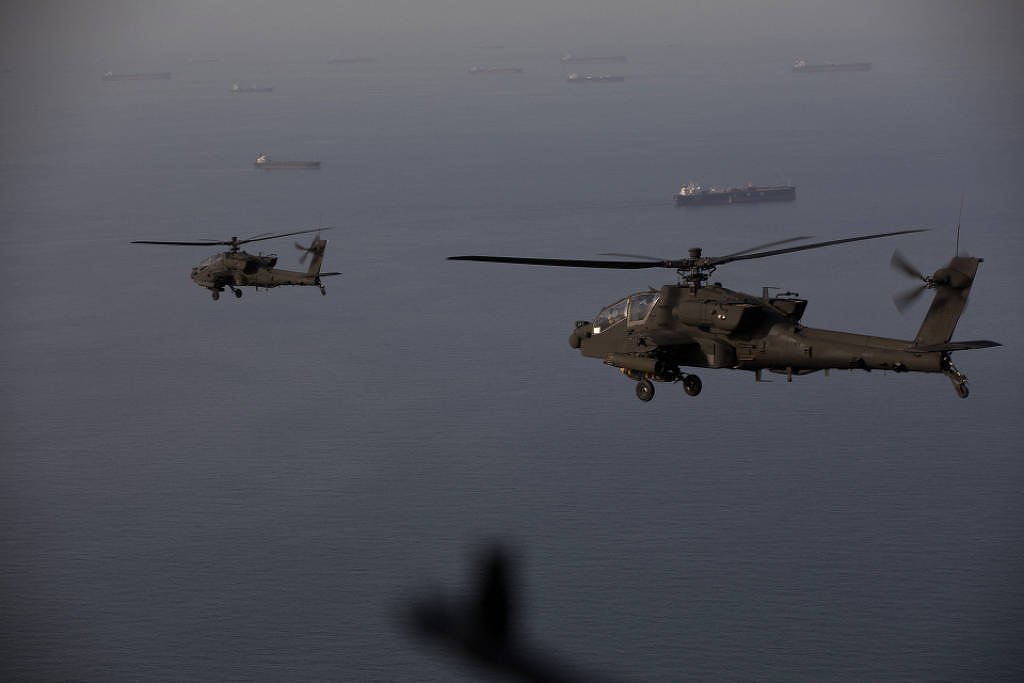
The agency warned that ship traffic in the region remains extremely dangerous due to Iran’s actions and also the naval blockade imposed on the theocracy’s ports by the United States. trump, by canceling the resumption of war, maintained the embargo that came into force on the 13th.
This Wednesday, at least one Philippine-flagged supertanker heading to the Persian Gulf was stopped by American forces and forced to turn back.
According to the most recent survey, released on Monday (20), another 27 ships did the same, and 34 escaped the blockage. Iranian Touska was shot and apprehended by the US on Sunday (19).
Volatility continues to affect the energy market, Tehran’s main weapon of pressure in the conflict. After a slight fall With Trump’s announcement on Tuesday (21), the price of a Brent barrel for futures contracts returned to around US$100 with this Wednesday’s attacks.
As the naval ballet unfolds, uncertainty grows regarding negotiations for a more lasting peace agreement, which includes issues such as freedom of navigation in Hormuz and the fate of the ayatollahs’ nuclear program — the presumed reason for the start of the war on February 28.
The capital of Pakistan, Islamabad, remains mobilized to receive delegations from rivals, who met in the city without success the weekend before last. This time, Trump had announced the resumption of talks over the weekend, but they did not take place, despite the team led by his deputy, JD Vance, being ready to travel.
Iran has rejected negotiating the naval blockade, which it considers a ceasefire violation. Previously, he had demanded a ceasefire in Israel’s attacks on Hezbollah in Lebanon, and he succeeded, under pressure from the USA. He then announced the reopening of Hormuz, only to close it again.
There was no formal response to the new extension of the truce. “No decision has been taken,” said Esmail Baghaei, spokesperson for the foreign ministry, on Wednesday.
He repeated that it is not possible to negotiate with the blockade in force, which was later also said by one of the negotiating leaders, the head of Parliament, Mohammad Ghalibaf, and President Masoud Pezeshkian.
The attacks in Hormuz suggest that Iran will seek to be as inflexible as possible, at least until something changes in the diplomatic scenario.
But there are mixed signals in theocracy too. The new supreme leader, Mojtaba Khameneito this day he has not appeared in public or on TV, raising doubts about his ability to command. Another important negotiator, Chancellor Abbas Araghchi, was disqualified by the Guard, whose generals are the main power in the country, after announcing in the X the reopening of Hormuz.
In addition to the risk of resuming the air campaign that decimated the regime’s leadership, severely degraded the country’s military capabilities and left more than 3,000 dead, there is also economic pressure — the closure of Hormuz and the blockade affect its economy, dependent on the sale of oil to China.
Trump played this card in a post this Wednesday. “Iran is collapsing financially! They want the Strait of Hormuz open immediately — hungry for money! Losing $500 million a day. Military and police complain that they are not being paid. SOS!!!”, he wrote on the Truth Social network.