The failure of negotiations between the United States and Iran in Pakistan not only revealed the depth of their differencesbut marked an immediate turn towards military pressure. After more than 20 hours of dialogue without agreement, The talks collapsed in front of three irreconcilable red lines. Hours later, the president Donald Trump raised tension by ordering the blockade of the Strait of Hormuz on Sundaya key route for the global oil trade that was closed by Tehran since the start of the war and for which it intends to charge a toll. What can happen now?
Delegations from the United States and Iran left Islamabadthe capital of Pakistanwithout clarifying if there will be a new meeting. For now, the two-week ceasefire remains in place.
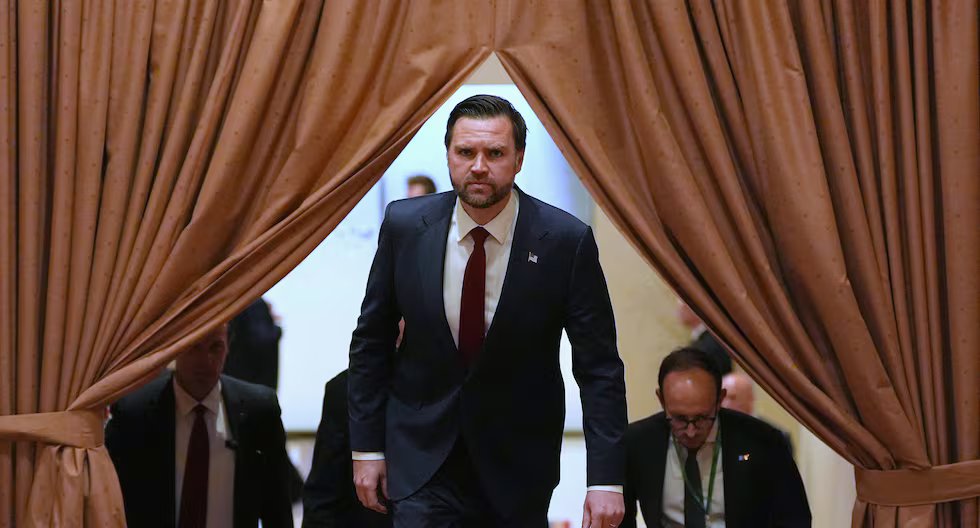
The vice president J.D. Vancea United States negotiator, departed on Air Force Two, leaving a “final offer” on the table, about which there are no details. While Iran’s negotiator, Parliament Speaker Mohammad Baqer Qalibaf, called on Washington to gain the trust of the Islamic Republic.

US Vice President JD Vance (right) speaks during a press conference after meeting with representatives of Pakistan and Iran. (Photo by Jacquelyn MARTIN / AFP).
/ JACQUELYN MARTIN
While the spokesman for the Iranian Foreign Ministry, Ismail Bagaei, stated that the differences of opinion are now limited to “two or three important issues” and that “no one expected an agreement in a single meeting.”
The EFE agency listed the three red lines that prevented the end of the war from being agreed: the elimination of Iran’s nuclear program, the total liberation of the Strait of Hormuz and Israel stopping its attacks in Lebanon.

Pakistan’s Foreign Minister Ishaq Dar (second right) and Army Chief Syed Asim Munir (second left) walking with Iran’s Foreign Minister Abbas Araghchi (center left) and Speaker of the Iranian Parliament Mohammad Bagher Ghalibaf (center right) upon arrival in Pakistan. (AFP).
/ HANDOUT
Vance demanded that Iran commit to not pursuing a nuclear weapon now or in the future. He said that was a non-negotiable condition for the United States, something Tehran rejected.
The United States demands the dismantling of the tools that allow Iran to quickly manufacture a bomb, EFE said.
“We need to see a commitment of will, and we have not seen it,” Vance said in a press conference after the dialogue.
Bagaei said on social network X that the “nuclear issue” was one of the central topics discussed. He insisted that the success of the process depends on the counterparty refraining from “excessive demands and illegal requests” and accepting the “legitimate rights and interests of Iran.”
Regarding the Strait of Hormuz, the United States wants an immediate, commercial and unrestricted reopening. In addition, he promised to clean up mines unilaterally.
For Iran, “there will be no changes in the strait unless the US accepts a reasonable agreement,” according to the official press, which added that the country demands that any passage of ships be coordinated directly with its Armed Forces.
Regarding Lebanon, Iran demands US commitment to stop Israeli aggression in that country.
Washington maintains that the two-week ceasefire agreed with Iran is limited to the direct conflict between the two countries and does not link Israel’s military actions in Lebanon.

United States President Donald Trump speaks to the media before leaving the White House for Miami, Florida, on April 11, 2026. (EFE/BONNIE CASH).
On Sunday, Trump announced that his country will block the Strait of Hormuz and accused Iran of maintaining its “nuclear ambitions.”
“The meeting went well, agreement was reached on most points, but the only really important point, nuclear weapons, was not approved. Effective immediately, the United States Navy, the best in the world, will begin blocking all ships attempting to enter or leave the Strait of Hormuz”Trump wrote on his Truth Social network.
In Iran, the Revolutionary Guard responded to Trump that the country’s security forces have “full control” of the Strait of Hormuz, and warned that its enemies would be caught in a “deadly whirlwind if they make a false step.”
Iran “will never agree” to dismantle its nuclear program

An Iranian woman walks next to an anti-American mural near the former US embassy in Tehran, Iran, on April 11, 2026. (EFE/EPA/ABEDIN TAHERKENAREH).
/ ABEDIN TAHERKENAREH
The international journalist and analyst Carlos Novoa held to The Commerce that the failure of the negotiations was foreseeable due to the “maximalist” stance adopted by the United States from the beginning of the dialogue.
“From the moment the United States sought to impose a position, this result was seen coming,” he stated.
Unlike other processes, he explained, in Islamabad there was no progressive negotiation. “Negotiations usually go from the least important to the most important, but this time a direct and central scheme was proposed. It was all or nothing,” he pointed out.
According to Novoa, the demand to dismantle the Iranian nuclear program and the total reopening of the Strait of Hormuz were part of that same logic. “Iran will never accept being forced to give up its uranium enrichment program.”which he considers key to his defense”, Indian.
In this context, he stressed that A successful negotiation requires concessions from both sides.something that did not happen. “The best negotiation is one in which everyone gives up something, and this time it has not happened that way,” he noted, while considering that the strategy also responds to President Trump’s political rhetoric.
Regarding the main red lines, Novoa identified the nuclear program as the most difficult structural obstacle to overcome. “Gradual nuances can be found in Hormuz and on the Lebanese front there is room for specific agreements, but the nuclear issue is the core of the conflict”he explained.
In his opinion, Washington will have to adopt a more flexible approach if it seeks progress. “There is no way for Iran to accept a total dismantlement. The United States would have to return to schemes similar to previous agreements reached during the Barack Obama administration,” he added.
The international analyst Francesco Tucciprofessor of Political Science and International Relations at the UPC, considered that the main obstacle to reaching an agreement is he iranian nuclear programin a context of total distrust towards the United States.
“The paradox is that This war, which sought to stop nuclear development, is convincing the toughest sectors of Iran that they need a nuclear weapon.”explained to The Commerce. “If they had had it, the attack would not have been possible,” he remarked.
Added to this is the dispute over Hormuzwhere Iran seeks to impose a toll as compensation for war damagea measure that Washington categorically rejects. “They are red lines that are born from distrust. And without trust, diplomacy fails,” he summarized.
Regarding the final message from Vice President JD Vance, who left a “final offer” on the tableTucci interpreted the gesture as a sign of pressure, but also as a reflection of a lack of clear strategy. “Everything indicates that the Trump administration is not clear about how to finish what it has started,” he stated. “Proposals are presented that the other party cannot accept, and that shows the absence of a solid plan.”
Along these lines, he warned that The conflict has entered a “spiral of mutual distrust” that makes any negotiated solution difficult. “There will be more proposals, but many are going to fail. Negotiating like this is extremely difficult,” he pointed out.
Tucci stressed that, despite international pressure, Iran maintains a resilient position on the ground. “His strategy has worked: he has blocked Hormuz, his institutions are still standing and he continues with drone and missile attacks,” Indian. In parallel, he warned that the situation also impacts Israel, where the Iranian response is beginning to erode internal support for Benjamin Netanyahu’s government.
“Everything is connected: Lebanon, Iran, Israel. But today the agendas are not aligned. The United States is looking for a way out, Israel has another strategy, and that makes the scenario even more confusing,” he emphasized.
Trump’s move in the Strait of Hormuz

A woman walks past a giant billboard reading “The Strait of Hormuz remains closed” in Tehran’s Revolution Square on April 12, 2026. (Photo by ATTA KENARE / AFP).
/ ATTA KENARE
About the Trump’s order to block the Strait of Hormuz, Tucci said that it can be read as a negotiating pressure maneuverbut with a high risk of escalating into a major conflict.
“It can be a negotiating pressure, but this can escalate to the military,” he stated, noting that Washington could even seek the support of European allies for this blockade or expand its operations with selective attacks. “Trump has many options, both political and military, and could adopt even more aggressive behavior,” held.
In this scenario, Tucci stressed that the US military deployment is not without difficulties. “We must keep in mind that this massive deployment is also suffering setbacks,” he indicated, in reference to recent incidents in the fleet. In his opinion, this could push the US to diversify its strategy beyond aircraft carriersresorting to other types of offensive.
The analyst also linked military pressure with internal factors in USA. He recalled that Trump faces midterm elections and a sensitive economic context. “If the price of gasoline exceeds certain levels, voters will not be happy. Trump is risking the majority in Congress”he warned, which could accelerate more forceful decisions to close the conflict.
Carlos Novoa stated that Trump’s announcement of blocking the Strait of Hormuz is an immediate pressure measure with risks of escalation. ““It is a clear signal to force conditions, but it could lead to an increase in violence, although not necessarily prolonged,” he warned.
Despite this, Novoa does not rule out a resumption of dialogue. “It is most likely that the parties will sit down to negotiate again, but they will have to do so with concrete proposals. If they insist on the same positions, especially on the nuclear issue, any attempt will fail again,” he concluded.