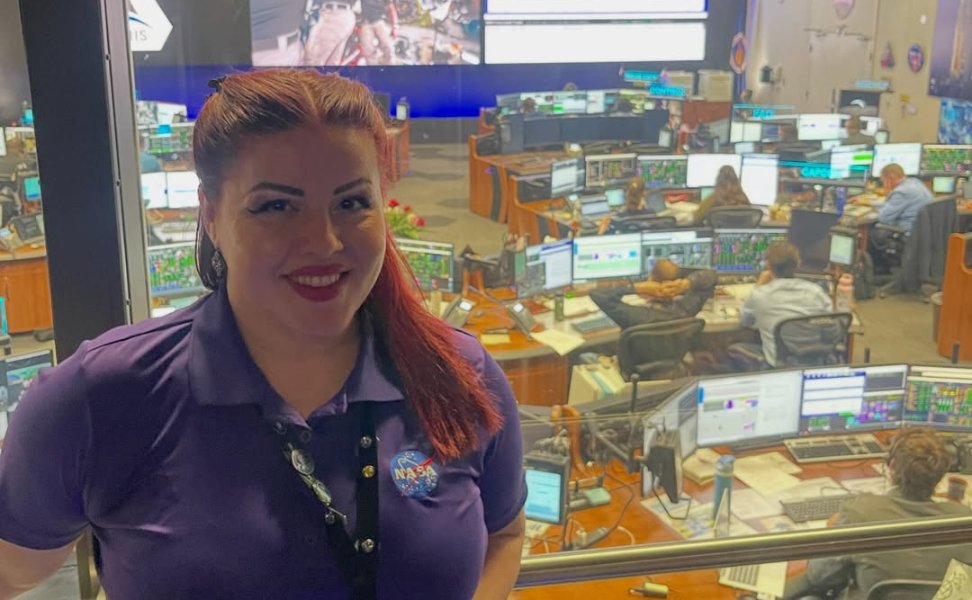
While all eyes were on the launch of the “Artemis 2” rocket, somewhere among the large number of people watching NASA make history is her, Martina – the first woman from the Balkans who became an analog astronaut and is an inspiration to a large number of young and talented people in the country.
Martina Dimoska is the first woman from the Balkans who became an analog astronaut and who had the opportunity to closely follow NASA’s mission to the moon, “Artemis 2”. The road from Kichevo to Houston was full of challenges, says Martina Dimoska, who has been working hard for a decade to build a career in the field of space research.
While all eyes were on the launch of the “Artemis 2” rocket, somewhere among the large number of people watching NASA make history is her, Martina – the first woman from the Balkans who became an analog astronaut and is an inspiration to a large number of young and talented people in the country.
How does it feel to be a part of the NASA team, especially working on missions related to returning a man to the moon?
– The feeling is incredible, a combination of immense gratitude, responsibility and sincere admiration. At one point you realize that everything you’ve worked for for years has led you to the opportunity to contribute to something bigger than yourself. It still seems unreal to me, but at the same time it brings an awareness of the difficulty of the task and the trust that has been given to you.
What is particularly significant is that our team looks after all human flight missions, from the International Space Station to the missions to the Moon, which gives a broader perspective and responsibility within the overall architecture of human space exploration.
What’s it like to be part of Artemis 2, a history-making team?
– It’s an incredible feeling to be a witness to such a significant part of history, but at the same time a part of teams that are actively writing it. I had the honor of being in Teague Auditorium and watching the official briefings, as well as being present when NASA Administrator Jared Isaacman and US President Donald Trump spoke to the crew.
But the human moments left the strongest impression on me – the zero-G (zero gravity) Rise indicator, Reed Wiseman’s friendship bracelet, Christina Koch’s historic moment, who will be remembered as the first woman to orbit the moon; as well as the naming of the lunar crater Carol, after Commander Reed Wiseman’s deceased wife, and the crater Integrity. It is those human touches, in addition to all the technical achievements, that define the true value and impact of these missions in my eyes.

What was the most challenging part of the adaptation period?
– The most challenging was the pace. In a period of about five months, I moved from Macedonia to California, and then to Texas. Although I am used to “living in a suitcase”, this period was particularly intense and, honestly, now I feel the need to “anchor” and put down roots.
I simultaneously had to close work commitments in one place while starting new ones in another, which meant transitioning everything that had just been set up and organized in California. It required a high level of organization, focus and adaptability.
In parallel, there is a huge administrative and security process – checks, approvals and training. I wanted to go through all those steps, from security checks to all other approvals, to be fully compliant with all standards before sharing publicly. It requires patience, focus and mutual trust in the processes and in the team.
How was the passage to Houston and the NASA Johnson Space Center?
– The transition is still intense, but at the same time a very natural step. It is an environment with enormous dynamics, where from the first day you are surrounded by people who operate at the highest level – colleagues and mentors who have already written history and are a constant inspiration. Everything happens quickly, but at the same time systematically and structured.
I came to work in the run-up to the Artemis 2 launch, which in itself was an extremely challenging time, so after hours I literally spent hours in Teague Auditorium with colleagues and media from around the world covering the events. There were days when it was as much as 12 hours completely dedicated to watching, networking and learning from all those experts who were speaking on the spot.

You work as a human systems integrator – can you simply explain what this role entails and how it contributes to missions to the moon?
– The role of Human Systems Integrator at NASA means ensuring that humans are at the center of every mission. That includes everything from health and safety, to performance, ergonomics and how astronauts interact with the systems around them.
Simply put, our job is to ensure that all technologies, procedures and systems are designed to enable the crew to function safely and optimally, especially in extreme conditions such as missions to the moon. This means constant coordination between engineering, medical and operations teams to ensure that the human factor is fully integrated into every aspect of the mission.
What makes this role especially complex is that as an engineer you have to have a complete picture of everything that surrounds astronauts – everything they wear, everything they live in, everything they interact with. At the same time, a deep understanding of the human organism is needed to be able to anticipate potential risks and challenges. This is a dynamic and highly responsible job with constant exposure to problems to be solved in real time, involving many engineering teams, experts and tight deadlines. Your role is to unite all those aspects and direct them towards one common goal – that the mission is ready for flight, and that the astronauts are maximally protected and optimally supported.
What were the beginnings and what would you say to young people?
– My path started with proactive volunteering, first of all to gain experience, as well as continuous learning. I’ve participated in events, conferences, hackathons and competitions – some more successful than others, but you always either get a connection or a lesson. In that period, there was no clear path in front of me, so I often had to build it myself, step by step.
Studying was also intensive – I graduated in materials engineering and nanotechnologies at St. Cyril and Methodius University, and then continued with studies and programs in the USA and France, concluding with a master’s degree in space sciences at the International Space University. That experience was not only academic, but also transformative – it showed me how other ecosystems work and how important it is to think globally.
Research work through those studies later grew into four analog missions, where I had roles from crew member to commander, in collaboration with NASA, the European Space Agency, the Canadian Space Agency, the Polish Space Agency, Axiom Space, and other partners. These were environments that test you both technically and humanly, and teach you how to function in extreme conditions and teams. But honestly, success for me is not only measured by titles or accolades, but by how many doors we have opened for others and how many lives we have touched.
I would tell young people not to measure their potential according to the environment in which they find themselves. If something doesn’t exist around you, it doesn’t mean you can’t be a part of it. Sometimes you will be the first.
And most importantly, to not allow other people’s limitations to become their own. The world is much bigger than it appears from any “fixed point” and there is a place for you in it.