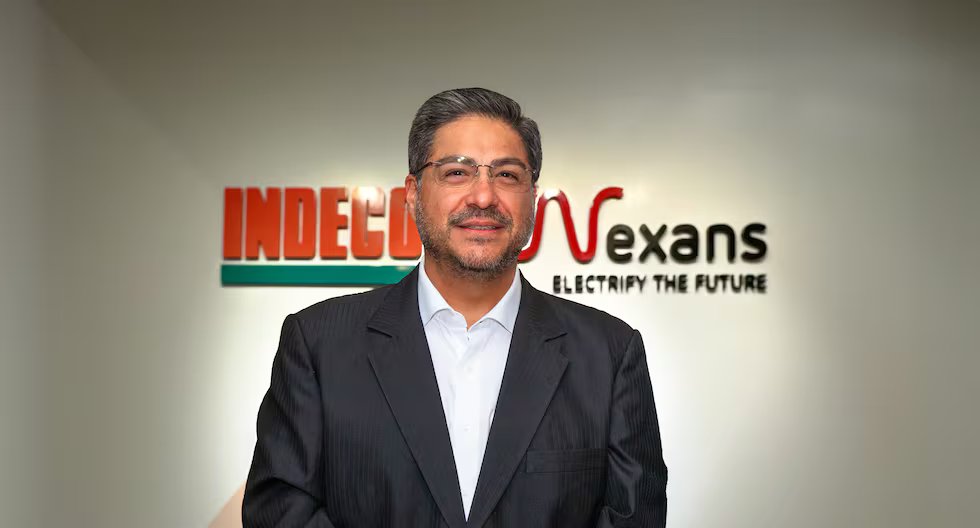
In that period, the company has passed through Peruvian, American, Chilean hands and, since 2008, through French hands, following its acquisition by Nexans, the second largest global cable manufacturer. What does the company project for 2026? Reply Alex García, general manager of Indeco by Nexans.
– Does the Indeco brand operate only in Peru?
Indeco means Copper Industriesand is the Nexans brand in Peru. We export to many countries in the region, such as Colombia, Chile, Ecuador, Panama, Costa Rica, Brazil and Honduraseither with the Indeco brand or with the Nexans brand. But the Indeco brand is the one that is positioned in the Peruvian market as the most recognized in the electrical cables sector and with which we have the largest market share.
– What market share do you have in Peru?
By far, we are the first cable producer. We are the oldest company and also the most important player in all the segments in which we participate: residential, commercial, mining, infrastructure and renewable energy.
– And on average?
If we average all the segments that exist in Peru, we are close to 70% participation.
– What were the results of Indeco in 2025 and what do you expect this year?
Indeco grew double digits last year and in 2026 we expect the same. We have had a very good first quarter, in which we also grew by double digits, and we believe that we are going to continue like this for the rest of the year.

Not all copper produced in Peru is exported. Indeco converts copper cathodes (sheets) into wire rods and cables.
/ Lucien Kahozi
– What factors fuel this growth?
The self-constructionfirst of all, which is where the weight of the Indeco brand is much stronger. And another segment that has grown a lot is infrastructureand I am referring specifically to new Lima airport already Line 2 of the Lima Metrowhich has been awarded 100% to us. And we are also present in all mining projects.
-Is Mining another important client for you?
We are a copper manufacturer and we go hand in hand with copper mining and the economy of our country. As soon as there is a new mine that opens, Indeco is always present. We are the main customer of the Peruvian mines and also their main supplier when we transform their copper cathodes into cables for daily operation.
– That is an important point because you buy copper cathodes (sheets) to make cables, and then you sell those cables to mining.
It’s true. It is always said that Peru exports raw materials, but the mines make a great effort to produce cathodeswhich have already had a certain manufacturing process. But we also convert those cathodes into copper wirewhich we export to the Colombian and Ecuadorian markets and to part of the Brazilian and Chilean markets. We are an actor that gives added value to copper, converting it into wire rod for export. That’s the first stage.
– The second are the copper cables?
That’s how it is. As a second stage, we process that copper wire to turn it into a finished product that we also export, which is the copper wire. So, we have two stages where we add value to the Peruvian industry: exporting copper wire rod and exporting finished cables.
– From which mining companies do you buy copper cathodes?
We buy from Southern Copper, Marcobre and Cerro Verde.
– How much does Indeco bill?
We are, in total, with all the products we have, above US$400 million.

Indeco is the first producer of copper cables in Peru. It operates a factory in El Cercado de Lima. Another factory in Los Olivos is operated directly by Nexans.
– Is the price of copper cable rising in parallel with the rise in the price of copper?
Yes, but there is a more current factor that not only has to do with the price of copper and that is the war in the middle eastbecause many raw materials come from there.
– What raw materials come from the Middle East?
The plastics (that cover the copper cables) come from the Middle East. The information we have is that the price of oil and resins with which it is made the plastic They will rise between 20% and 30%, on average. If the price of oil rises, the price of transportation from anywhere in the world will also rise.
– But won’t the demand for copper shrink because of this?
The price of copper will continue to rise because demand will continue to rise, whether for cables in energy and construction, or for electric car components or any other of the productive segments that exist. The demand for copper is rising, and no new mines are being opened in the world that can cover that demand.
INVESTMENTS
– Where is Nexans aiming? What is the strategy for the medium and long term?
Keep working to be a pure electrifier. And in Peru we want to be pioneers and first in renewable energies, and continue supporting the mining sector. We want to consolidate ourselves through innovation and differentiation in the residential and commercial markets. And here I want to emphasize that 100% of the energy with which our products are manufactured comes from renewable sources.
– Is all the energy you use in your processes renewable?
For three years, all the energy we receive in our factory comes from renewable sources. We have cPEP (product environmental profile) certificates that guarantee that we reduce our carbon footprint and that we have specific plans for it. And that goes hand in hand with the recycling of copper and raw materials, and with small details that we can work on within our facilities, which help the environment.
– Do you have an investment goal or plan?
Every year we invest between US$4 million and US$5 million annually in Peru. Last year we closed an investment of US$2 million for the construction of a vertical warehouse for raw materials and finished products. What we stop having as a square meter we gain as a cubic meter. We closed that investment in January of this year, but it was made last year.

Nexans is the second largest global manufacturer of cables and cabling systems.
– And for 2026?
We continue to buy machinery so we can continue automating our equipment and get rid of old equipment. That was the plan we drew up four years ago: for every new piece of equipment we buy, two or three old ones have to leave. With this we free up space in the plant and become more efficient.
– Are you aiming for any project in the region, like Indeco?
We were in the largest wind farm in Latin America, the Horizon Parkin Chile, where 100% of the copper cables we supplied came from Indeco. The Line 7 of the Chilean Metro It has also been covered with cables from our factory. And we have won renewable energy parks in Colombia, Panama and Ecuador. We also work with mining in these last two countries.
– Do you have expectations with renewable energy projects?
Renewable energy projects are a very important vertical for us. Not only for Indeco, but also for Nexans. We have been present in the largest wind farm in Peru: Punta Lomitaswhich we supply 100% with Nexans cables. And now we are participating in projects inside and outside Peru.
– Do you have any program to promote equity?
In Peru, almost 35% of our administrative positions are female. We have been increasing that in the last five years. We even have a campaign that we launched three years ago with our clients and companies in the electrical sector, in association with Senatiwhich is called ‘I’m a woman, I’m an electrician.’
– Is it a program for female technicians?
Yes. We work with twenty or thirty students so that they can have basic knowledge of electricity and then they can get a job with us or in the market. They are people who do not have the financial means to be able to continue their career at Senati. Indeco pays 100% of the race to the first five places in these promotions. And when they finish it, they come to do their internship with us so that we can then hire them.
– Are there electrician technicians working at Indeco?
We now have female operators coming from these promotions. Before, the concept that was had was that work within our industry was not for a woman, and we have been denying that. That is why we believe that it is important to have equity, which does not mean firing men but rather offering the same opportunities for them to can fight for position.