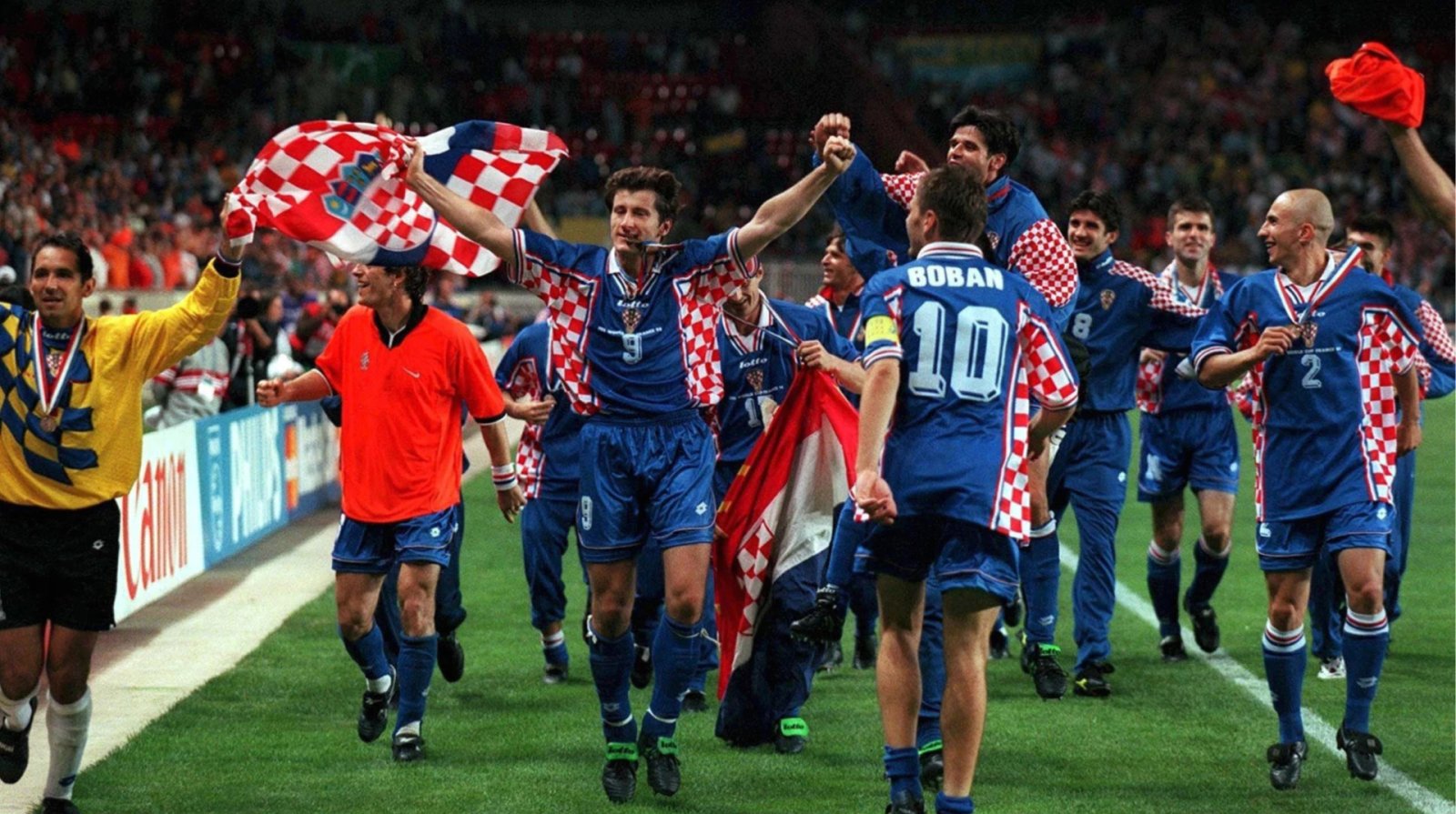
The national team of Croatia approaches the next World Cup as one of the shadow favorites.
How else? At the last two tournaments, “Shashkov” definitely won medals.
Well, their formation at the world football Olympiad took place 28 years ago – at the 1998 World Cup, where the debut team of the World Cup defeated Germany itself.
Boban, Shuker, Prosynechki – this story is about them.
***
“Sport is good. But there are also political consequences. Before the tournament, maybe 5% of people knew about us. Now it’s 15%,” coach Myroslav “Chiro” Blazhevych said.
Modest!
In fact, Croatia won the hearts of the whole planet at the 1998 World Cup, because the popularity of the tournament was insane.
What kind of shape? Why were they not there before? How do they play so well?!
Few could adequately answer.
Croatia has a population of only 4 million, and declared its independence on June 28, 1991, after which it survived 4 years of Serbian aggression. It was difficult – battles, sieges, losses. What can be said if young Luka Modric grew up in Zadar, where mines fell every day!
Now we know this story well, but then the world only pricked up its ears cautiously.
“I saw strong patriotism in the team and took advantage of it. We were an unknown country and everyone wanted to put themselves in the center of attention. It was very easy to motivate such players,” Blazhevych later admitted.
***
For Croatia, it was the second major tournament in the history of the national team.
The first – Euro-1996 – ended with a scandalous exit from Germany in the quarter-finals. According to millions of fans, “Shashkov” was condemned then.
“I have never cried because of football in my life, but that time at Old Trafford I cried because we played better than the Germans,” insisted Slaven Bylych.
Who does not remember him? A burly, authoritative central defender – and part-time rock musician.
Together with him, Zvonimir Soldo from Stuttgart and Ihor Shtymats from Coventry played in defense – also tall and powerful.
Robert Yarny on the left and Dario Šimych on the right could support the attack, but primarily concreted the flanks.
The main creatives of Croatia were located in the center, where the loser of Real and Barca Robert Prosynechki, the motor of Milan Zvonimir Boban and the unrecognized genius Alyosha Asanovych, whose career went bozna-de, played.
Well, and the attack – Real superstar Davor Suker and Valencia talent Goran Vlaović.
Whoah!
“Ciro knew our qualities, so he didn’t delve too much into tactics. His task was to deal with the big egos in the locker room. The way he did it was impressive. Somehow we talked about him – me, Boban, Asanovych, Shuker and Prosynechki. We agreed that no other coach could handle our locker room.
We respected Ciro. When he first came to us, he immediately said: “You will be world champions.” At first we laughed, but he made us believe it,” Shtymats recalls.
In addition, they were motivated by the wounds inflicted by the war, which touched every family in Croatia.
Slaven Bylych said before the tournament: “We will not play for ourselves and not for the flag. We will play for those who died.”
Well, there was also brotherhood. They were friends off the field and played together since at least 1987, when they brought Yugoslavia victory at the World Cup U20.
Boban tells a revealing story of how he and Shtymac secretly left the Yugoslav camp in Chile to meet with two hot chili peppers:
“We were young guys enjoying life. We expected the coaches to let us go, but the answer was no. And we left on our own.
When we returned, the coach announced that he was sending us home. And ahead was the semi-final against GDR Matthias Sammer. And then the team stood up for us. Everyone stood up and declared that if we were kicked out, they would go too.”
That’s who they were – the Collective.
And all together – talent, friendship, coach’s charisma, political weight – eventually turned their performance into a legend.
***
In the group round, Croatia made its debut with an easy 3:1 win over Jamaica, which was mainly remembered for Prosynechka’s space ball.
In the second round, Japan usually resisted, but Shuker broke through it as well.
Defeat against Argentina in the third round meant nothing – Croatia was conserving strength for the playoffs.
“Well, what can I say… We felt the weight of history on our shoulders already in the game against Jamaica,” says Shuker. “That tournament is not just a memory. It’s something that is etched in my soul forever.”
Davor is, of course, a brilliant goalscorer with 114 goals in La Liga, but he has never played as inspired as he did at that World Cup.
Match 1/8 the final against Romania was closely fought, but Shuker elegantly slipped the ball to Asanović, disorienting Gabriel Popescu. Penalty! And even the referee’s order to kill him did not prevent Davor from bringing his victory – 1:0.
“Before the tournament, I was hoping to go to the sea on vacation as soon as possible. But now, you know, I don’t mind staying in France as long as possible,” he said after the game.
Appetite comes while eating!
Moreover, ahead of the Croatians was Germany, which made them cry two years earlier.
***
It was then that journalists came to the Croatian national team and asked questions – about Yugoslavia, the Serbs, the war.
They heard what Berlin and Paris had long been weaned from.
“We weren’t like Czechoslovakia or Poland. We were in the middle. We’d watch FA Cup finals on TV and my dad would buy AC/DC and Iron Maiden records.
But I also never played for the national team U17 and U19. We have there was a coach then from Serbia, and he took me aside and said: “Your family is labeled through a nationalist father,” Bylych said.
Boban also had something to say – on May 23, 1990, his kick to the body of a policeman on “Maksimir” became the climax of the Serbo-Croatian massacre. It was because of this that Zvone missed the 1990 WC:
“It was all planned by the Serbs. Even Arkan said that they were the ones who organized to provoke the incidents and then point the finger at Croatian nationalism.”
In turn, Shtymac broke down in tears when it came to Vukovar, a besieged town on the border that the Serbs destroyed and killed thousands of civilians.
And they all together remembered the last final of the Cup of Yugoslavia, when on May 8, 1991, Hajduk flew to Belgrade to play with the star Red Star in military helicopters.
“I was shocked that the club decided to play, considering everything that was happening,” Bylych recalled. “It was very hot and hostile. Crvena Zvezda was better than us then, they were European champions. But we felt it was a game between Croatia and Serbia – and we won. To this day, that cup is considered a military trophy.”
Maybe Germany lost in 1998 because it didn’t have similar stories behind it? Nothing drove her forward with the same force?
In any case, that match shocked the world. The aging squad of the Germans did not create anything, while the Croatians had masterpieces from Yarna and Vlaović, and Shuker single-handedly dealt with them all.
3:0!
Journalist Srdjan Fabianac explains: “We have a very strong patriotism, and that’s why all the Croatian national teams play from the heart. For us, in any sport, national team players are national heroes.”
And what can we say about the 1998 World Cup? They are not just heroes – they are icons.
***
And it doesn’t matter that in the semi-final Croatia became the victim of the best evening of Lilian Thuram’s life.
Even now it is perceived, rather, as a whim of the football gods.
Already in the match for the 3rd place, Shuker and Prosynechki brought to their knees the super-powerful Netherlands with Bergkamp, Overmars, Kluivert, de Boer and other leaders of Ajax-1995.
For Shuker, it meant the Golden Boot of the tournament:
“Personal glory? To be honest, I never thought about it. All I dreamed about then was to raise the Croatian flag on the highest stage in the world.”
And he raised! They raised!
In 1998, the Croatian national team laid the foundation for the nation’s football prosperity, because the new generation received not just idols, but also tangible proof – they, “Shashkov”, can beat the biggest teams in the world.
Only one person looked sad – it was coach Blazhevych, who was sad even after many years:
“If I had then the experience I have now, Croatia would have become world champions.”
Who knows, who knows.
But what is absolutely accurate and sincere is the performance of Luka Modric at the presentation of the Golden Ball 2018:
“I want to thank my idol, the captain of Croatia at the 1998 World Cup and my great inspiration, Zvonimir Boban. He and his partners gave us the confidence that we too can attempt something big in Russia.”
Boban, who listened to it live in the hall, cried.