The availability of housing is one of the biggest problems not only for young Slovaks. Apartment prices are growing faster than incomes, the first mortgage is not taken until around the age of 37, and own housing without the help of family is becoming unattainable for single people. They only increased the price of real estate by 14 percent year-on-year. We talked to a construction expert about why the situation is getting worse and basically doesn’t solve where the state is failing and what could actually improve the availability of housing.
In an interview with Juraj Suchánek, director of the Institute of Urban Development, you will learn:
- Why is housing still unaffordable, even though the problem has been known for years
- What must happen in order for the situation to improve and for housing prices to stop rising
- How should a person with an average salary of 1,600 euros get to own housing and whether housing will be divided according to income and not according to need
- Why don’t we have more apartments, when investors make so much money on them, and why reducing the area is a problem
- Which has caused us to be one of the worst countries in the EU in the ratio of real estate prices to salaries
- Why it is not worth living in state apartments and when will the Slovak housing market change for the better
Why is housing in Slovakia becoming less and less affordable for ordinary people, even though it has been talked about as a problem for years?
A number of factors influence the availability of housing. Slovakia has little new construction, slow permitting, a lack of prepared land where it is needed, growing technical and regulatory costs and a weak ability of the state and municipalities to coordinate infrastructure with housing construction. If the supply of apartments grows more slowly than the demand, prices naturally rise. The problem of housing affordability is not only a mortgage problem, but mainly a problem of insufficient supply.
Is it realistic that the situation with apartment prices will improve, or has Slovakia already reached the point where housing will only be for the upper middle class? What will the reality of housing for Slovaks look like then?
Improvement is possible, but it will not come by itself. If the offer of apartments does not fundamentally increase, housing will be increasingly divided according to income and family background. Own housing will be available mainly to people with higher incomes, couples with two stable incomes or those who receive help from their parents. Others will live longer in rent, with their parents, in smaller apartments or further from work centers. This then has an impact on labor force mobility, starting families as well as the quality of life.
How do you think a young person under the age of 30 could get their own home if they earn an average of 1,600 euros per month? How could the state help him?
With one income of 1,600 euros per month, buying an apartment in larger cities is very difficult. Realistically, it often works out only with a smaller apartment, in a cheaper location, with sufficient own savings or with the help of family. The state could help him with a combination of measures: better availability of credit for the first home, support for saving for own housing, construction of affordable apartments for sale and rent, and especially by reducing construction costs – through faster permitting, softening of strict standards and infrastructure support. The 90% loan itself will only help those who have sufficient income for repayment. It will not solve the problem of high apartment prices.
If the other measures recommended by the experts are also implemented, not only making available a 90% loan from the price of the apartment to people under 35 years old, how many years can we wait for the improvement of the availability of housing? Which measures do you think are the most effective?
The effect depends on the measures used. It can be very fast when changing VAT. We have to realize that from the V4 countries, we have an extremely high VAT set for apartments – 23%. In the Czech Republic it is 12% for ordinary apartments, in Poland 8% and in Hungary 5%. Other improvements may be visible in the horizon of 2 to 4 years, but the systemic change of the housing market is more a matter of 5 to 10 years.
The most effective measures are those that will increase the supply of apartments: acceleration of permitting processes, preparation of areas for construction, investments in public infrastructure, predictable spatial planning and stable rules for developers and municipalities. Increasing the availability of mortgages may help a specific group of people, but if the number of apartments does not increase, they may rather push for further price growth.
How is it possible that Slovaks only take out their first mortgage around the age of 37 – what does this say about the housing market? Is it realistic that this age limit will decrease in the coming years?
It says that young people get their own housing late. They need to save longer, often waiting for a more stable income, partner or family help. The market does not provide them with enough affordable apartments. This limit can be reduced only if the availability of loans improves, the supply of smaller and more affordable apartments increases and construction speeds up. If only the mortgage limit changes, the effect will be limited.
Where do you think the state is failing the most – in spatial planning, construction procedures or in supporting construction?
The biggest problem is that these areas don’t work as one system with one line. Spatial planning often does not create enough space for new housing construction, permitting is slow, and the costs of public infrastructure or various fees (for example, for development) are increasingly transferred to builders and are subsequently reflected in higher apartment prices.
As a result, even if there is interest to build, projects are being prepared for years and at higher costs. The state should create the conditions so that cities and towns can plan for growth and that the construction of apartments goes hand in hand with schools, kindergartens, roads, water supply and sewerage. The problem is also the very strict and binding standards that impose significantly stricter demands on the construction of new apartments than in neighboring countries.
If the state really wants to solve the situation, an appropriate step would be to create an interdepartmental working group with the involvement of representatives of the business sector – developers. It is necessary to clearly identify obstacles preventing more intensive and affordable construction and then set the necessary measures. Today, none of the departments has the power and the ability to change the situation on their own, and attempts at partial solutions do not have sufficient effect.

If you had to name one biggest obstacle that hinders affordable housing in Slovakia today, what would it be?
The biggest obstacle is the lack of new supply. All the others are reflected in this: slow permitting, strict and binding technical standards, lack of prepared land, high costs, lack of infrastructure, resistance of municipalities to construction. If more apartments are not built in locations where people really need to live, accessibility will not fundamentally improve.
Is state rental housing a real solution to the housing affordability crisis, or is it more of a long-term project without a quick effect?
State-supported rental housing is important, but we cannot expect a quick solution to the crisis from it. It is a long-term tool that can help a certain specific group of residents and in a certain period of their lives. However, in order to have a real impact on the market or the availability of housing, it must be thousands of apartments per year, not individual projects.
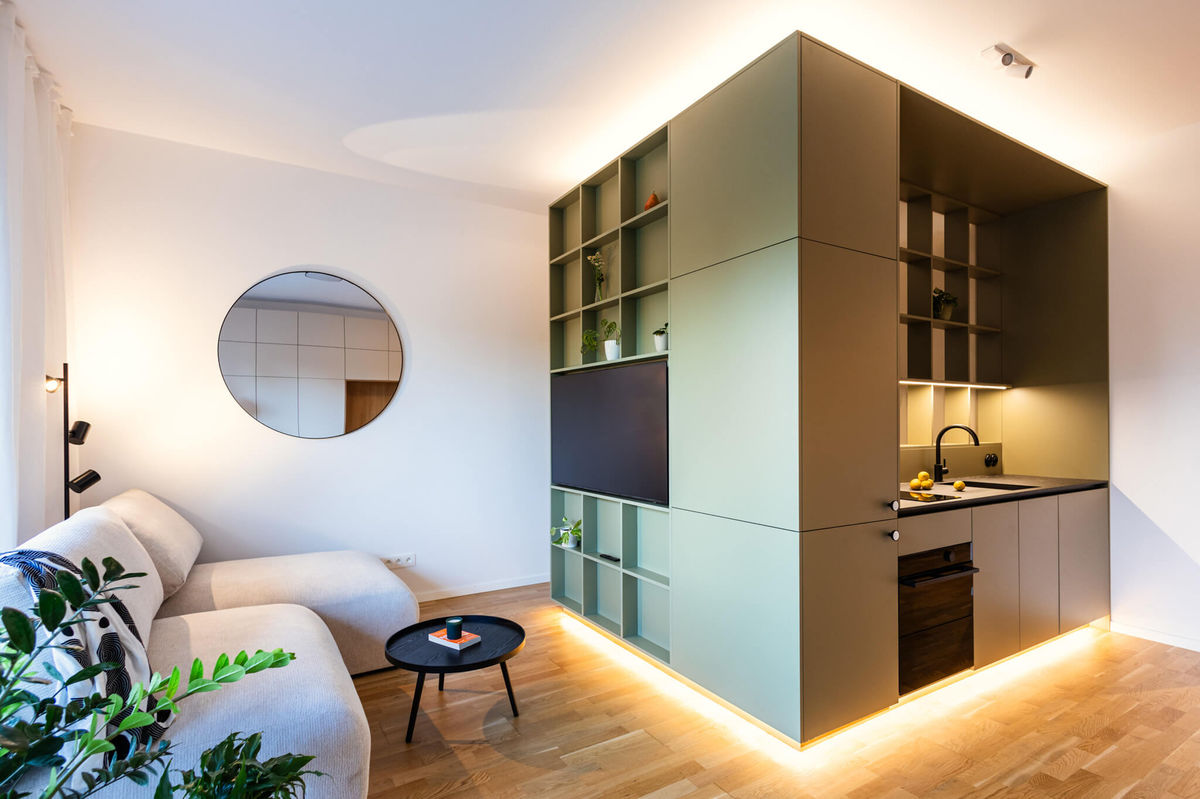 Photo: Radovan Ondruš
Create space interior apartment source Radovan Ondrus 1 Apartment interior with 35 square meters.
At the same time, the state should not only support rental housing. We also need a model of affordable apartments for purchase, because owner-occupied housing is still the dominant preference of households in Slovakia. Living in your own apartment in Slovak reality also represents a certain form of investment.
Own apartment paid off during productive years represents significantly lower housing costs in retirement age. In the system of state-supported rental housing, the employer will no longer contribute to the pensioner, and such housing will also be at a cost level close to commercial rent.
Why is Slovakia one of the worst countries in the EU when it comes to the ratio of real estate prices to income? Why don’t higher housing prices automatically mean more new construction?
Slovakia has a combination of relatively low incomes, rising housing prices and insufficient new construction in the most desirable locations. Higher apartment prices do not automatically mean more construction, because a developer cannot build a new project overnight. It needs a compliant spatial plan, land, permits, network capacities, financing and predictable rules.
If permitting takes years and the infrastructure is not ready, the market cannot respond flexibly to demand. It is also necessary to say that the developer will not start large-scale projects even if there is a high risk that he will not be able to sell the apartments due to the high price when all costs and an adequate margin are reflected. Therefore, prices rise faster than supply.
In recent years, developers have increasingly reduced the size of apartments in order to remain more affordable. Is it a natural reaction of the market and foreign influence, or a signal that housing is getting beyond the financial possibilities of ordinary people? How do you perceive this step?
It is a natural reaction of the market, but also a warning signal. Developers are trying to keep the total price of apartments at a level that buyers can still finance. When the price per square meter rises, downsizing is one of the few ways to maintain an affordable apartment price.
The problem is that a person buys a cheaper apartment, but at the price of a smaller living area and lower comfort. If tiny apartments become the main way of addressing affordability, it means that we are failing systemically in our ability to deliver adequate housing at an adequate price.