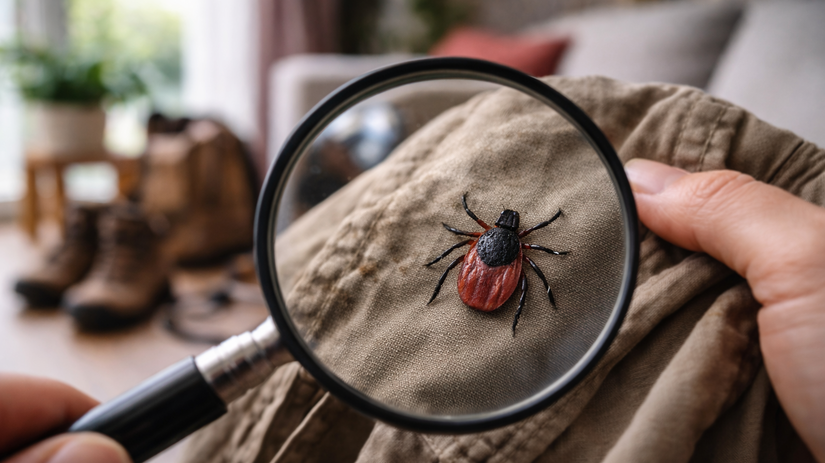
Warming is gradually causing some originally subtropical parasites to become established in central or northern Europe as well. With increasing warming, in a few decades, it will be possible, for example, for new species of ticks to become domesticated in southern Slovakia. At present, although their occurrence can be recorded in our region due to “clogging”, however, they would not survive the winter in nature. This follows from the statement of Branislav Peťek from the Institute of Parasitology of the Slovak Academy of Sciences (SAV) for TASR.
“There are several types of ticks in the subtropics that have already gone ‘on the march through Europe’, for example the dog tick with the technical name Rhipicephalus sanguineus, living in the Mediterranean, but it is already being reported from Hungary, even close to our borders. It has also already been recorded in our country, even its ‘domestication’, it multiplied in an apartment in Bratislava, where it was brought on a dog from a seaside holiday. Our winter in nature would not survive,” explained the expert.
One such type of tick is, for example, Hyalomma, whose findings have also been recorded in the region of northern and central Europe. Most often, it was a case of tick contamination on birds. “It only has two hosts, the larval and nymph developmental stages manage it on one, and it is often birds that spread them ‘around the world’. They fall out of it as suckled nymphs, which grow into adult ticks in the soil under suitable temperature conditions, which are already looking for a second host, which are large animals,” explained Peťko. According to him, however, the necessary air and soil temperature is not yet present in Central and Northern Europe, therefore limiting the development of this tick to an adult.
As he clarified, the Hyalomma tick is specific in that it can actively search for a host. “Hyalomma is a large tick, comparable to our largest steppe drinker tick, but unlike it, it has a thin and significantly longer so-called head, which is a forward-protruding mouth organ system, and longer bright and striped legs, which allows it to move faster, directly run after the host, and this allows us to quickly distinguish it from domestic species,” added Peťko.

According to him, when adult Hyalomma ticks are found in our conditions, it is possible to consider their importation in different packages or containers, in which they arrived in the country of origin and were imported to Central or Northern Europe. “The question is whether in the conditions here, which are cold for them, they are able to attack the host, some large animal and possibly even a person, and at the same time transmit some tropical disease,” noted the expert.
In addition to the causative agents of Lyme disease or tick-borne encephalitis, which are also transmitted by the common tick, Hyalomma is, according to him, the main carrier of the virus that causes fever with bleeding in the skin – Crimean-Congo hemorrhagic fever. “This virus is also transmitted by the steppe drinking tick, technically Dermacentor marginatus, whose area in Europe also extends to southern Slovakia, and we also find it quite often, but so far this disease does not occur in our country,” added Peťko.