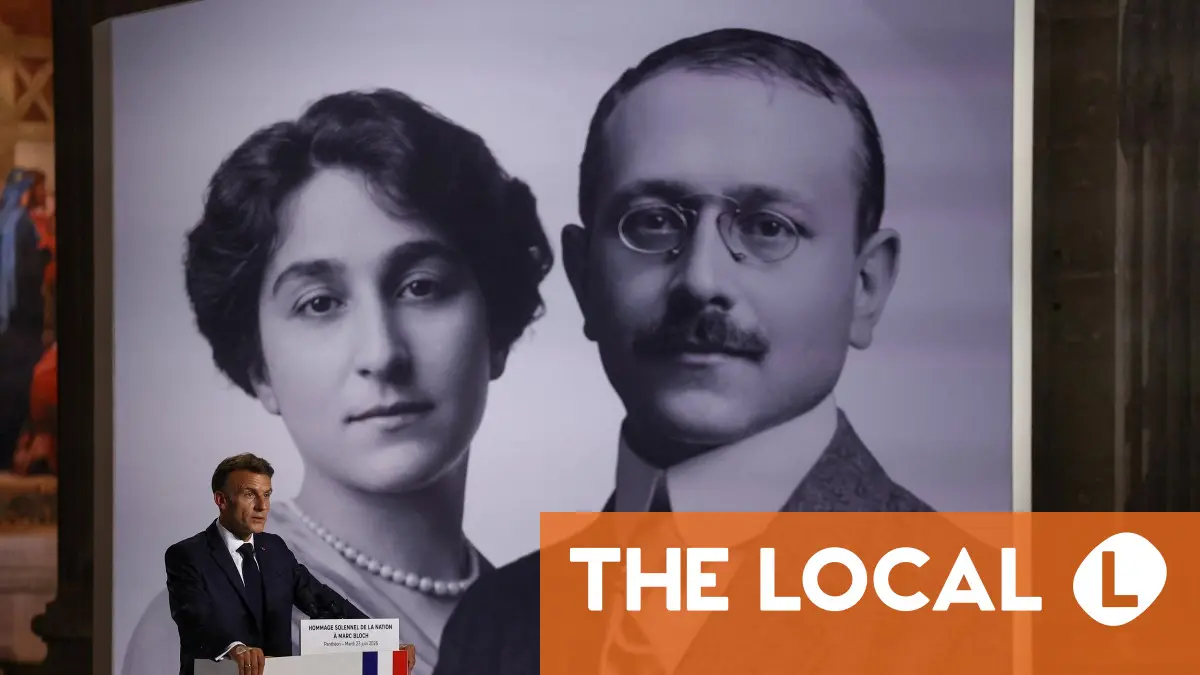
French scholar and Resistance fighter Marc Bloch, who was tortured and executed by the Gestapo in 1944, entered the Pantheon on Tuesday, becoming the first historian to receive the honour bestowed on exceptional figures in politics, culture and science.
Soldiers on Tuesday evening carried in two symbolic caskets representing Marc Bloch and his wife Simonne Vidal into the former church in the French capital’s Latin Quarter.
President Emmanuel Macron in his homage described the scholar of Jewish heritage, who fought in both World Wars, as a “man of the Enlightenment” who chose “the army of the shadows” – a reference to the French Resistance.
But “Marc Bloch’s resistance was also in thinking and writing,” said Macron, referring to one of his most widely cited works on France’s collapse to Nazi Germany in 1940.
Bloch and his wife’s caskets contained his medals and photographs, as well as letters from her to their children, according to the historian’s granddaughter Suzette Bloch.
“It’s a tremendous recognition,” the former AFP journalist said ahead of the ceremony at France’s secular temple of national memory.
Bloch’s induction carries political significance less than a year before France heads to the polls to elect a successor to Macron, with Marine Le Pen’s far-right National Rally (RN) party eyeing its best chance at seizing power.
Born into a Jewish family from Alsace, Bloch was a renowned specialist of the Middle Ages. He revolutionised the study of history by incorporating anthropology, economics and sociology.
He fought in World War I and was decorated for bravery, receiving the Legion of Honour among other awards.
The 53-year-old father of six asked to be mobilised again as World War Two began in 1939.
Despite his standing, he was stripped of his rights as a Jewish academic in 1940, and his apartment was requisitioned.
After the Nazis occupied all of France, Bloch joined the French Resistance in 1943.
Arrested in 1944, he was tortured under the authority of Gestapo chief Klaus Barbie, who was nicknamed the ‘Butcher of Lyon’ for his cruelty and sadism.
On June 16th, 1944, 10 days after Allied forces landed in Normandy, Bloch was executed by the Nazis alongside other Resistance fighters.
He cried “Vive la France!” (Long live France!) as he was shot.
Bloch is buried in a village cemetery in central France, and, in accordance with his family’s wishes, his remains will not be moved.
His wife, Simonne Vidal, died in Lyon in 1944, after going there under a false identity following her husband’s arrest. Her body was never found.
Bloch left behind L’Etrange Defaite (Strange Defeat), published posthumously, in which he analyses France’s collapse to Nazi Germany in 1940 and highlights the failures of its military leadership.
The president said Bloch criticised “the French people of influence and power” who admired Hitler and no longer believed in France, leading to the collaborationist Vichy regime.
“This defeatist mindset persists,” he warned, describing it as “a slow-acting poison in our public life that must be fought tirelessly”.
The Pantheon houses more than 80 national heroes, including writer Victor Hugo and French-American Resistance member Josephine Baker.
Bloch’s family requested that far-right politicians be excluded from the ceremony, citing the historian’s “deeply anti-nationalist” views.
While protocol requires parliamentary leaders to be invited, Le Pen – who leads the RN in the lower house – would not be attending, a member of her team said.
The far-right party’s leader Jordan Bardella nevertheless paid tribute to the historian.
“Marc Bloch will remain forever relevant,” he said in a post on X.
Matis Bloch, the Resistance fighter’s great-grandson and himself a historian, said the far right had been “constantly invoking” the scholar for the past two decades.
“There’s something that seems entirely contradictory to us, and it deeply irritates us,” he told Franceinfo.