ACQUISITION PLANS:
An executive said if its takeover of Foodpanda is approved, it would ensure couriers a stable income and implement technological advances
-
By Shelley Shan / Staff reporter
Grab Holdings yesterday pledged to support Taiwanese couriers and food businesses, and ensure cybersecurity if regulators approve its acquisition of Foodpanda, amid scrutiny of the deal.
The Singapore-based courier service platform in March announced that it planned to buy Foodpanda in Taiwan from its parent company, Delivery Hero, for US$600 million.
The deal is being reviewed by the Fair Trade Commission (FTC) and could be completed this year.
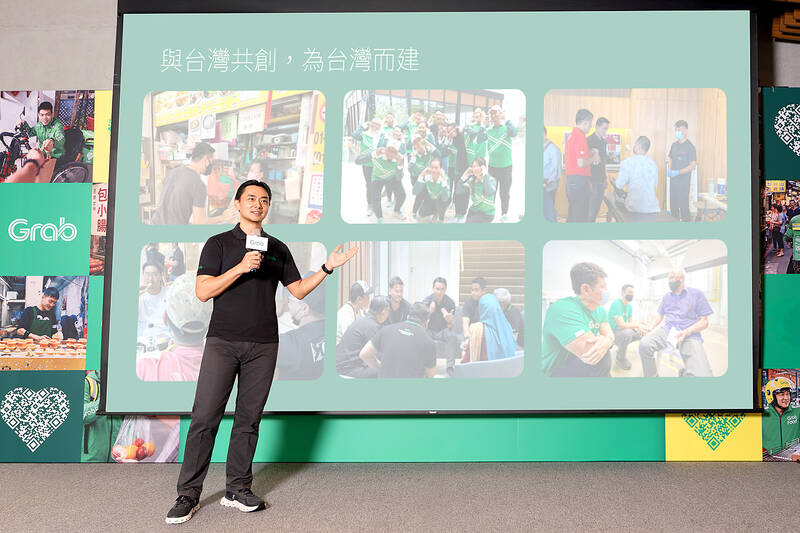
Photo courtesy of GrabTaxi Holdings
Taiwan would be Grab’s first market outside Southeast Asia if the deal is approved.
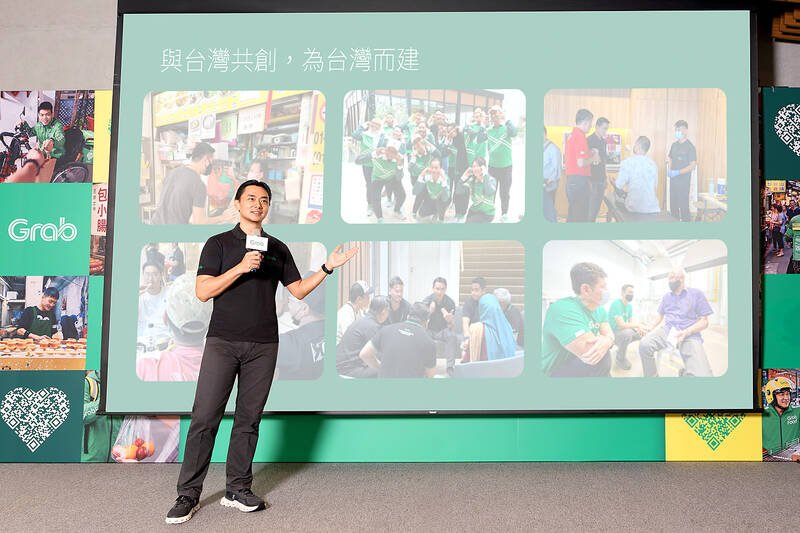
Grab group managing director Yee Wee Tang (余偉騰) told the company’s first news conference in Taipei that the entry into Taiwan’s food delivery market “makes a lot of sense,” as Taiwan, like other countries in Southeast Asia, has many densely populated urban areas.
“Taiwanese, in general, are tech-savvy and use mobile phones on a daily basis. The nation also has a very diverse food culture, and people are used to ordering food through mobile phones,” Yee said.
The government is scheduled to implement the Delivery Workers’ Rights Protection and Delivery Platform Management Act (外送員權益保障及外送平臺管理法) next month.
Asked whether the act would hurt the platform’s bottom line, and if it would affect the acquisition price for Foodpanda and food delivery fees, Yee said that Grab would comply with the act if the company secures regulatory approval to operate in Taiwan.
“Our understanding is that the acquisition is still ongoing and a lot of details are still being worked out, so it is not the right time to comment or speculate,” he said.
Yee was also asked how the company plans to win consumer trust and convince the FTC that the deal would create greater value for the market.
He was also asked whether the company would pledge not to increase delivery fees or leverage its dominant position in the market to claim a larger share of profits from other firms.
“Grab currently does not have any presence in Taiwan. We would be a new, independent player in this market. If we get the approval for the deal, we would compete fairly, but aggressively,” he said.
Asked whether Grab plans to enter Taiwan’s ride-hailing market, Yee said the company’s priority is its acquisition of Foodpanda and ensuring a seamless transition for the platform’s couriers and merchant partners.
Grab has made a series of commitments to food delivery couriers and merchants in Taiwan, Yee said during his presentation.
The company would ensure couriers have a stable income from the start and seek to minimize job disruptions arising from the transition, he said.
Couriers would be equipped with smart tools to improve delivery efficiency, receive weekly payouts and enjoy flexible working arrangements, he added.
Meanwhile, vendors could be assured that food delivery services would continue to operate smoothly and reliably throughout the transition, Yee said, adding that they would also be provided with an artificial intelligence-powered assistant to help optimize operations and boost sales.
Grab’s merchant app could help food vendors translate their menus into English and facilitate communication with overseas travelers by translating conversations into Chinese, he said.
“We would also help businesses interested in expanding into Southeast Asia by helping launch pilot programs in selected cities,” he said.
Prior to Grab’s offer, Uber Technologies in 2024 agreed to acquire Foodpanda’s Taiwan business from Delivery Hero for US$950 million.
However, the deal was blocked by the FTC in December 2024 over concerns that it would give the combined company more than 90 percent of the local food delivery market.
Uber abandoned the acquisition in March last year and paid a termination fee of about US$250 million.
Last month, Uber proposed acquiring Delivery Hero in a deal valuing the company at about 10 billion euros (US$11.57 billion) as it seeks to bolster its competitive position against DoorDash in international markets.