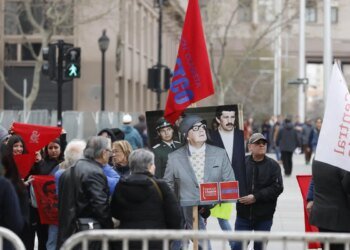
After the National Police admitted that it had “undercover agents” within human rights, environmental and union organizations, the public complaint by the Alianza Pueblo Unidos por la Vida opened a new front of questions about police intelligence work and its scope.
The groups requested the Public Ministry (MP) to issue protection orders for members of their groups and their families, considering that the latter were also subjected to surveillance “without judicial control,” even when they were not participating directly in the organizations or in political activity.
“We are concerned about the hidden intention that actions could be taken against the leaders and their families. Information was monitored and collected from children, mothers, siblings, people whose only connection was that they had an activist relative,” said Jorge Guzmán, member of the Popular Coordinator of Human Rights of Panama (Copodehupa).
They also questioned the position taken by the Police, which denied the accusation of infiltration and maintained that the actions of its units took place “within the framework of the law.” According to the complainants, these tasks would be related to investigations and search procedures carried out by the MP against popular organizations critical of the government of President José Raúl Mulino.
“The statement issued by the Police is a confession on one part and, if the attorney (Luis Gómez) does not act, the work of the Public Ministry would be called into question,” said Guzmán.
NGOs “ghosts” and “instigation”
On the table, the leaders also placed a document in which the names of agents, their positions, IDs and the alleged functions they would have performed within the structure of the National Directorate of Police Investigation (DNIP) appear.
According to the report, which was already presented to a United Nations Human Rights rapporteur, part of this structure would have operated under the “fronts” of organizations that presented themselves publicly as environmental groups. Among the aforementioned groups is a supposed collective called the Solidarity Action Center.
They maintain that, using rented cars and police units, this group would have carried out tours in Río Indio, an area in which the Panama Canal Authority plans to build a reservoir that would involve the transfer of peasant communities from their lands.
According to the organizations, the “undercover” police officers sought to gain the trust of the inhabitants of these communities to obtain information that would later be processed by the DNIP. In some cases, they claim, this practice would have also been used in different ways and would also have led to judicial proceedings against union leaders, among them the Single Union of Construction Workers (Suntracs), a group that faces a dissolution process promoted by the Ministry of Labor and whose board of directors, for the most part, is detained and under criminal charges.
They detail that some agents participated as “students” in university rallies, to “mix among the protesters.” “Some of the units participated in student marches, posing as university students, where they proposed actions outside the context of the protests, such as burning cars and vandalism; practices that in our experience we avoided so as not to offer an excuse for repressive measures in the demonstrations,” Guzmán pointed out.
The leaders also presented an organizational chart that mentions Major Carlos Carvajal and Second Corporal Bryan Rodríguez, who, according to the complaint, would occupy positions in the “operational direction and command” of the alleged network.
The document indicates that the structure would be divided, in turn, into subordinate subsections, with specific units to serve certain social groups. Among them there is talk of a unit dedicated to indigenous affairs. In that section appears the Ngöbe indigenous leader Kekin Sánchez, whose surveillance would have occurred in East Panama and who actively participated in the protests against the mining contract. Also mentioned is Toribio García, leader of the Ngäbe-Buglé Region, who had an active participation in the mobilizations after the approval of the reform to the Social Security Fund through Law 462, in 2025.
The leaders also do not rule out that some episodes of vandalism or violence recorded during the protests in Bocas del Toro against Law 462 could have some “relationship” with “covert” units that, according to their complaints, had participated in demonstration activities.
Law 21 of December 31, 2013, on organized crime, designed primarily for anti-gang and organized crime investigations, authorizes security forces to carry out undercover operations to obtain information, which must be carried out with an order from a prosecutor and must be subject to the control of the guarantee judge.
“Unions are not criminal organizations and protest is not a criminal act,” said Yamir Córdoba, current secretary general of Suntracs, who demands that it be shown whether the operations were authorized by a court.
Politicians and civil society react
The Citizens’ Alliance for Justice expressed its “deep concern” and called on the Ministry of Security to be “accountable” for the scope and legality of “covert” surveillance.
“Physical monitoring, unauthorized interception of communications, digital monitoring and the infiltration of undercover agents into union, trade union, environmental, indigenous, student and community organizations constitute practices incompatible with a democratic society,” the civic group said in a statement published yesterday.
He highlighted that freedom of thought, association and expression are protected both by the Political Constitution of Panama and by international treaties signed by the country.
“We emphatically remind the authorities that the police and intelligence establishments have strict constitutional powers and limitations. The privacy of social activists, their homes and their families is inviolable. The monitoring of relatives of leaders and the alleged use of espionage technology without judicial authorization surpass any legal framework,” they noted.
The former vice mayor of Panama City and environmental activist Raisa Banfield also spoke out about the complaints. His reaction was accompanied by a photograph in which he is shown with one of the “undercover” agents identified as part of the “network.”
“I was alone in front of MiAmbiente telling me that they were young people worried about mining. They carried signs while they spied on us and who knows how much more,” Banfield said on his X account.
Juan Diego Vásquez, president of the Vamos Coalition, also questioned the Government through his social networks regarding possible abuses of power related to the use of espionage tactics against opponents.
“Today it is not about those who were subjected to such abuse, but rather about remaining silent in the face of that abuse today, we are endorsing what happens tomorrow. The differences of opinion inherent to democracy should not lead us to tolerate or remain silent in the face of abuses of power against freedoms,” he said.
The Star of Panama consulted the Police about these new complaints, but the institution reported that, for the moment, it maintains the position expressed in its statement.