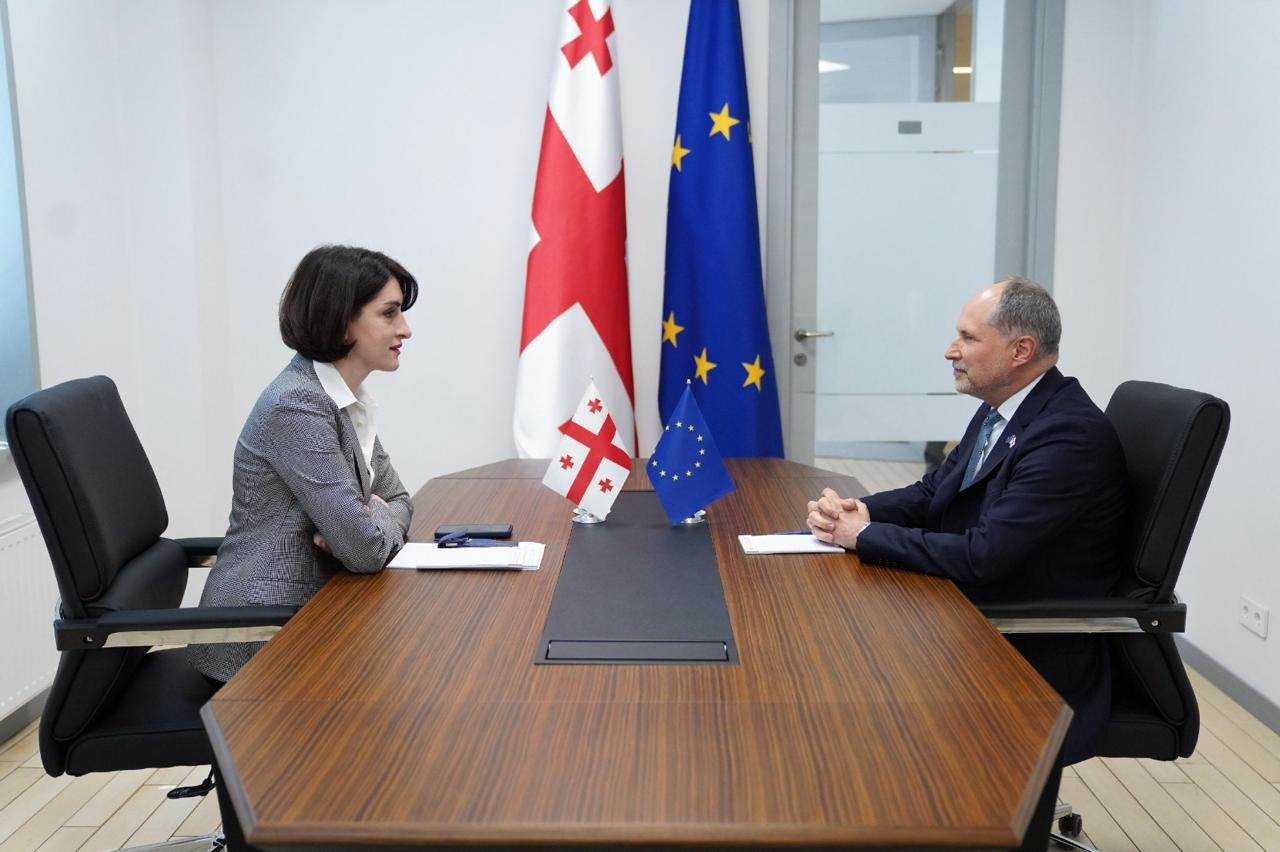
The Ministry of Foreign Affairs of Georgia summoned European Union Ambassador Paweł Herczyński on April 27 over his recent remarks made in Brussels, where the diplomat warned, among others, not to let the Georgian people “go back to the dark times.” The summoning followed calls from senior Georgian Dream officials, including Prime Minister Irakli Kobakhidze, to bring in the diplomat over what they denounced as a “threat.”
Herczynski said during April 23 launching ceremony of the “Georgia in Focus” exhibition hosted by the European External Action Service that “Georgia is at a crossroads” and that “the future in Georgia is not written yet, but whatever will be decided in the next weeks and months will determine if Georgia belogs to the family of European countries based on democracy, rule of law, and human rights, or Georgia, unfortunately, would move back to its dark past.”
He further said, “We cannot let Georgia and wonderful, warm, hospitable Georgian people go back to the dark times of violence, civil war, poverty, deprivation, corruption. This is not the future they deserve.”
Georgian Dream Foreign Minister Maka Botchorishvili, who met with the summoned ambassador at Tbilisi’s Ceremonial Palace on Monday afternoon, made comments to journalists afterward, while Ambassador Herczyński left without comment.
“The will of the Georgian people is expressed in its choice of the Government of Georgia,” Botchorishvili said, adding, “Therefore, the government knows best and feels best which crossroads Georgia stands at, how much Georgia’s security needs warning, and how much stability we need in Georgia, and how much we do not need encouragement of further polarization of this society and a radical agenda.”
“Those statements, those actions, those steps taken from Brussels, the attitude that we see toward the Government of Georgia, which, by the way, was elected by the Georgian people, is unacceptable,” she said, adding, “Everything that fuels polarization in our society is unacceptable.”
“Whatever explanations we may hear, facts and actions remain facts and actions. The picture we see is unacceptable. We expect that from Brussels, there will be the attitude that Georgia deserves in good-faith relations.”
MFA’s Statement
The Ministry of Foreign Affairs also issued a statement, saying that Botchorishvili “underscored that the current policy of Brussels toward Georgia, as well as the steps taken and statements issued in relation to the country, undermine trust between the parties and adversely affect the Georgia-EU partnership.”
“Regrettably, the actions undertaken by Brussels can only be assessed as contributing to further polarization within Georgian society and as fostering a radicalized political agenda,” the ministry said.
It further said Botchorishvili “noted that the Government of Georgia has consistently demonstrated its readiness for constructive dialogue and expects from the European Union an approach based on fairness and mutual respect.”
The summoning follows strained relations between Tbilisi and Brussels amid the Georgian Dream’s anti-democratic moves and anti-EU rhetoric. The EU said in November that Georgia is a candidate country “in name only” and moved in February to suspend visa-free travel for Georgian holders of diplomatic and service passports.
Georgian Dream officials and allied media have repeatedly accused European diplomats of interference in domestic affairs. In recent months, authorities have summoned several Western ambassadors, including the ambassadors of Germany and the United Kingdom.
EU Delegation’s Statement
The delegation of the European Union to Georgia also issued a statement saying that Ambassador Herczyński “was invited” by Botchorishvili, and that “they had a substantive discussion about EU-Georgia relations.”
“Since Georgia’s independence, the EU has stood by Georgia, helping to build a democratic and prosperous state,” the delegation said, adding, “The EU has shown time and time again that it wishes Georgia to move forward.”
Pointing to the EU’s 2023 decision to grant Georgia candidate status, the statement added, “Like majority of Georgians, we believe that membership in the EU offers Georgia the best guarantee of peace and prosperity.”
“Accession to the EU requires sincere commitment and tangible reforms to align with EU values and standards. Unfortunately, the current trajectory taken by Georgian authorities pushes Georgia away from the path of EU membership. Persistent anti-EU rhetoric further undermines the credibility of Georgia’s EU aspirations,” the statement stressed, adding, “The European Union does not force anyone to become a member. We wish that Georgian authorities do not miss this historic opportunity that still exists.”
Also Read:
This post is also available in: