On April 16, Georgia is to close airspace over the area of Abastumani, a health resort in the country’s south, with officials citing the need to ensure clear skies above the local astrophysical observatory. However, sources told Radio Free Europe/Radio Liberty’s Georgian Service that the move is in fact a “whim” of Bidzina Ivanishvili, the billionaire founder of Georgian Dream, who owns a residence in the area.
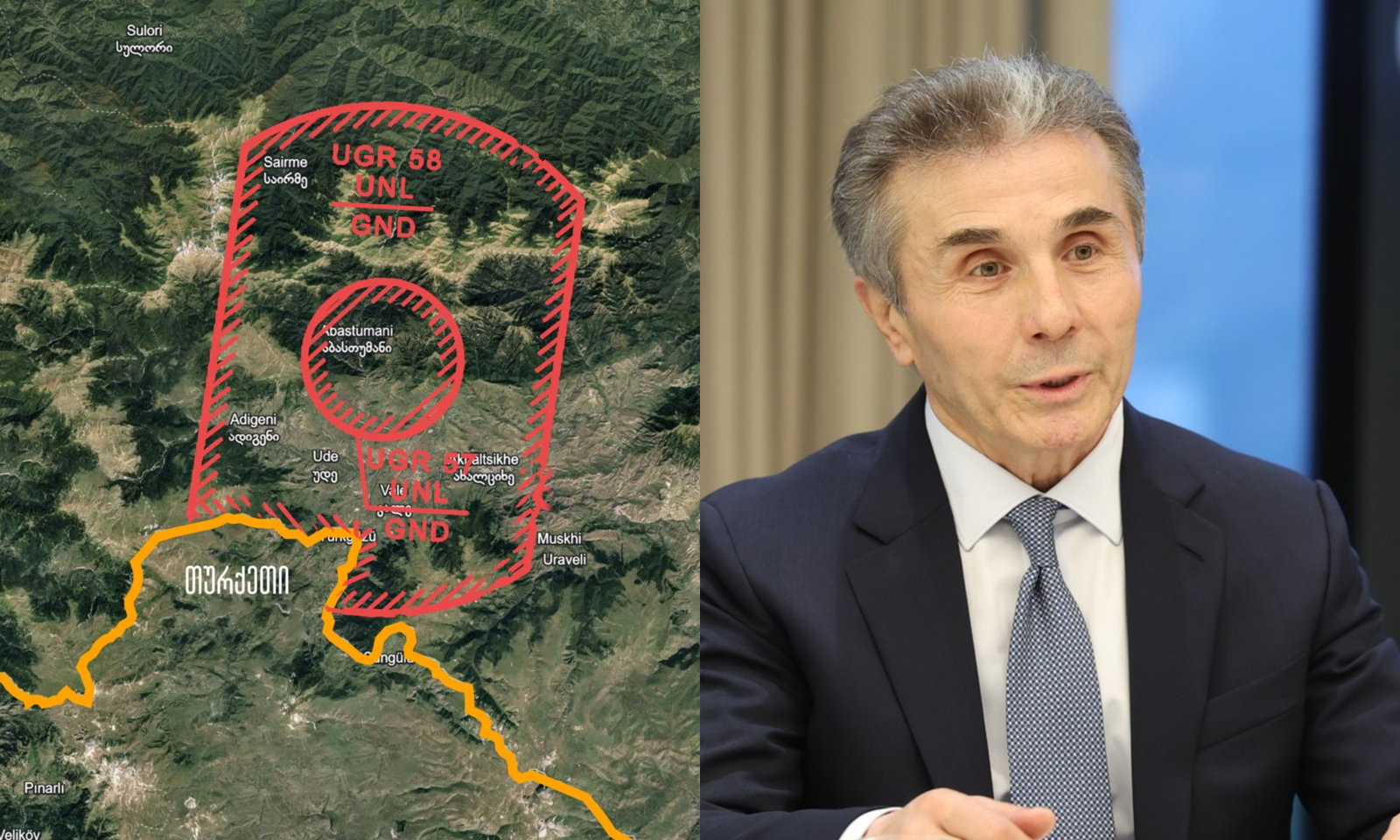
The government’s February 9 decree, signed by Georgian Dream Prime Minister Irakli Kobakhidze and published by RFE/RL, orders the closure of the “Abastumani 2” airspace along the border with Turkey with the goal of “ensuring atmospheric transparency for astronomical observations.” Effective from April 16, the decree restricts all flights above the area except for Georgia’s state aviation, rescue missions, or safety or bad weather emergencies. The decree applies the GND-UNL restriction, meaning vertical scope from ground level to “unlimited” altitude flights.
A journalistic investigation by RFE/RL’s Georgian Service, however, cites sources in the aviation industry and state regulatory bodies claiming that the closure, covering an area roughly 52 km in diameter and at least “four times the size” of Tbilisi territory, is more a “whim” of Ivanishvili, who has maintained a family residence in the area since 2020.
At the same time, the manager of the well-known Abastumani Observatory told the outlet that the restriction, which RFE/RL describes as unprecedented in Georgia and at odds with international practice around observatories elsewhere, was long requested by the observatory itself.
Restriction and Potential Effects
According to the RFE/RL report, published on April 15, the new restrictions will amend and disrupt routes – including Route N644 and M747 – that have been daily used by “dozens” of international airlines in flights connecting European and Asian destinations. The outlet said they first heard about the restriction, which remained unknown to the public until recently, from an “informed source” months ago.
Representatives of EUROCONTROL, an international aviation union, however, told RFE/RL that it had been warned as early as 2023 about the pending restriction, which would add an average of 10 km to long-haul flights, and the agency has taken it into account when planning future routes.
Per the report, the restricted zone fully covers Abastumani, the Adigeni municipality, and parts of southern Georgia, effectively closing off approximately 2,000 square kilometers of airspace. The restriction covers nearly a third of the distance between the Turkish border and the Caucasus range, “significantly narrowing maneuvering space and pushing flights northward,” the report says, affecting the area that it says is already constrained by the mountainous terrain.
Anonymous sources from the aviation industry and state agencies told RFE/RL that they are concerned the new restriction could cause severe disruption, including flight diversions, increased costs and travel times, bottlenecks, as well as heightened safety risks and higher airfares.
It is also feared that the measure could undermine the country’s ability to fully benefit from its role as a Eurasian transit corridor, a role that has grown in importance as flights have been diverted amid Russia’s war in Ukraine and conflicts in the Middle East. RFE/RL has cited official figures showing that Georgia’s airspace traffic load has increased by 52% since 2019, with the upward trend continuing. Following the restriction, sources warned that airlines may seek alternative transit routes.
According to the outlet, a smaller section of airspace had already been closed as early as 2019, with officials at the time also citing requests from the astrophysical observatory. These temporary restrictions, designated “Abastumani 1,” were, however, practically extended indefinitely through 2025, according to the RFE/RL report, which said that the sole exception applied to aircraft flying to and from the Abastumani area, while the only helipad in the territory was reportedly owned by Ivanishvili.
‘Ivanishvili Whim’?
Various media and watchdog reports have documented major infrastructural changes in Abastumani, once a popular but later neglected health resort, since Ivanishvili took an interest in the resort around 2018.
Ivanishvili, currently a “honorary chairman” of the ruling Georgian Dream party, does not hold any formal government position.
RFE/RL cites earlier reports and concerns raised by corruption and environmental watchdogs regarding the state, as well as businesses linked to the billionaire, purchasing property and carrying out reconstruction in the area. Since 2020, Ivanishvili has “owned a private family residence in the mountain balneological resort spread along the southern slopes of the Meskheti Range,” according to the outlet, making Abastumani one of his several strongholds in Georgia.
Aleksandre Tevzadze, who has served as director of the Abastumani Astrophysical Observatory since 2025, has defended the restriction as “good news,” saying the facility has long requested such measures and arguing that the observatory requires a larger clearance zone than those imposed since 2019.
RFE/RL, however, has cited international practice regarding astrophysical observatories that do not usually resort to such radical “unlimited” vertical restrictions, while also noting that the level of restriction is “unprecedented” for Georgia, too.
“In international aviation practice, a restriction of the GND-UNL type (ground to unlimited altitude) is the highest level of safety measure and is almost never used over civilian facilities,” the report says.
Also Read: