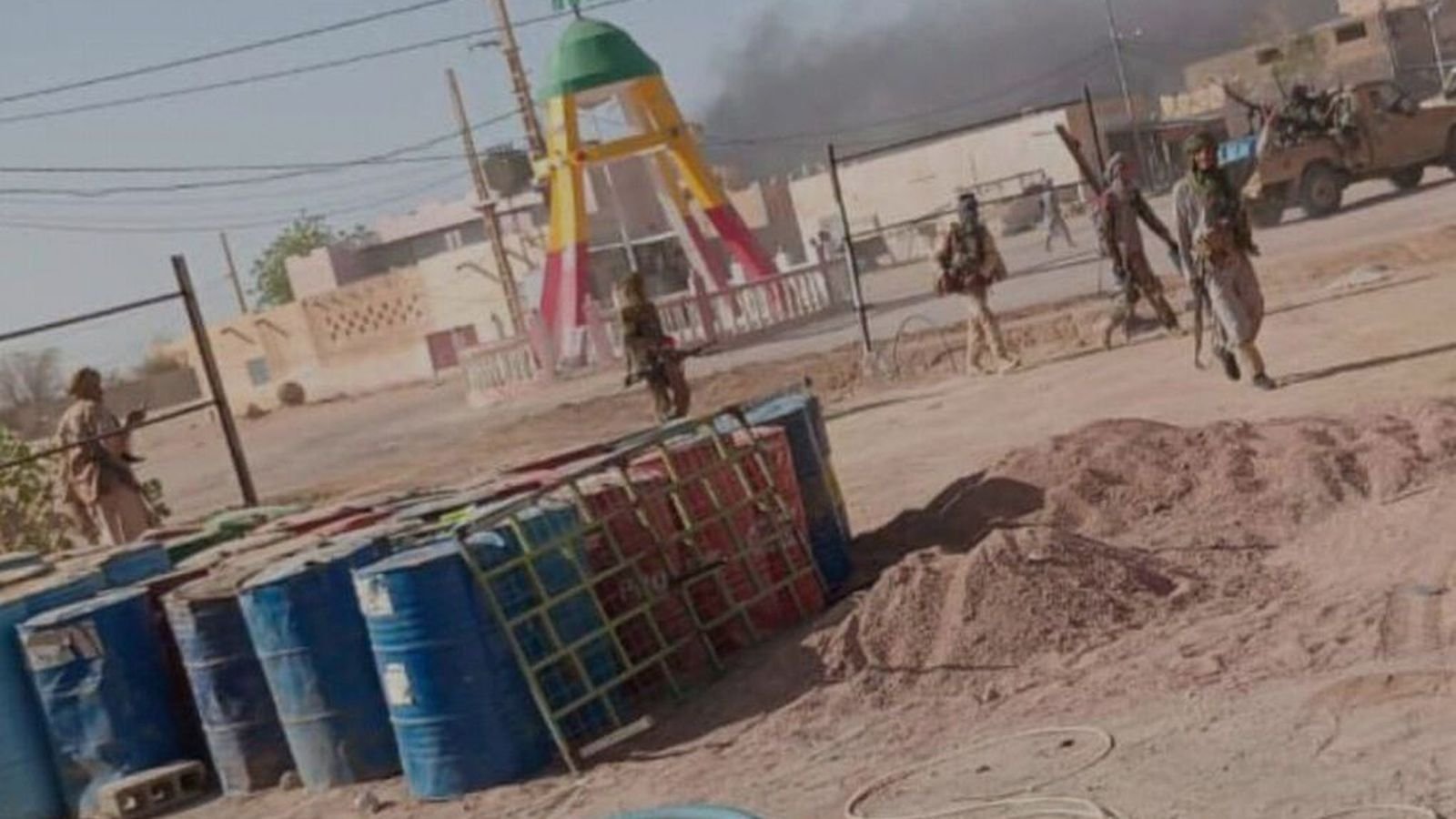
Explosions and gunfire were heard in Bamako, the capital of Mali, this morning as an array of militia groups carried out what appeared to be coordinated attacks in the city.
Mali’s military said in a statement earlier today that it is engaged in battles with unnamed “terrorist organizations” across the country. Efforts would be made to drive the rebels away. Riots were also reported in Gao in Eastern Mali and Kidal in Northern Mali.
A junta seized power in Mali in 2020 and still rules the country today.
A Tuareg rebel group in Mali known as the Azawad Liberation Front (FLA) is said to have captured the city of Kidal and part of the city of Gao. This is claimed by Mohamed Elmaouloud Ramadane, the group’s spokesperson, in a Facebook post, but this has not been confirmed. Ramadane urges the governments of neighboring Burkina Faso and Niger not to get involved in the conflict in Mali. The US government has condemned the attacks.
Visual confirmation of the FLA capturing the National Youth Camp of Kidal, in Kidal city. https://t.co/kjjSDRIM8m pic.twitter.com/MtPwEMN1Jk
— Brant (@BrantPhilip_) April 25, 2026
The Tuareg are a group of people in northwestern Africa that stretches from southwestern Libya to southern Algeria, Niger, Burkina Faso, and yes, Mali. Over the years, the FLA has fought for the independence of the Azawad region in Northern Mali, but Islamists have gained a foothold within the movement in recent years.
Al Jazeera has quoted sources within the country’s military as saying that militants from the Islamist movement Jama’at Nusrat al-Islam wal-Muslimin (JNIM) are also suspected of rioting in many parts of the country.
Al-Qaeda affiliate JNIM has gained ground in Mali in recent years, along with many other jihadist movements, but the group is said to effectively control large parts of Mali and Burkina Faso. Al Jazeera’s sources say JNIM is trying to overthrow the government.
It appears that FLA and JNIM made a concerted attack; The FLA concentrated on the northern part of the city, while the JNIM attacked cities elsewhere in the country.
Mali, a West African country of 24.5 million people, has been under military rule since a military coup led by General Assimi Goïta in 2020.
Militant groups have long maintained their presence in the so-called Sahel region, which refers to the dry region south of the Sahara desert that extends across Africa. There, for years, they have profited from unregistered gold mines, in addition to which the groups tax the inhabitants of their territories and finance themselves through robbery. The groups also finance themselves by smuggling drugs and people, to name a few.
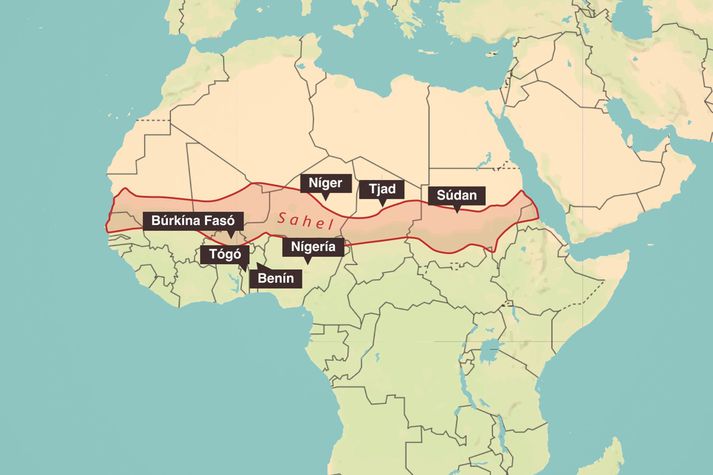
There have been a number of coups in West Africa in recent years, including in Niger, Burkina Faso and most recently in Guinea-Bissau, and military junta governments have repeatedly referred to the rise of these Islamist groups when they seized power and vowed to take a firmer grip on these issues.
In contrast, military junta governments in Africa have recently expelled troops from the United States and France and instead accepted Russian help to fight powerful militias and insurgent groups active there and elsewhere in the Sahel region. But after the death of Yevgení Prigozhín, the owner of the mercenary group Wagner, Russia’s position in Africa has worsened considerably. Russia’s new mercenary group, the Africa Division, run by the Ministry of Defense, has not produced the same results as the Wagner forces did in their time, either in terms of profits or influence.