According to Helsingin Sanomat, Belgian authorities have accused a man living in Finland of being active in the Islamic State (Isis) terrorist group.
The daily said authorities suspect him of leading a group of several Isis members from Finland.
The man is currently in custody in Belgium. A verdict in the case is expected next week, according to Helsingin Sanomat.
Prosecutors are demanding a 12-year prison sentence for financing terrorism and plotting the use of an explosive device.
The paper added that the case is linked to the National Bureau of Investigation’s 2024 detainment of three men suspected of participation in a terrorist group. However, they were released after a few days.
According to HS, those men remain at large, and the preliminary investigation in Finland has not progressed to charges in more than a year and a half.
The paper said seven people are facing charges in the trial in Antwerp, most of them living in Belgium. The man who resides in Finland is suspected of being one of the group’s leaders.
HS said the man, in his 40s, is originally from the Muslim-majority North Caucasus region of Russia. In 2012 he fled Russian authorities’ persecution to Ukraine.
The man has denied the charges.
According to HS, the man was already suspected of terrorism while living in Ukraine. His defence has argued the suspicions were based on Russian allegations. No charges were brought against him in Ukraine.
His current defence is similar, saying that the suspicions were based on incorrect information in an international arrest warrant issued by Russia.
The man arrived in Finland shortly after Russia’s full-scale attack on Ukraine in February 2022. Finland granted him asylum in August the following year, on grounds that he would be persecuted by Russian authorities.
Supermarket competition questions
An editorial in Iltalehti suggested that competition in Finland’s grocery sector may not be as fierce as some people may think.
The tabloid pointed to a previous interview with retail analyst Arhi Kivilahti, who said that supermarket competition is not as fierce in Finland as it is in Germany, for example.
Finland’s grocery market is among Europe’s most concentrated, the editorial noted.
The two biggest players — S Group and Kesko — hold 82.5% of the Finnish grocery market.
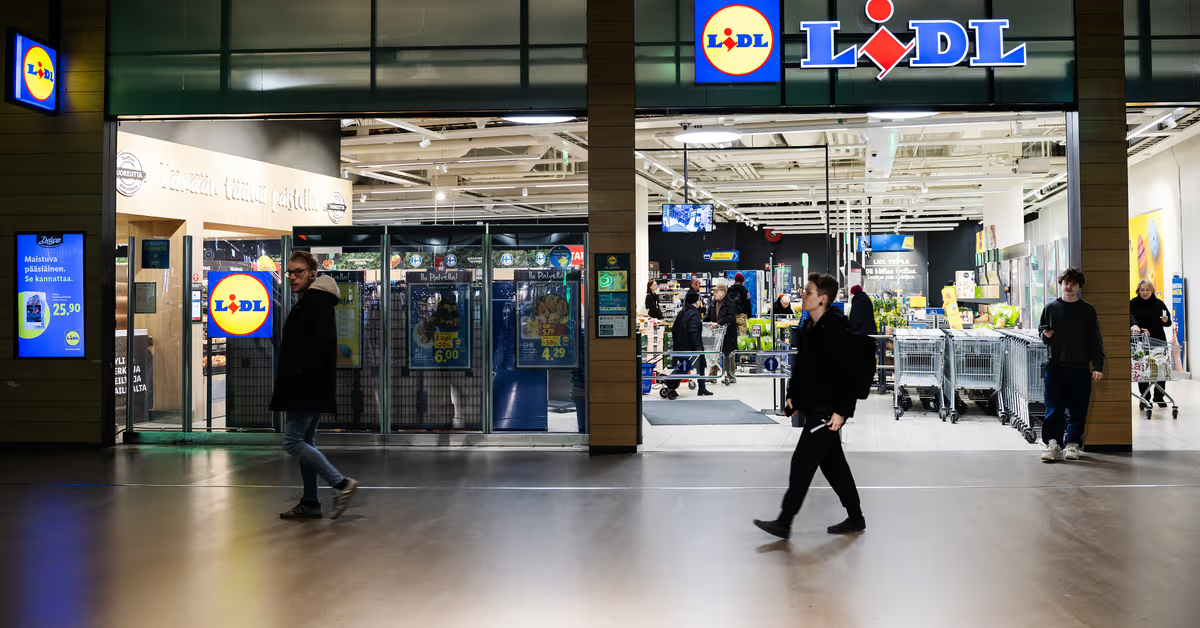
The German supermarket chain Lidl, which arrived in Finland more than two decades ago, has a 9.5% market share, the paper noted.
While Lidl’s arrival slightly shook up Finland’s grocery market, the paper cited an Yle report that found Kesko and S Group to be among the most profitable grocery companies in the world.
Retail analyst Kivilahti told IL last month that Lidl — which the paper recently found had Finland’s lowest grocery prices in a ‘shopping cart’ comparison — could actually be doing a lot more to shake up the market, and could lower its prices further.
However, Lidl is faring better in Finland than in most of the other European countries in which it operates, the editorial said, pointing to an article in Talouselämä in April.
Lidl’s chief executive in Finland, Conor Boyle, told the business publication that it is a completely different matter to enter a market as a third player as opposed to one that already has seven or eight major competitors in place.
As an example, the paper noted that in Germany, grocery prices are falling because the country’s two largest discount stores are in a price war. It said price wars force competitors to look at their own prices.
“One problem with Finland’s competitive situation is the vertical concentration of trade. In Finland, competitors cannot buy products wholesale at a reasonable price, as we only have two operators and Lidl, which do their own import and procurement,” the editorial read.
The paper suggested that barring new legislation to address the issue, the only other solution would be the introduction of a fourth player in the market — like German discount chain Aldi, for example.
The paper recently asked Aldi whether it plans to start up business in Finland.
Their answer was no.
Staycation tips
Swedish-language daily Hufvudstadsbladet offered a number of tips for people having ‘staycations’ over the summer holidays.
It said one major bonus in staying put during the break is financial — there are no airline tickets or hotel reservations to pay for. Another is the travel time it saves, offering more time for relaxing.
The summertime tips came from the Martha organisation, a home economics-centric non-profit group.
The first tip was to “use nature like a playground”.
“Find a day this summer when you can spend a longer time in the forest, so that the whole family has time to settle down and find their own activities. Bring snacks, a book, a blanket and let time do its thing,” it suggested.
The next tip encouraged people to take a small camping trip “without making a big deal about it”.
It said that when camping, “many people make the mistake of starting too big. A long trip, too much equipment, high expectations. It’s not necessary. The first night in a tent could just as easily be close to home, in a place you already know.”
If camping’s not your thing, the paper also suggested sleeping in your car.
It said that turning your vehicle into a temporary home requires little preparation and offers a sense of freedom. But finding a good location is key, according to the paper.
“The morning is often what makes the whole experience. Waking up without rushing, opening the door and being outside right away. Drinking coffee outside, eating something simple and letting the day start slowly,” it explained.
Other tips included outdoor cookouts, going biking and seeking out a new nearby beach.
The final tip encouraged families to get together at the start of summer to make a joint summertime “bucket list”.
“Fill the list with things you actually have time to do and want to do. It doesn’t have to be big.”