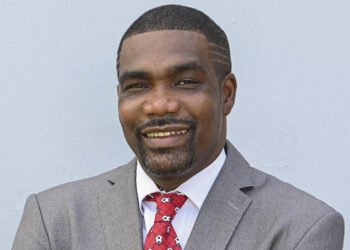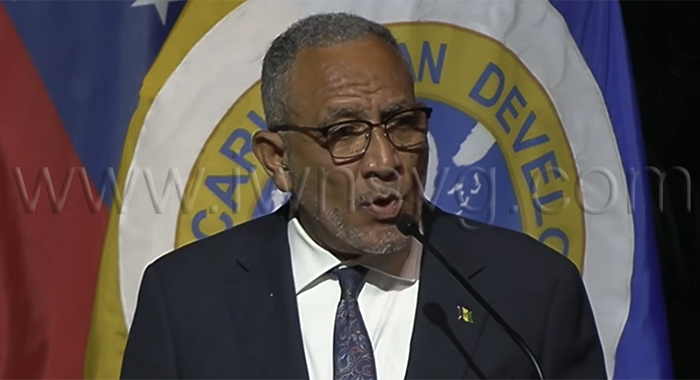
NASSAU, Bahamas — Prime Minister of St. Vincent and the Grenadines Godwin Friday has urged the Barbados-based Caribbean Development Bank (CDB) to move faster and more decisively on reforms and climate-resilient development, warning that borrowing member countries are facing “chronically high” debt, worsening climate shocks, and a shrinking pool of concessional finance.
Responding to the welcome address at the 56th Annual Meeting of the CDB Board of Governors on behalf of the Bank’s borrowing member countries (BMCs) on Wednesday, the prime minister said the region’s small, open economies are being squeezed by global turbulence while carrying legacy vulnerabilities that they did not create.
“Central government’s debt remains chronically high, with debt-to-GDP ratios exceeding the prudential 60% target in nine member countries, in my own country exceeding 113%,” he further stated.
He said this debt overhang “severely limits” governments’ ability to fund growth-enhancing investment and protect vulnerable citizens, even as the region is asked to do more with less.
High debt, tight aid, and rising costs

Friday cited tightening supply chains, rising shipping and fuel costs, and a high cost of living, noting that while some of these pressures are now linked to conflicts in the Middle East, the underlying fragility predates those crises:
At the same time, he said, official development assistance (ODA) from traditional partners has “experienced a marked decline”, widening what he called a “critical financing gap”.
The Vincentian leader said the region requires an estimated US$14 billion annually for comprehensive climate response, but is currently mobilising less than 10% of that amount.
“It is therefore imperative that our development partners become more adaptive, more responsive, and willing to provide highly concessional financing and dedicated resources for loss and damage that will not worsen a bad debt situation.”
CDB’s ‘indispensable’ role and the integration test
Friday, who is also Kingstown’s minister of legal affairs & justice, economic planning, and private sector development, repeatedly described the CDB as “indispensable” to the region’s development project and to the long-term viability of Caribbean integration.
“However, regional economic integration is sustainable only if partners all derive benefit from it, and economic disparities among member countries do not grow too wide. The bank is uniquely positioned to promote that end.”
Emphasising that the CDB is “the only multilateral development bank whose core constituents and owners are the Caribbean people”, Friday argued that this gives it both the legitimacy and the responsibility to lead in tailored solutions for small, vulnerable economies.
“Through decades of working directly in this space, the bank has developed a wealth of experience, talent, and invaluable knowledge about our countries and region. The bank has become indispensable to our development.”
He said the CDB is, therefore,well placed to speak credibly and in a focused manner for its Caribbean constituents, and to be in the lead in designing solutions tailored to the needs of our economically and climate-vulnerable small open economies.
SVG as a case study in resilient infrastructure
Friday used St. Vincent and the Grenadines as a concrete example of how targeted CDB investments can shift a country’s resilience trajectory after years of repeated shocks.
He referenced major projects supported by the bank, including the modern port in Kingstown, school and road programmes, and rural infrastructure.
The prime minister said this kind of partnership should guide the bank’s work across the region.
“The borrowing member countries call for greater collaboration in building resilience in a comprehensive way spanning environmental, economic, and social dimensions. This comprehensive resilience framework must guide the bank’s operational priorities in the years ahead.”
Climate: hurricanes Beryl and Melissa and the cost of delay
Friday reminded delegates that the annual meeting was taking place just as the Caribbean enters another hurricane season, with the memory of recent storms still fresh, including Beryl and Melissa in 2024 and 2025, respectively.
“We are familiar with the enormous economic toll those extreme weather events extracted, and therefore must respond effectively.”
He called for an environmental and climate strategy rooted in adaptation and resilience, with a focus on climate-resilient economic assets, upgraded coastal infrastructure, and expanded early warning systems.
In that context, Friday singled out the CDB’s Climate Change Project Preparation Fund as a critical tool for unlocking flows.
“The bank’s climate change project preparation fund is critical in dissolving resource bottlenecks, enabling timely and enhanced capital flows for adaptation.”
Economic resilience: diversification, energy, blue and green economy
On economic resilience, Friday argued that Caribbean states must be supported in absorbing shocks while maintaining inclusive growth and pivoting away from narrow, vulnerable economic bases.
He said borrowing member countries must “aggressively pursue economic diversification across modern frontiers”, highlighting priority areas such as digitalising public services, reducing fossil fuel imports through renewable energy and investing aggressively in solar, and the sustainable use and management of marine resources.
The prime minister also spoke of value-added agro-processing to strengthen domestic food security, reduce food import bills, and encourage export growth.
He warned that growth models that neglect equity are “misguided”, saying, “It is misguided and unsustainable if it leaves vulnerable populations behind.”
Social resilience: people at the centre
Friday insisted that resilience must be people-centred, with a strong emphasis on social protection, basic services, and community development.
“Social resilience requires strengthening people’s ability to withstand shocks by expanding access to essential services and developing responsive and effective social protection systems,” he said.
He singled out the Basic Needs Trust Fund (BNTF) as a flagship vehicle that should be preserved and strengthened.
CDB Forward: ‘the time to act is now’
The Vincentian leader strongly endorsed the bank’s institutional reform agenda, “CDB Forward”, describing it as a necessary response to what he called the “implementation deficit” in regional development.
He said there is a broad mandate from borrowing members for the bank to execute, not just design, reforms.
“The bank must make its development impact felt with greater speed and with far more reach. The borrowing member countries have delivered a clear mandate. We must move swiftly to implement the transformative reforms to eliminate friction and drive our institution forward. The need is urgent, and therefore the time to act is now.”
Friday called for accelerated project implementation, a concerted effort to reduce undisbursed loan balances, and a modernisation of the procurement framework:
He also encouraged the bank to “aggressively embrace and leverage partnerships” with other multilateral development banks and bilateral partners, in order to mobilise private capital and expand co-financing.
Appeal to shareholders: back the 10-year plan and SDF 11
Friday’s address included a direct appeal to CDB shareholders and non-regional partners to provide robust financial backing for the Bank’s new 10-year strategic plan (2026–2035) and for the Special Development Fund (SDF) 11, which provides concessional resources to the most vulnerable members.
He said this support is essential to ensuring that Caribbean development is driven not by vulnerability, but by “deliberate choices”, “capable institutions”, and regional solidarity.
‘Our path must not be defined by our vulnerability’
Friday cited one of the architects of Caribbean development thinking, Sir Arthur Lewis, the CDB’s first president.
He argued that while resilience and an “unconquerable spirit” have long defined the Caribbean experience, the region must ensure that its development path is shaped by agency rather than victimhood:
“Resistance, adaptation, and an unconquerable spirit define the historical experience of the Caribbean people. Despite our limitations, we continue to deliver better lives for our people,” Friday said.
“However, the region’s development path must not be defined or be limited by our vulnerability. It must be shaped by our deliberate choices, our capable institutions, and by regional solidarity.”
Quoting Sir Arthur Lewis, he added:
“In the words of Sir Arthur Lewis, the bank’s first president, ‘The Caribbean people can solve their own problems, but first they must find the secret that will put hope, initiative, direction, and an unconquerable will into the management of their affairs.’ That advice remains relevant today.”
Friday urged governors to enter the meeting’s closed sessions with a clear commitment to governance reforms, sustainable development pathways, and a stable, inclusive and thriving Caribbean “for generations to come”:
“Let us enter these meetings committed to working collaboratively on these vital governance reforms and sustainable development pathways, and may our choices foster a stable, inclusive, and thriving Caribbean that is sustainable for generations to come. I thank you, and God bless.”