The parliament heard the annual report on the work of the public television and radio company Teleradio-Moldova. The company’s management reported on audience growth, new programs and the fight against propaganda, while the opposition was interested in too high salaries and expenses of the public broadcaster that were not comparable to the market.
What company executives said
The management of Teleradio-Moldova presented a report on the company’s work in 2025 at a meeting of the parliamentary commission on culture, education, research, youth, sports and media on April 22. Teleradio-Moldova is a public television and radio company that includes two television channels – Moldova 1, Moldova 2, as well as four radio stations – Radio Moldova, Radio Moldova Tineret, Radio Moldova Comrat and Radio Moldova Muzical.
The head of the company, Vlad Turcanu, presenting the report to the deputies, noted that the Teleradio-Moldova company worked “professionally and in a balanced manner,” including during the parliamentary elections, increased the audience of TV channels, radio stations on their websites, fought propaganda, and also “created a radio station in Gagauzia, thus breaking the (information) monopoly formed (in the autonomy) by hostile forces.”
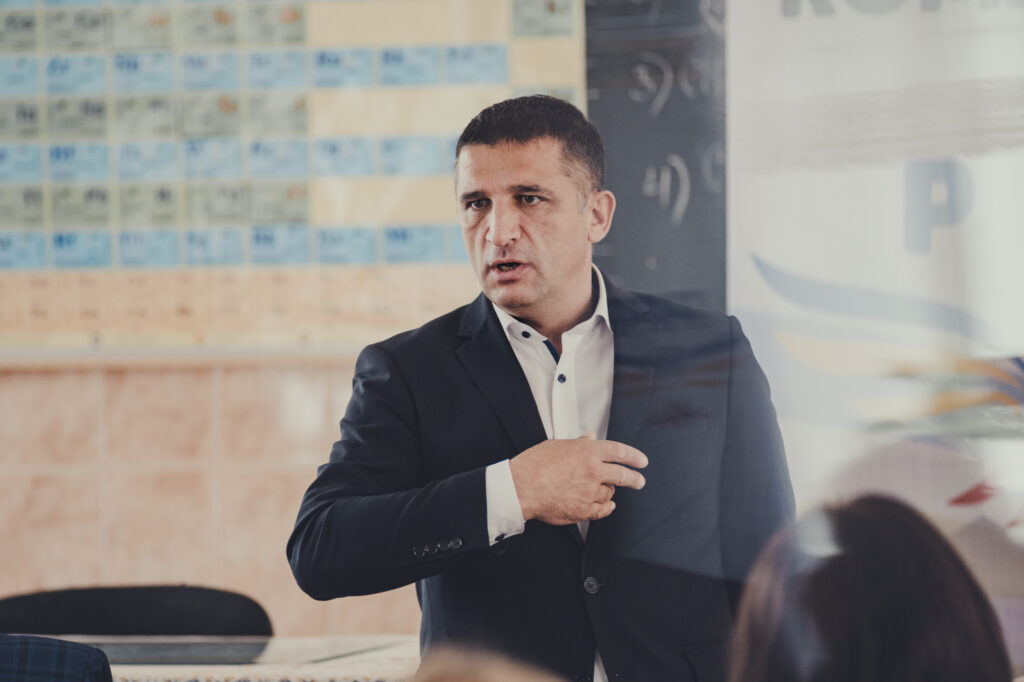
According to Turcanu, about 2 million lei were spent on the launch and operation of the Radio Moldova Comrat radio station. It is currently broadcasting in Comrat and Vulcanesti, and will soon begin broadcasting in Ceadir Lunga. The radio station also received a grant from the Japanese government – 21 million lei for the modernization of equipment.
Further, Tsurkanu drew attention to the fact that the television and radio company increased its audience in 2025. “TV channel Moldova 1 is the most watchable channel in Moldova with a share of about 20%. This is data from both the official meter and the iData study,” he said.
His deputy, Andrei Zapsha, noted that the Moldova 1 and Moldova 2 TV channels produced more than 17 thousand hours of content in a year, and the Moldova 1 audience grew by 4%. “This is modest growth, but we were able to stabilize the downward trend and return to organic growth,” he said.
The most watchable, according to him, are the news program Mesager, the morning show Buna Dimineata and the election debates.
Another deputy director of the company, Cornel Ciobanu, said that four Teleradio-Moldova radio stations broadcast 70 programs, including for children, music lovers and people with special needs. Eight of these programs are new. He noted that there are no official measurements of radio ratings in Moldova, but opinion polls show that Radio Moldova remains the most popular radio station. The average listener spends about 114 minutes a day with her, and her online audience has grown by 11-22%.
He also said that Radio Moldova Comrat produces 55% of the content in the Gagauz language and 45% in Russian.
What interested the deputies?
Socialist MP Adela Raileanu noted that, judging by the ratings, Moldova 1 TV channel is the third most popular in the country, and asked about the salary formation system. “How are salaries set? What is the salary of creative workers? – she asked, adding that, according to her information, salaries vary from 10 thousand to 70 thousand lei.
Turcanu replied that the minimum salary in the company is 8 thousand lei, and the average is comparable to the average in the economy. “We have higher salaries, but not like that. There are 10-15 people from the editorial area with higher salaries (which are fixed) based on their performance,” he said.
He was also asked about the opposition’s access to the public television channel. Turcanu replied that “there is a separate report – with names, dates and those who did not come.” And he added that “After previous discussions, I invited Vladimir Voronin twice, and he refused twice.” According to Turcanu, Alexander Petkov, Ion Cheban, Vasily Kostyuk, Renato Usatii and Ion Chicu were also invited to appear on the air.
“We do this because we don’t want this criticism to hinder our development. Development means a balance of opinions,” said the head of Teleradio-Moldova.
Deputy of the Alternative faction Gabriela Cuneva drew attention to the company’s annual budget – about 250 million lei, which is comparable to the entire advertising market of the country. According to her, Teleradio-Moldova’s expenses per viewer are about 100 lei, while in the private sector it is 20–30 lei. Also, according to her estimates, one hour of production costs the company about 60 thousand lei, while private TV channels cost 5-8 thousand lei.
Turcanu responded that “numbers alone are not enough” to assess the social value of content. “All states invest in public media,” he added.
Kuneva noted to this that she analyzed the cases of Germany and Great Britain, where the effectiveness of public media is also compared with private ones.
In response, Tsurkanu said that one of the company’s tasks is to combat propaganda, including the expansion of editorial policy in Transnistria. He also explained the high costs: Radiocomunicații alone receives about 27 million lei annually for broadcasting, in addition, the company has a symphony orchestra on its staff.
Zapsha added that the deputy’s calculations are incorrect: taking into account two TV channels and four radio stations, the real cost of producing content, according to his estimate, is about 5 thousand lei per hour. The leaders of Teleradio-Moldova also noted that the budget of a similar television and radio company in Estonia is five times larger than the budget of Teleradio-Moldova, and in Montenegro – twice.
Subscribe to our Telegram channel @newsmakerlive. Everything that is important to know right now about Moldova and the region quickly appears there.
Want to support what we do?
You can contribute to quality journalism by supporting us one-time through the E-commerce system from maib bank or by taking out a monthly subscription to Patreon! This way you will become part of changing Moldova for the better. Thanks to your support, we will be able to implement even more new and important projects and remain independent. No matter how you support us, you will receive a small gift. Follow the link to become our partner. It’s not difficult and even pleasant.