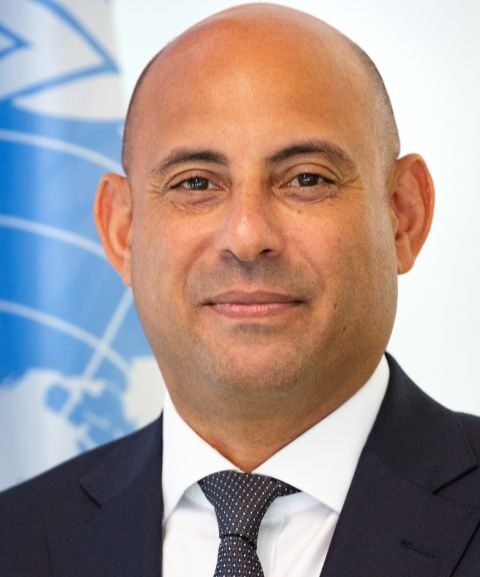
by Simon Stiell
As the head of UN Climate Change, I’m used to making the case for clean energy. Today, the latest fossil fuel energy crisis is doing that job for me, including in the Caribbean.
War in the Middle East has exposed a brutal truth: fossil fuel dependency rips away countries’ sovereignty and security, putting food prices, household budgets, business bottom lines, and entire economies at the mercy of geopolitical shocks. In a world of “might is right” politics, which gets more volatile every month, the costs of fossil fuel subservience are spiralling out of control.
The latest conflict has unleashed what the International Energy Agency has called “the greatest global energy security threat in history,” constricting oil and gas supplies and sending prices soaring. Inflation inevitably follows, with higher bills for families and businesses of all sizes.
The impacts are reverberating around the world. The World Food Programme predicts that the war could push global hunger to record levels this year. It projects an increase of 21% in food-insecure people for West and Central Africa and 17% for East and Southern Africa. An increase of 24% is forecast for Asia, 16% in Latin America and the Caribbean, and 14% in the Middle East and North Africa.
Incredibly, however, some argue that the correct response to the current crisis is to slow the shift to renewable energy, and instead double down on the cause of the turmoil — fossil fuels. This defies economic logic and basic common sense. With geopolitics in disarray, energy price chaos will keep happening again. Continued dependence on fossil fuels would leave countries forever lurching from crisis to crisis.
It would also mean our planet keeps heating up, supercharging climate disasters like mega storms, droughts, fires and floods. These are already ruining millions of lives and tearing shreds out of every economy. In October 2025, when Hurricane Melissa made landfall in Jamaica, killing 45 people, it caused an estimated US$ 8.8 billion in economic losses. Another 46 people died in Haiti, and a total of one million people were displaced across all affected countries, according to the World Meteorological Organisation. If temperatures keep rising unchecked, this will only get worse. And yet the cause – fossil fuels — continue to receive trillions of dollars in subsidies globally.
The good news is there is a clear solution to both the climate crisis and the fossil fuel cost crisis: accelerating the shift to clean energy systems — where renewables supply the power, backed by modern grids and storage, and clean technologies, like electric vehicles, replace polluting alternatives.
Sunlight and wind don’t depend on narrow and vulnerable shipping straits. Clean energy like solar and wind power allows nations to regain control of their economies and security, insulating their countries from global turmoil, while creating jobs, cutting pollution, improving health, boosting stability, and lowering costs. Renewable power is the cheapest there is.
Many countries are already seizing these benefits and protecting themselves from climate disasters. But others need support. Over US$2 trillion flowed into clean energy last year — twice as much as fossil fuels — but very little went to the vulnerable developing economies that need it most.
That must change urgently. Richer countries — and the international financial institutions they have — have every incentive to ensure that affordable finance flows to developing nations for climate action. Because a truly global shift benefits us all.
In our interconnected global economy, climate disasters hammering supply chains are a major inflation driver for every country. But through international climate cooperation, countries are creating an alternative to the strong-arm politics dominating international affairs.
At UN Climate Change, we’re supporting this cooperation. Our annual conferences, known as COPs, have driven major progress — roughly halving the projected rise in global temperature, transforming global energy markets and supporting resilience-building. But we need to go far faster, and to ensure a just transition, including for economies and communities that have historically relied on fossil fuels.
The quicker countries move, the greater the gains, and the climate cannot wait. So, we’re increasingly focussed on turning climate commitments into real-world outcomes that benefit billions more people. Last year at COP30 in Brazil, US$1 trillion was committed to grids and storage to invest in modern, clean energy systems. This year’s COP31 in Türkiye will drive further progress across sectors and regions.
Today’s turmoil underscores the urgency of this work. Climate cooperation is a cure for the chaos of this moment. Clean energy and climate resilience are essential, not despite global instability but because of it.
Simon Stiell is the Executive Secretary of UN Climate Change