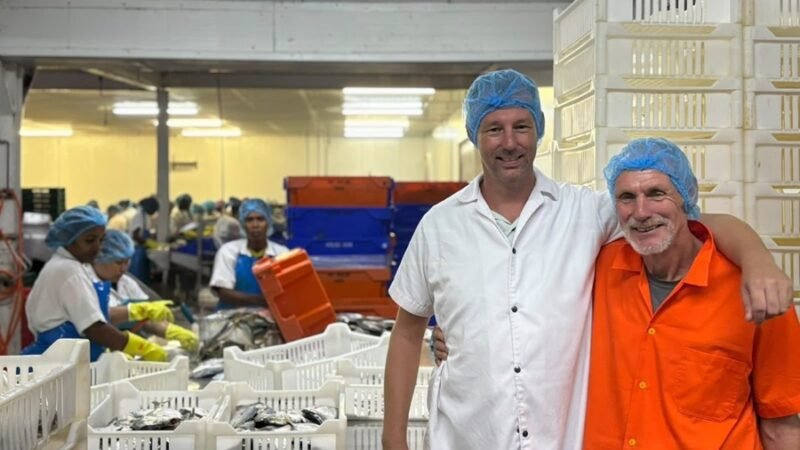
Father and son Murk and Gerben van der Veen successfully run the Holsu fish processing company in Domburg. From fleet maintenance to fish processing and from water purification to product development: the duo does everything under one roof. And that has been paying off for years, because the empire continues to grow. They told their story to the Dutch Schuttevaer.
Sculpture Else van Andel
Murk van der Veen left for Suriname with three brothers in 1989 on the ship with the appropriate name ‘De Vier Gebroeders’. To achieve this, the quartet had to brave a fourteen-day journey across the Atlantic Ocean. “That was quite an adventure, of course, because we didn’t really know what we were getting into. At that time it was a much bigger challenge than it is now,” says Murk.
“Especially with the high oil prices, you have to get more and more out of your fish to be able to break even”
Gerben van der Veen
“The coast of Suriname slowly came into view, but we were of course not familiar with it. It became shallower and shallower and we thought: ‘This is going to be dangerous, we will soon get stuck’. We also had no nautical chart of the area. We then waited a long time for another ship to enter the river. ‘If he can do it, we can do it too’, we thought. And so we arrived in South America for the first time.”
Internationally operating company
Van der Veen has now lived in Suriname for over 34 years and Holsu has grown into a large and internationally operating company. About twenty years ago, his son Gerben (44) joined the company and decided to cross the pond for good.
Where Holsu used to only consist of a storage facility for the fish that came off the fishing boats, today the fish processing company is almost bursting at the seams. Fishing boats sail out three times a month, staying away for five to eight days and bringing back between 25 and 35 tons of fish. All that fish and the fish that father and son buy from local fishermen are processed at Holsu itself.
Some fish species are frozen and shipped whole, other fish are processed on site into, for example, surimi for the Japanese market. “About fifteen years ago, Japanese entrepreneurs approached us with the question if we wanted to produce surimi, a type of washed minced fish, for them,” says Murk. “We then built a small factory for that. That was quite a job, because of course we didn’t know anything about that.”
Father and son can now talk about good cooperation with Japan, where many ten kilos of blocks of minced fish are exported very regularly. Special products such as fish balls are still made from it.
Furthermore, Holsu ships fish such as catfish, baracudas and snappers to Volendam, from where they are re-exported within Europe. Yet another part of the fish catch, such as fillets and snappers, goes to Jamaica and is intended for tourism.
(read more below the photo)

All-rounders
Unlike in the Netherlands, at Holsu, which ships around ninety containers per year, everything is actually carried out under one roof. “In the Netherlands you have a fishing boat and then you outsource everything. The processing of the fish, any repairs to the ship and so on. We do everything, absolutely everything, ourselves, simply because outsourcing is not an option here. So we do all electricity, technology, fish processing, fleet maintenance and even water purification with our own people.”
Due to the great expertise required to keep the Surinamese company and its fleet running, Holsu employs a lot of people. More than 150 employees are responsible for processing the fish and the technical service consists of at least twenty people. In total, the company employs more than two hundred people. “This work is also extremely labor intensive,” emphasizes Murk, as he makes his way past the stacked crates full of fish in the warehouse on Sir Winston Churchillweg. “You have to imagine that every fish, big or small, passes through someone’s hands.”
But directors Gerben and Murk are also still rolling up their sleeves. “You also learn a huge amount from it. What I have learned here in twenty years, I would never have learned in the Netherlands,” says Gerben firmly. “For example, when machines from abroad were installed here, I would watch. Or I would learn how something worked by looking it up or watching videos about it on YouTube. I now know every corner of the company.”
(read more below the photo)

Artificial Intelligence
Recently, Gerben also likes to be informed and inspired from another side: the side of artificial intelligence (AI). “AI is really a solution for this. You can learn and discover everything – and very quickly – and it saves you an incredible amount of time. I have developed my own system using AI for, among other things, clocking in for our employees. Something that would otherwise have cost a lot of time and money.”
Although Murk and Gerben have more than enough tasks on their to-do list, innovation and expansion remain the order of the day. “There is still enough to be made from your fish, including that part of the fish that is normally thrown away, for example. Not so long ago, we therefore started producing fish nuggets, fish burgers and tasty treats. Intended for supermarkets, but we also sell them in the shop that we recently opened on our premises. And that is actually going very well. I wouldn’t say that it is our wish to expand even further, but you actually have to. Especially with the high oil prices, you have to you get more and more out of your fish in order to break even,” Gerben admits.
“We do everything, absolutely everything, ourselves simply because outsourcing is not an option here”
Murk van der Veen
Murk, who has been fishing all his life, agrees. “If the catch is good, there is still something left at the end of the line. But if the catch is less, as was the case a while ago, then we have to pay extra.”
Fortunately, an acquaintance of Murk and Gerben will join them at very short notice. “My brother might also want to join the company. He will come here for five months in November to try out whether it is something for him.”