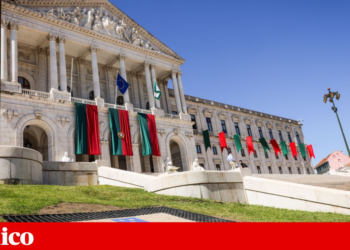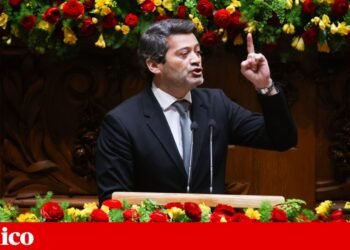
After the morning solemnityin which, in a Parliament painted with carnationswarned young people and called for transparency in party financing, António José Seguro divided the afternoon of his first 25th of April as President of the Republic between music, poetry and debate. He brought together a group of 25 young people with whom he renewed the commitment to form a “coalition”.
This Saturdaythe doors of the Belém Palace opened to receive almost two thousand people who, with carnations in their hands or on their lapels, painted the gardens red. Under the hot sun, many waited more than an hour in line to enter the official residence of the President of the Republic where, on this 25th of April, concerts and performances.
To open the celebrations, Paulo de Carvalho and his son, Agir, took the stage to sing the Revolution. As expected, the lineup included the song And After Goodbyethe initial password for April 25th. Then, this Saturday, as in the early hours of 52 years ago, they sang Grândola, Vila Morena. There followed a performance poetry by Alice Neto de Sousa, accompanied by Giulia Gallina. Maria Caetano Vilalobos, Maze, Muleca XIII and Sir Scratch starred in the performance “Palavra Futuro” and Raquel Marinho, accompanied on the piano by Filipe Raposo, performed the recital “the poem teaches to fall into freedom”.
Throughout the afternoon, António José Seguro, always with a carnation in his lapel, accompanied by his wife, Margarida Maldonado Freitas, dressed in bright red, were in the gardens, distributing greetings and taking photographs. Elsewhere, the President of the Republic received Rui Coimbras, president of the Federation of Portuguese Cerebral Palsy Associations, in audience. The meeting allowed Rui Coimbras to show Seguro equipment that allows people with disabilities to vote independently.
Seguro wants “coalition with young people”
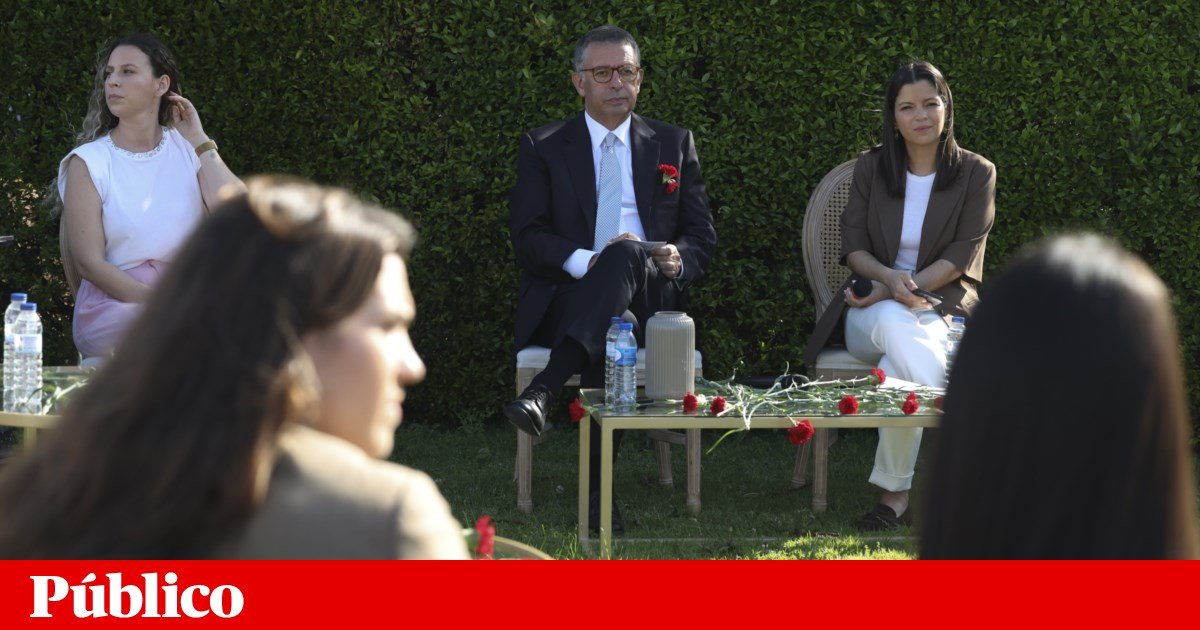
And if the first 25th of April began as President, speak to young peoplewarning that freedom cannot be treated “for granted”, António José Seguro ended the day listening to them. At the last point of a extensive programthe head of state wanted to “say very little” and “listen” to the 25 young people he invited to a debate in the gardens.
The young people were the same ones with whom, on the day of his inauguration as President of the Republic, he had a debate at the Higher Institute of Social and Political Sciences of the University of Lisbon (ISCSP).
On that day, said he wanted a “coalition” with youth and, this Saturday, he insisted on the idea. “It corresponds to my ambition and also to the priority of this mandate, to form a great coalition with young Portuguese people”, he highlighted, in a short intervention, before listening to the concerns and challenges launched by the youngest.
In interventions lasting around three minutes, young people — doctors, teachers, students, coming from Bragança, Fundão or the Algarve — They were diagnosing the country’s problems, making criticisms, making appeals, pointing out paths.
From the need for decentralization and combating territorial asymmetries to the lack of historical and political literacy among youth, to defending the reform of the electoral system, there were several topics brought up by the presidential guests. And without forgetting the dangers that democracy faces, namely misinformation or the distrust that part of the population feels in institutions. There were also those who dedicated their speech to crimes against women or the importance of deepening European integration. Furthermore, the head of state heard a correction: there is no one under 35 years old in the new State Council.
After listening to the 25 young people, António José Seguro addressed the dozens of people who were watching the conversation to ask if they “confirm or deny” that it is a “myth” that young people are not interested in the future of the country and have no ideas. And the assistance confirmed what the interventions had already shown.
Because he wanted to listen and not talk, the President of the Republic did not respond to the interventions, arguing that his role is to give youth the necessary “space”. “I will give voice to your proposals”, “ideas” and “your generosity”, he promised, pointing out that, behind the proposals brought by the young people, “values” and “principles” were seen.
And he renewed an appeal he had already made: “Change the policy to change the country”. “Enter politics”, he continued, pointing out that it is necessary to “dream again”. “I’m counting on you”, he stressed. And, responding to the challenge of one of the young people, who had suggested a new meeting for a year from now, he concluded: “One year is too late, it has to be sooner.”