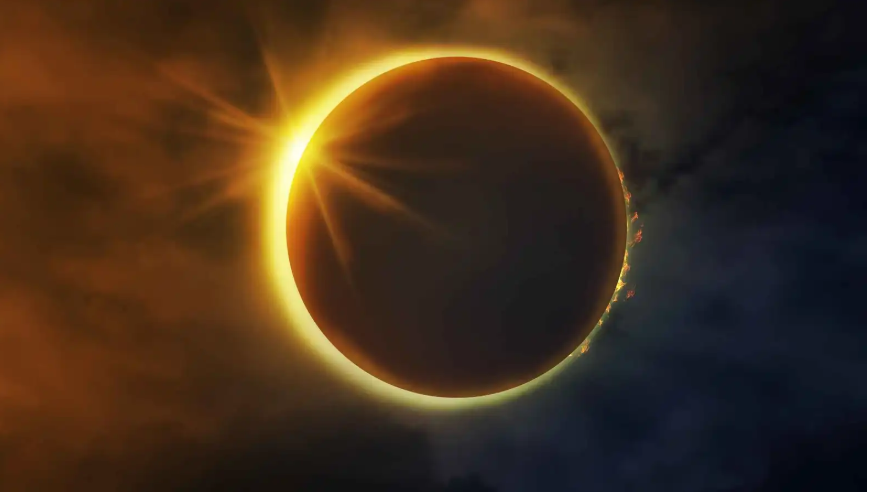
Astronomy enthusiasts around the world are preparing to observe one of the most prominent celestial phenomena in recent years, as August 12, 2026 will witness a total solar eclipse that is expected to attract the attention of millions of observers and researchers around the world.
According to international astronomical observation bodies and centers, this eclipse is the first event of its kind that can be seen from large parts of Europe since 2015, and it is also the first total eclipse to cross the European mainland in more than a quarter of a century.
A total eclipse occurs when the Moon passes directly between the Earth and the Sun, completely blocking its disk for a short period, causing the day to turn into semi-darkness in areas within the path of full visibility. In some locations, this exceptional moment may last for more than two minutes, giving scientists a rare opportunity to study the solar corona surrounding the Sun.
The phenomenon is not limited to the disappearance of sunlight, but is also accompanied by noticeable changes in the surrounding environment, such as the dimming of natural lighting and a slight drop in temperatures, with the possibility of some stars and planets appearing in broad daylight.
The path of the total eclipse extends through areas from Siberia, Greenland and Iceland to northern Spain, while areas such as Scoresby Sound in Greenland and the Spanish cities of Burgos, Valladolid and Leon are among the best locations to view the event.
As for the Arab world, most countries will not be within the full range of vision of the eclipse, while some distant regions may witness limited partial phenomena that are difficult to observe clearly.
Astronomers describe this event as one of the most dazzling natural phenomena, not only for its visual beauty, but also for the scientific opportunities it provides to study the sun and its surrounding atmosphere. Experts also stress the necessity of using glasses and specialized observation equipment when observing the eclipse, warning against looking directly at the sun as it may cause serious damage to the eyes.
As its date approaches, the world awaits what has become known among those interested in astronomy as the “Great Eclipse,” a rare cosmic spectacle that combines scientific astonishment with natural splendor.