There was a general regional and international trend towards unifying Yemen and disarming the militias. In this context, the “Prevention of Aggression” battle was launched, with the aim of uniting the country.
In fact, the local tribes – directly supported by the coalition of “Sunni giants” – advanced significantly, turning the tide for everyone. Fighting spread to several cities and regions, including Mawza, Al-Khokha, Al-Hudaydah and Taiz.
But what happened suddenly?
Tel Aviv understood that the situation in Yemen was heading towards a decisive conclusion and that the battle was drawing to a close.
So what exactly happened?
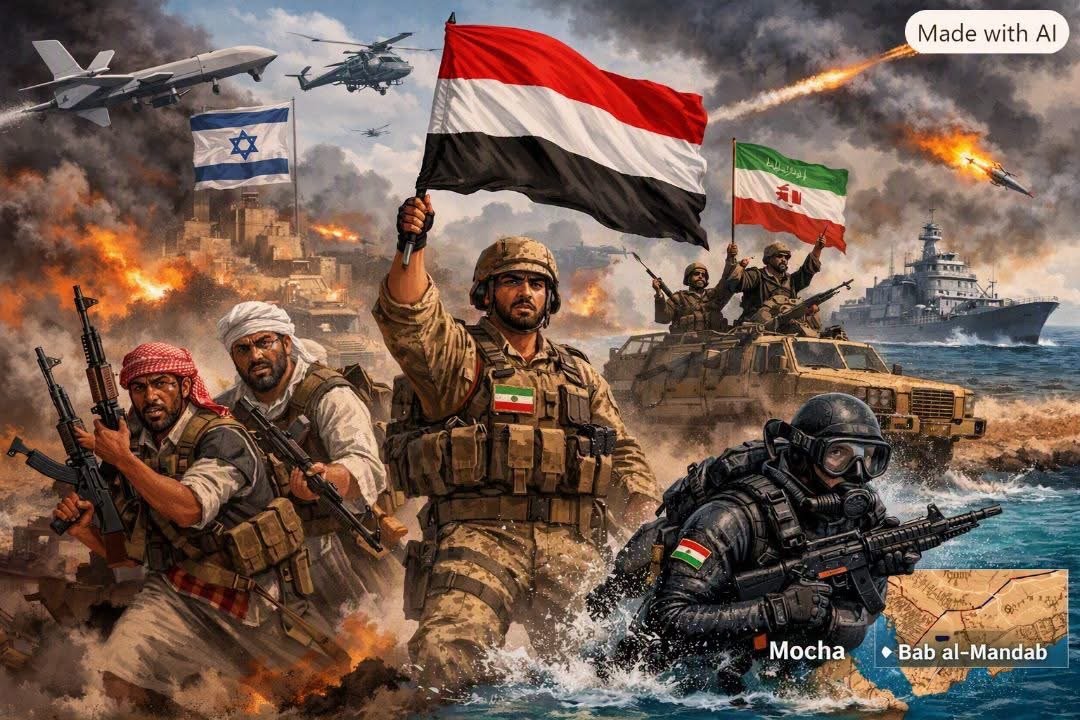
In the city of Mocha – located about 80 kilometers from the Bab al-Mandab strait – there was a large military force of about 50,000 armed men; Yemeni press reports indicate that this force was supported by the United Arab Emirates.
However, just before the tribal advance – backed by Saudi Arabia, covered by Turkey and including “special operations divers” (known as “human frogs”) – reached the area, these forces suddenly withdrew, handing the entire region over to the Houthis.
This is reminiscent of the events in Syria during the revolution, when the Free Syrian Army was fighting against the Islamic State; whenever the Free Syrian Army tightened its siege on the group, the latter surrendered its territories to the deposed regime.
But the story does not end here.
Yemeni press sources report Israeli pressure on the state supporting these forces to prevent the handover of Mocha to the advancing troops, fearing the Arab tribes could reach the Bab al-Mandab Strait. As a result, Lt. Gen. Tariq Abdullah Saleh—nephew of the late Yemeni president Ali Abdullah Saleh and commander of a militia of 50,000 fighters apparently allied with the army and tribal forces—abruptly surrendered his positions to the Houthis, while some commanders fled through the Bab al-Mandab Strait to Somalia.
But why exactly Somalia?
This is the crux of the matter. Reports in the Yemeni press indicate the presence of an Israeli operations center in the Somaliland town of Berbera – a facility that oversaw the entire scenario, from start to finish.
Briefly:
In Mocha, according to reports and testimonies circulating in Yemen, Tel Aviv, Tehran and another state formed an alliance to confront the coalition of “Sunni powers”.
Ultimately, however, tribal forces and the Yemeni army will re-emerge as a major force after the betrayal in Mocha and the situation will change radically.
As for the unification of Yemen, the decision has already been taken; the obstacles we see today will not stop the progress of the tribes and the army, because the clock in Yemen cannot be turned back.
Let’s wait and see.
Ali Tami