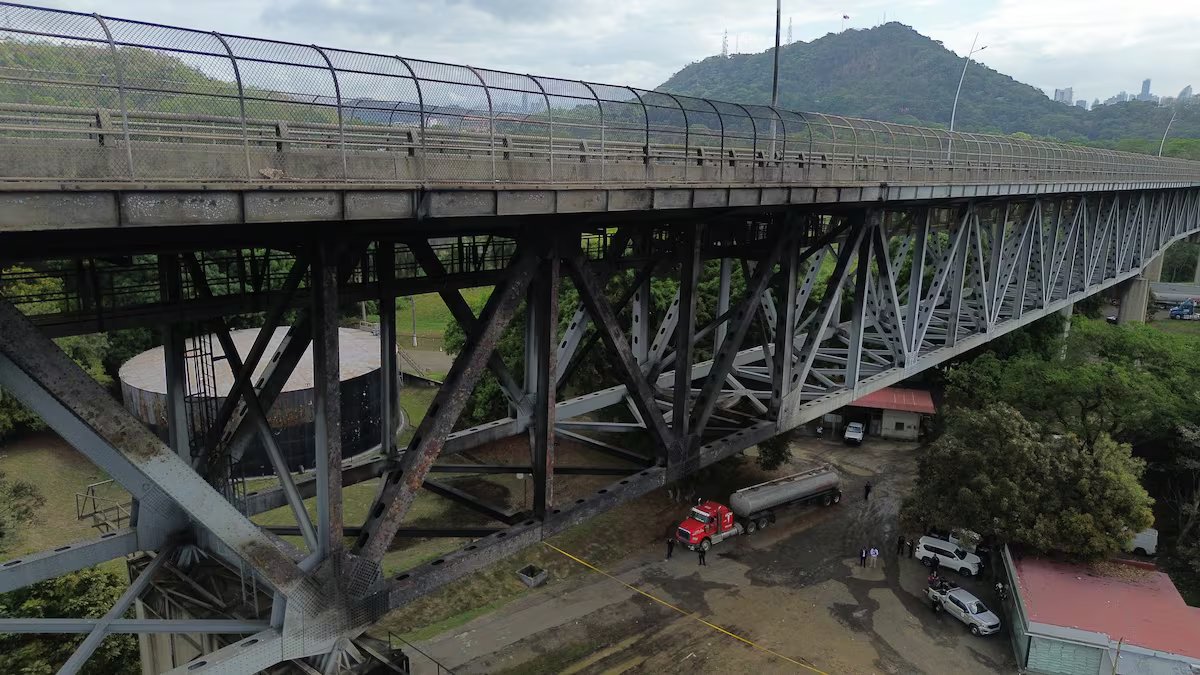
Although the technical report ruled out critical structural damage after the explosion and fire, specialists warned that the real risk for the Bridge of the Americas would be to postpone the repairs and measures recommended for a 63-year-old structure through which some 65,000 vehicles circulate per day.
After the presentation of the technical report on the Bridge of the Americas, prepared by specialists from the USA in conjunction with the Ministry of Public Works (MOP)experts agree that, although no critical structural damage was detected after the explosion and fire of three tanker trucks on April 6, it is key to urgently execute the recommendations raised.
The report, which included on-site inspections, acoustic analysis and thermal imaging at key points of the structure, determined that there are no immediate risks to the safety of the bridge.
However, it does establish priority actions to guarantee its conservation, including structural scans in the concrete piles—especially in pile 10—, the repainting of the areas affected by the fire, the installation of extensometers to monitor deformations and the evaluation of the tread slab and carbon fiber, with a view to a possible replacement in the medium term.

For the former director of Maintenance of the MOP, Diana Peña, Short-term measures must be implemented without delay. He warned that subjecting these works to bidding processes could delay them unnecessarily. “If it is short-term, it must be executed immediately; administrative processes usually take months,” he said.
Peña recalled that the bridge—with more than six decades of operation—requires a comprehensive intervention based on evaluations already contracted, which is why he considered it unnecessary to start new studies without first knowing those results. In addition, it recommended that, once the works are defined, they be carried out comprehensively, even if they involve partial or total closures, as long as an efficient alternative route is guaranteed.
In that sense, he warned about the importance of reinforcing the maintenance of the Centenario Bridge, which would function as an alternative route in case of restrictions on the Bridge of the Americas. He stressed that this structure also requires periodic attention, especially in its cable-stayed systems, and advocated for a State policy on infrastructure maintenance.
“Everything that is not maintained deteriorates and ends up costing more,” he warned, citing as a reference that countries like Japan allocate between 2% and 3% of the value of their bridges to their annual conservation.

For his part, structural engineer Rogelio Dumanoir, member of the Society of Engineers and Architects of Panama (SPIA)agreed with the recommendations, but was more critical when pointing out that the bridge currently does not have a permanent maintenance crew or essential systems such as drinking water, compressed air or the service gondola used for inspections at the bottom of the structure.
“Without permanent maintenance, in an environment as aggressive as Panama’s climate and with lax control of loads, the threat to the integrity of the bridge will continue to be constant,” he warned, recalling his experience as an inspector during the reversion of the bridge to Panama and in rehabilitation processes.
Dumanoir also questioned the proximity of the fuel tanks in the La Boca sector with respect to the bridge structure, pointing out that Panamanian regulations establish minimum distances for this type of facilities. In his opinion, the proximity of these tanks—where the incident occurred—represents a risk that must be reviewed, especially after an event that involved explosions and high temperatures near critical infrastructure.

Bridge will have high precision sensors
In the evaluation, in which specialists from the Technological University of Panama (UTP), the Panama Canal Authority (ACP)MOP engineers and American experts, specific findings on the road structure were identified.
Among the results, it was determined that in the concrete pile there was only minor lamination, without structural impact. No deformations or failures in the connections were detected in the metal superstructure, and the damage was mainly limited to the paint. Likewise, the tread slab did not present any damage to its integrity or to the adhesion of the carbon fiber.
The authorities highlighted that these results coincide with previous evaluations carried out by Panamanian technicians, which reinforces that the bridge remains operational and safe under current conditions. However, they reiterated the need to maintain the restriction of 10 tons per vehicle—in force since 2009—as a preventive measure to avoid further deterioration of this key infrastructure for the country’s connectivity.
At the moment, The MOP reported that it will install high-precision sensors in 28 points of the Bridge of the Americas, with the aim of monitoring in real time the behavior of this important structure, key for mobility between the capital and the interior of the country.
The strain gauges —devices that allow measuring deformations at specific points on a surface—will record normal movements and vibrations of the bridge, which will facilitate constant monitoring of its operation.

Edwin Lewis, director of Studies and Designs at the MOP, explained that this plan is part of a comprehensive maintenance program that also includes changing the paint in affected areas and the progressive replacement of rivets with bolts.
Since November 2025, a complete technical evaluation of the bridge has been carried out, independent of the incident that occurred recently, without any effects having been identified to date. that compromise the stability or safety of the structure.
Currently, around 65 thousand vehicles circulate daily on the Bridge of the Americas, while the Centenario Bridge registers around 25 thousand, according to the latest capacity released this week by the entity. This difference responds, to a large extent, to the strategic location of the Bridge of the Americas, which connects more directly with the city and facilitates access to work centers, health services and other activities.
This scenario shows the high demand for this infrastructure and reinforces the importance of projects such as the Fourth Bridge over the Canal and Metro Line 3, which will contribute to improving mobility in the metropolitan area.
Lewis emphasized that the maintenance, monitoring and reinforcement of the structure will continue, with the aim of guaranteeing its proper functioning and the safety of users.