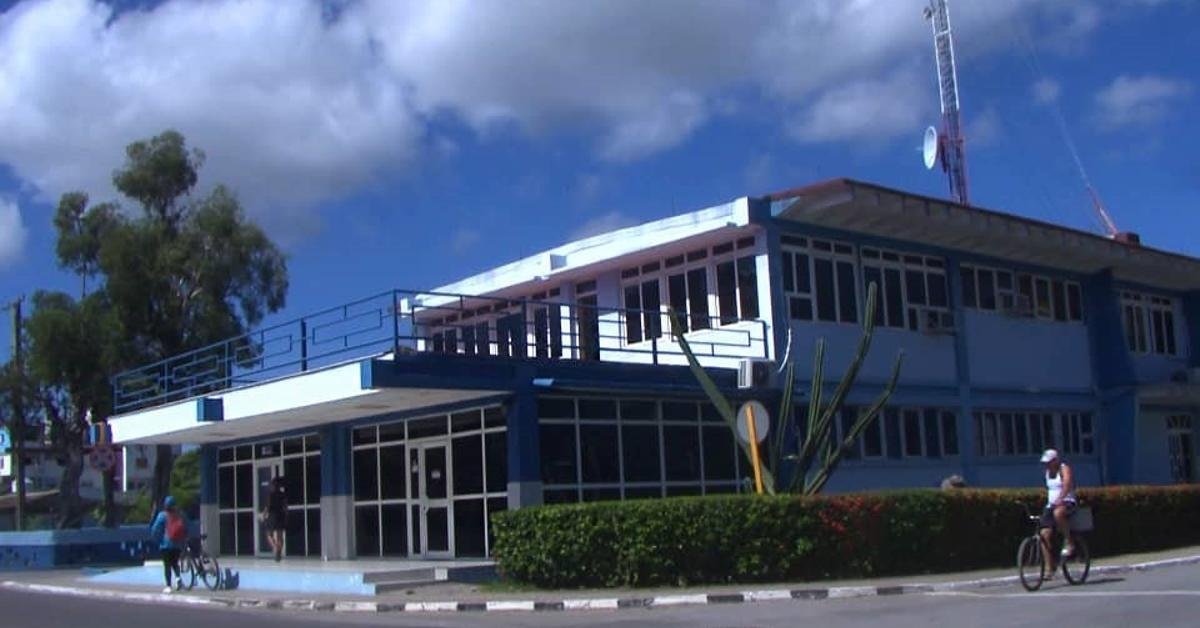
Havana/This Sunday, the Isle of Youth began to recover part of its communications after five days practically isolated from the rest of the world due to a breakdown in the two main roads that connect the special municipality with the national network. The restoration, however, is still partial and the work continues, as confirmed to 14ymedio in Customer Service at the Cuban Telecommunications Company (Etecsa).
“We inform that, since this morning, there has been a gradual recovery of voice and data traffic on the Isle of Youth, indicators that reflect that the network already allows communication to be established,” the state monopoly said this Sunday on the Facebook account of its Pinera subsidiary. “Work continues to consolidate the restoration of services,” the company added.
For her part, an operator confirmed to this newspaper that the repair has not yet been completed. “The work continues and will depend on how the weather behaves in the next few hours,” he explained, without specifying when the fault can be considered completely resolved.
The official meteorological report indicates that on the afternoon of this Sunday there will be an increase in cloudiness in the western area of the Cuban archipelago and the possibility of thunderstorms will increase. However, little waves are forecast on the south coast, right in the area where the damaged lines are located.
The restoration, however, is still partial and the work continues, as confirmed by Etecsa to ’14ymedio’
The gradual recovery of communications puts an end, at least partially, to five days in which the double insularity of the pine trees also acquired a digital dimension. The breakdown left mobile phones and internet access out of service.while a good part of the landlines only allowed local calls to be made. For those who had relatives in Havana, other provinces or abroad, the lack of communication was practically total.
Last Tuesday Etecsa detailed that the damage was in “the two main connection roads” that link the special municipality with the rest of the Cuban network. The company referred to them as “maritime links” and assured that its specialists worked alongside Geocuba employees in the repair, under “complex conditions.” During these days, however, he has not detailed the causes of the breakage.
The company enabled alternative connections to keep local authorities in touch, but did not offer a similar solution for residents. On Thursday, when this newspaper called Etecsa to ask about a possible restoration date, the response was very different from this Sunday: “We don’t have a date yet, stay connected through official channels.”
The situation caused numerous complaints, especially from Pineros who live outside the municipality and suddenly lost contact with their families.
The situation caused numerous complaints, especially from Pineros who live outside the municipality and suddenly lost contact with their families. It also revived criticism about the lack of alternatives in the event of a breakdown of this type and the vulnerability of essential infrastructure for a territory separated by sea from the main island.
The episode is especially significant because in 2008 Etecsa connected the Isle of Youth with the national network through an underwater fiber optic cable. The infrastructure began operating shortly before the passage of Hurricane Gustav, which on August 30 of that year hit the territory with category 4 and winds exceeding 200 kilometers per hour. Despite the destruction of poles, towers, homes and electrical networks, the connection with the rest of the country was maintained. The official press then celebrated that “communication never failed.”
Eighteen years later, without a hurricane of such magnitude hitting the Gulf of Batabanó, the Pineros have spent five days without one of the most basic tools of daily life: being able to call, send a message or connect to the internet.