On Valentine’s Day in 2024, Texas Gov. Greg Abbott interrupted a private dinner with his wife to take a call from Elon Musk.
Mr. Musk had recently been rebuked by a court in Delaware, where his two largest companies, SpaceX and Tesla, were incorporated. A judge had voided Mr. Musk’s pay package at Tesla, valued at about $50 billion, calling it “an unfathomable sum.”
Mr. Musk had spent years building a close relationship with the Republican governor. Now, on the call, Mr. Musk wanted to know if Mr. Abbott would support Mr. Musk’s businesses if he incorporated them in Texas, rather than Delaware.
“One hundred percent,” Mr. Abbott said, recounting the story in a 2025 speech at the University of Texas School of Law.
Mr. Musk followed through, further entwining his trillion-dollar electric vehicle maker, Tesla, and his two-trillion-dollar rocket maker, SpaceX, with the state. Mr. Musk had been cultivating Texas’s Republican leaders since he moved there in 2020. For a while, the strategy paid off handsomely. Mr. Abbott held up his end of the Valentine’s Day bargain, awarding Mr. Musk and his businesses at least $1.7 billion in grants, tax breaks and other incentives in the past two years, according to a New York Times analysis.
Since this month’s election, Mr. Musk’s big bet on Texas has become vulnerable. Texans voted out many of his political allies, including Mr. Abbott, even after Mr. Musk gave Republicans nearly $500 million nationwide.
But unlike his breakup with California six years ago, Mr. Musk, 55, cannot easily pick up and leave this time. He is far more embedded in Texas than he ever was on the West Coast, where he started his business empire.
Tesla and SpaceX control seven major facilities in Texas that span at least 20,000 acres, including a spaceport and a lithium refinery, as well as a 100-million-square-foot semiconductor facility that is under construction. Mr. Musk personally owns 1,000 more acres in the state. By one estimate, his companies employ more than 20,000 people in the state. And Mr. Musk has formed more than 90 private companies in Texas and bought multiple properties. He even started his own city, called Starbase.
Mr. Musk has become “omnipresent” across the state, said Mark Jones, a political science professor at Rice University in Houston.
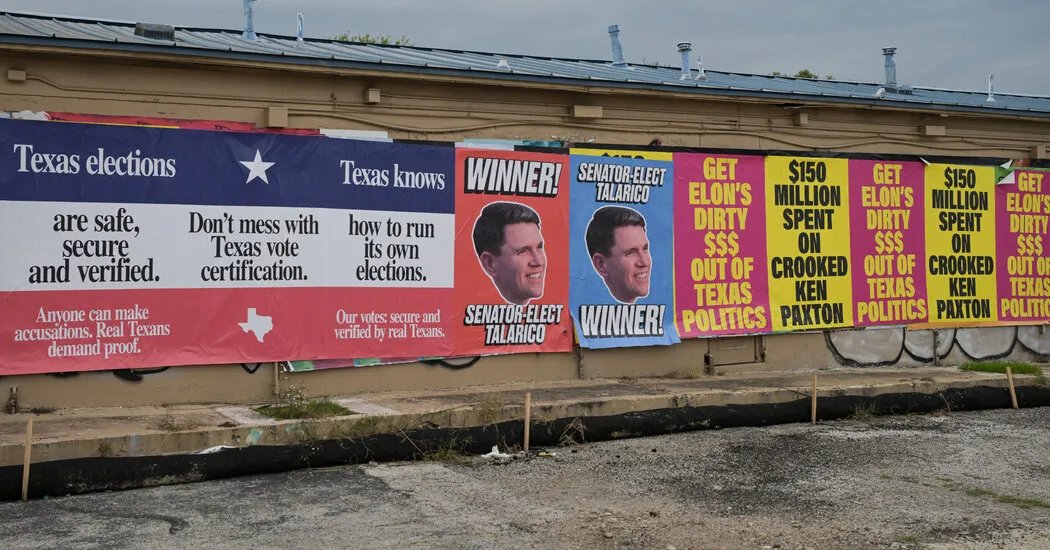
That means that for the foreseeable future, Mr. Musk may have to work with Texas Democrats, many of whom were elected after excoriating him on the campaign trail. James Talarico, the Democratic senator-elect, for one, said after the election that he did not intend to do Mr. Musk’s bidding.
Governor-elect Gina Hinojosa also took aim at Mr. Musk. In her first news conference as governor-elect, she announced that Mr. Musk’s attempts to buy a portion of a state park in South Texas near his rocket launch site — and her hometown — had been paused. In an interview with The Times, she took a more conciliatory approach, saying she welcomes Mr. Musk “but it needs to be about what a relationship can provide for Texas.”
Mr. Musk and his companies did not respond to requests for comment. SpaceX’s and Tesla’s shares fell after the election. Mr. Musk said earlier this month on X that those two companies “have prospered in Texas, because we were not constantly operating under an oppressive and extractive state government.”
‘We Love Texas’
Mr. Musk moved to California in the late 1990s, about a decade after leaving his home country, South Africa. In the early 2000s, he started SpaceX in Los Angeles and took over Tesla, opening a factory in Fremont.
But after pandemic restrictions in 2020 led to a fight with local officials, Mr. Musk told The Wall Street Journal that December that the state had become complacent with business competition and that Silicon Valley was stifling start-up creation, so he was leaving for Texas.
Mr. Musk and his advisers at SpaceX and Tesla immediately began building relationships with the state’s Republican lawmakers.
SpaceX hired Jeff Miller, a strategist who worked with former Republican Speaker of the House Kevin McCarthy, to help Mr. Musk make inroads across the state. Since 2020, SpaceX has paid Mr. Miller’s firm, Miller Strategies, more than $1 million, according to lobbying records. Tesla and SpaceX together use 10 more individual lobbyists in Texas, according to state lobbyist registrations disclosed this year.
Mr. Musk also developed a rapport with Mr. Abbott, who has led the state since 2015. In 2021, Mr. Abbott said in a CNBC interview that he spoke with the billionaire frequently.
“Elon consistently tells me that he likes the social policies in the State of Texas,” Mr. Abbott said.
Mr. Abbott approved a slew of incentives for Mr. Musk’s businesses. Last year, Mr. Abbott awarded SpaceX a $17.3 million grant for the expansion of its Starlink satellite-internet service facility in Bastrop County, just outside Austin. Mr. Musk has other operations in the county, including for his tunneling venture, the Boring Company, a company town called Snailbrook, and more than two dozen acres where he had planned to start a school system.
“We love Texas,” Gwynne Shotwell, SpaceX’s president, said in a statement at the time.
Mr. Abbott was also instrumental in greenlighting incentives for Mr. Musk’s mammoth semiconductor factory, known as Terafab, in Grimes County. The governor’s office announced a $30 million grant for the project in August, and has approved tax breaks estimated at more than $1.6 billion.
“Economic development incentives in Texas go through a rigorous statutory process with built-in review and accountability,” a spokesman for Mr. Abbott said.
‘Sympathetic treatment’
Mr. Musk and his companies enjoyed a string of wins in the Texas legislature in recent years when Republicans led both legislative chambers, a streak that is now in doubt.
After lobbying by SpaceX, Texas lawmakers voted last year to add spaceports like Starbase, the company’s rocket launch site in South Texas, to the state’s “critical infrastructure” facilities. A separate bill made it illegal to fly drones over Starbase and other sites like it.
SpaceX also won greater control over closing Boca Chica Beach near Starbase for rocket launches, despite the fact that the Texas Constitution protects access to public beaches. In a related lawsuit that went to the state Supreme Court involving the beach, Ken Paxton, the outgoing Republican attorney general and an ally of Mr. Musk’s, intervened in the court case to support SpaceX, and later cheered the ruling.
It’s “exactly what’s needed to ensure SpaceX has a safe and operational launch site,” Mr. Paxton posted on X. Mr. Musk spent more than $200 million trying to get Mr. Paxton elected to the U.S. Senate. He lost to Mr. Talarico. Mr. Paxton’s office didn’t return a request for comment.
While Republicans still control the State Senate, Democrats won control of the Texas House in the midterms. At minimum, that will create gridlock for any measure that Mr. Musk and his companies try to pass, said Mr. Jones, the political science professor.
“He can’t expect the same preferential, sympathetic treatment from state government,” Mr. Jones said.
‘Intimate and embarrassing’
Mr. Musk has tried to keep many details of his expansion across Texas a secret, aided by the state’s business-friendly records laws and Mr. Paxton, who enforces them.
In Texas, a business can weigh in on public records disputes and ask the attorney general to keep the information from the public. Now Mr. Paxton is being replaced by Nathan Johnson, a Democratic state senator who has vowed to investigate whether SpaceX has improperly received grants from the state.
Last year, The Texas Newsroom, a collaboration of public radio stations, requested communications between Mr. Musk and his businesses and anyone working for Mr. Abbott in an effort to understand their relationship. Mr. Abbott’s office argued the records should not be released because they would reveal policy decisions, including details of how the state entices companies to invest, according to responses to the requests reviewed by The Times.
The office noted the records could include “intimate and embarrassing” details about Mr. Abbott and Mr. Musk and his companies. SpaceX’s lawyer asked Mr. Paxton to withhold the communications; his office ruled that many of the documents could be withheld.
Mr. Abbott eventually released about 1,400 pages of records. All but about 200 were redacted.
Last month, Ms. Hinojosa sued Mr. Abbott in Travis County District Court for access to the emails, accusing him of breaking a state law that allows legislative representatives to view confidential records. She detailed the closeness of the two men, including Mr. Musk’s Valentine’s Day call, first reported by The Texas Tribune.
The Texas court agreed with her and ordered the records be released. Mr. Abbott, who has called the legal action “a sham lawsuit,” appealed the decision. A court ruled in his favor, blocking Ms. Hinojosa’s access to the records.
As she prepares to take office, Mr. Musk is still awaiting approval for an undisclosed amount of incentives on at least two major projects: a planned data center near its Starbase headquarters and a solar cell manufacturing plant that Tesla is building in Fort Bend County known as Project Crystal Sun.
Over the summer, officials representing Tesla asked the state for property tax breaks. They offered a hint at how they might respond to stronger resistance from Democrats: Without those incentives, “Tesla would be forced to further evaluate this potential investment outside of the state of Texas,” they said, according to state documents.