A seemingly minor election in a small Caucasus country achieved a miracle: align the interests of Donald Trump’s White House with those of the European Union.
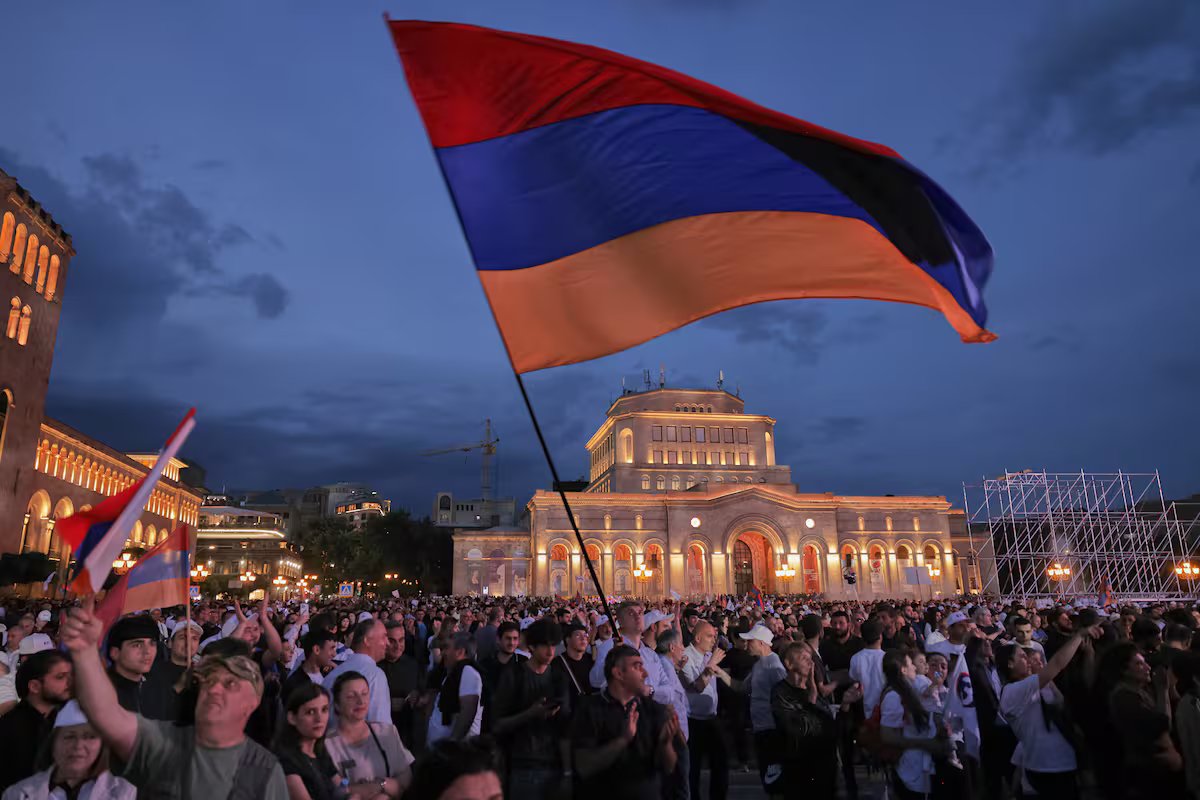
This Sunday’s parliamentary elections put at the epicenter of a geopolitical game to Armenia, a former Soviet republic of barely three million inhabitants seeking freedom from a historical dependence on Russia. A crossroads that also opens a question mark about the future of what boasts of being the only democracy in a neighborhood of autocrats.
Located in the south of the Caucasus, Armenia is a country that has historically been conditioned by its geography, an area in which the interests of three great empires converged and collided, the Persian, the Turkish and the Russian.
The bet of the current Prime Minister, Nikol Pashinyan, is to transform this location, which for decades was a source of isolation, into a strategic asset: a corridor connecting Europe with Central Asia, India and China, and shortening the distances between East and West. But to achieve this he must first overcome Vladimir Putin’s resistance, without bringing relations to a rupture that would be devastating for the Armenian economy.
Since the fall of the Soviet Union, of which it was a part, Armenia has depended on Russia to guarantee its security against Azerbaijan and Turkey, two countries it sees as an existential threat. In exchange, Russia, which today has a military base in Armenian territory, was guaranteed to be the Caucasian referee.
All that changed with the ukrainian war. Azerbaijan took advantage of the distraction of the regional arbiter to militarily recover Nagorno-Karabakh in 2023, an enclave that Armenia considers part of its territory. Russian peacekeepers stood by as a mass exodus of Armenians took place. For Armenia it was a traumatic defeat that changed the perception of Russians. According to analyst Richard Giragosian, the crisis was proof that Russia could become a “dangerously unreliable” partner.
With his political future seriously jeopardized by the humiliating military defeat, Pashinyan began to distance himself from Moscow. He froze Armenian participation in the military alliance led by Russia, multiplied contacts with Europe and the United States and began to defend a doctrine that breaks with decades of nationalism. Your idea of a “Royal Armenia” proposes abandoning ancestral territorial claims and concentrating on building a sovereign state within its current borders.
The reaction of the West
Western countries, which like Russia have a huge Armenian diaspora, responded to the call, and in recent weeks high-level leaders and officials paraded through Yerevan.
Last May, the first bilateral summit between the European Union and Armenia, with the top leaders present in Yerevan, marked a milestone for Armenia, an unprecedented diplomatic event that formalized the country’s ambition to join the bloc. The viral moment of the visit was when French President Emmanuel Macron personified this new union during a state dinner, singing a Charles Aznavour song while Pashinyan accompanied him on drums. Aznavour may have been born in France, but his real surname is Aznavourian, and to Armenians he is a national hero.

If the European deployment in Yerevan was forceful, the last to arrive to finish certifying this turn towards the west It was the Secretary of State of the United States, Marco Rubio. In a whirlwind visit to the Yerevan airport on May 26, Rubio signed a Comprehensive Strategic Partnership Letter and a memorandum on critical minerals.
Support from the White House has been explicit and total. Through his Truth Social platform, Donald Trump gave his “total and complete support” to the re-election of Pashinyan, whom he described as a “great friend and leader” who shares his vision of peace and prosperity for the South Caucasus. To clear up any doubts, the tycoon closed with a “Make Armenia Great Again”.
Trump had already committed directly to this region in August last year, when he received the leaders of Armenia and Azerbaijan at the White House to sign a peace agreement. One of the central points of this agreement was the launch of a broker called TRIPP which seeks to connect Azerbaijan with its exclave of Nakhchivan and with Türkiye through Armenian territory.
A strategic tool designed for American energy companies to access Central Asian resources while avoiding control by Russia and Iran. Since the tycoon has a weakness for leaving his name on things, the acronym TRIPP responds to Trump Route for International Peace and Prosperity.
The Russian reaction
The president of Russia, we already know, is not one to sit back and wait idly to see how the countries he considers to be in his zone of influence run towards the West. The Kremlin has deployed a pressure strategy that combines war warnings, economic sanctions and covert interference. Putin himself drew a dark parallel when he warned that Armenia could face a “Ukrainian scenario,” recalling that the conflict with kyiv began precisely with its attempts to get closer to the European Union.
But it did not stop at a rhetorical threat. Russia has already begun to apply surgical sanctionssuch as blocking the entry of emblematic products such as cognac, flowers, vegetables and Jermuk mineral water, due to dubious health reasons. For now the ace is kept up his sleeve. Armenia depends on a 85% of cheap Russian gasand Putin has made it clear that Armenia cannot belong to the EU and the Eurasian Economic Union at the same time. The consequence would be losing those preferential prices, which could cause a 14% drop in Armenian GDP.
In the electoral field, Russia is deploying the repertoire of interference that has already been seen in other countries, such as Moldova or Romania. According to a Reuters investigation, Moscow has stepped up its covert efforts through massive disinformation campaigns which include the creation of fake websites such as the “Yerevan1” portal and the use of bot farms to attack the government. The most daring thing, however, would be a $50 million plan to transport 100,000 Armenian citizens living in Russia to vote against Pashinyanseeking to tip the balance in an electorate where the margin of undecided people remains high.
Faced with this siege, Yerevan’s position is one of extreme balance. As expert Thomas de Waal of Carnegie Europe points out to LA NACION, Pashinyan is not looking for a traumatic breakup, but rather “continues to point out that he wants to see a gradual diversification rather than a total divorce from Russia.”
The pressure also carries a risk for the Kremlin itself. De Waal warns that if Moscow tightens the noose too much, it “risks a backlash from ordinary Armenians and the scenario of losing Armenia entirely if it takes extreme measures against the country.”
Risks
But he unrestricted Western support for Pashinyan entails latent risks for the very democracy they are trying to protect. Pashinyan is a skilled politician who, despite his defiance, meets frequently with Putin. This past Monday even the Russian president called him and wished him a happy birthday.
To ensure its political survival in this life or death choicethe prime minister has resorted to dubious strategies that refer to authoritarian manuals: from the arrest of opposition figures such as Russian-born tycoon Samvel Karapetyan on charges of sedition, to the detention of critical journalists and the use of state resources to mobilize voters.
The campaign has degraded into sordid exchanges, including clashes with the historic Armenian Apostolic Church and personal attacks that have soured the social climate. Some analysts see a real danger that Armenia, in its desire to distance itself from Moscow, will end up consolidating an elected autocrat if the international community does not condition its aid on institutional transparency.
“The victory of Pashinyan’s party in the elections is a necessary condition for the continued development of Armeniathe project to loosen ties with Russia and build stronger ties with Europe and the United States,” says De Waal. However, he adds that “It will be important to make your government more accountable and to make assistance conditional on building democratic institutions and norms”.