For months, the Democratic establishment had issued increasingly dire warnings that Dr. Abdul El-Sayed, a progressive Michigan firebrand who had never won an election, would struggle to win a swing-state Senate seat that the party could not afford to lose.
The state’s governor, members of Congress and attorney general lined up behind his primary opponent, Representative Haley Stevens, a centrist from a swing district. They argued that she could win the kind of tough races that are a hallmark of this battleground state, where voters have twice voted for Donald J. Trump and twice voted for Ronald Reagan.
On Tuesday, a slim plurality of Democratic primary voters disagreed, betting with their hearts on a candidate whose fiercely progressive message had thrilled a coalition of younger and college-educated liberals.
Now, as he heads into the general election, Dr. El-Sayed’s candidacy will pose perhaps the most consequential challenge to the party’s ascendant progressive wing: Can an insurgent candidate, with unabashedly left-wing positions, win in a moderate state?
Dr. El-Sayed will offer the first general election test of the competing theories of electability that have been debated among Democrats for nearly a decade. Since Senator Bernie Sanders exploded onto the national stage in 2016, progressives have argued that their party’s path to victory runs through a populist economic agenda that can attract a broad coalition of working-class voters. Centrists have pushed back, saying such proposals alienate the moderate voters the party must sway to win back areas where it has lost ground in recent years.
The narrow results hinted at the tough race ahead in November, when Dr. El-Sayed will face former Representative Mike Rogers, a Republican who left Congress in 2015. Dr. El-Sayed enters the general election without a strong mandate from Democrats, after more than half of primary voters cast ballots for other candidates. He performed best in wealthier, younger areas of the state, while Ms. Stevens did better in places with greater numbers of Black and working-class voters.
The close election underscored the divide between a loud, online liberal movement, which championed Dr. El-Sayed, and many of the voters who are the backbone of the party in battleground states.
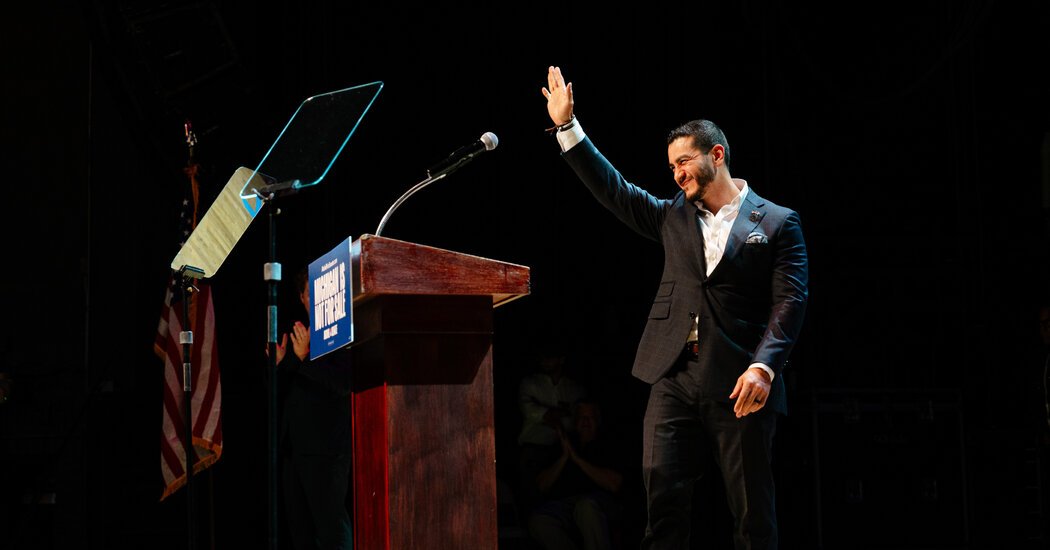
In a speech to supporters early Wednesday morning, hours before the race was called in his favor, Dr. El-Sayed attempted to frame his candidacy as bigger than traditional partisan divides. And he boasted about his ability to withstand an onslaught of attacks funded by outside organizations supporting Ms. Stevens.
“We are not a purple state. We are a state in need of a movement to take our politics back,” he said, speaking at his campaign headquarters in Detroit. “When we come through this, inshallah, we’ll have taken 70 million on the chin and kept fighting back.”
The stakes extend far beyond Michigan. Democrats must hold the state to have any chance of winning back control of the Senate. With Republicans holding 53 seats, Democrats must flip four Republican-held seats and keep all their own to win the majority. Michigan is the Democratic-held seat most at risk of going red.
At first glance, Dr. El-Sayed — a politically inexperienced, weight lifting, former public health official, who would be the first Muslim elected to the Senate — appeared an unlikely standard-bearer for his party. But he tapped into a sense of frustration in the primary electorate.
A charismatic campaigner, he fueled his candidacy with promises to lower costs, provide universal health care and ban corporate money in politics. Fluent in podcasts and social media, he crafted a platform centered on taxing billionaires, opposition to Israel and Medicare for all.
He also embraced people and positions that strategists say carries political peril in a moderate state like Michigan.
Dr. El-Sayed has campaigned with Hasan Piker, the Marxist streamer who critics say has stoked antisemitic sentiment — a charge he denies. Throughout his campaign, Dr. El-Sayed has called Israel’s government “evil” and its actions in Gaza a “genocide.” And he supports abolishing Immigration and Customs Enforcement.
“The risks with him are very obvious that he brings to the table positions that are just nonstarters with a general electorate,” said Lis Smith, a veteran Democratic strategist who worked for Mallory McMorrow, a more moderate Michigan Senate primary candidate who dropped out before Election Day. “That being said, he does connect a little bit more emotionally with the moment. He understands the anger that people across the political spectrum feel. ”
Many in the party’s liberal wing are looking even beyond November. A victory by Dr. El-Sayed would fuel their ambitions in the 2028 presidential race, providing evidence that progressive candidates can win not only in deep blue areas but also across the country. In 2028, Michigan will be among the first states to vote in the party’s presidential primaries.
“Now is an opportunity to chart a new path forward,” said Usamah Andrabi, a spokesman for Justice Democrats, a progressive group. “Clearly Democratic voters are on board with that new vision.”
But first, Dr. El-Sayed must win a tough race in November.
No Republican has won a U.S. Senate race in Michigan in over three decades. But Mr. Rogers has come close: Two years ago, he lost to Senator Elissa Slotkin by a razor-thin margin.
Even before the race was called on Wednesday morning, the Senate Republicans began showcasing their attacks, releasing a video ad calling Dr. El-Sayed “the most radical candidate in America.” The spot highlights his refusal to disavow a remark from his supporter Hasan Piker that “America deserved 9/11″ — a comment Mr. Piker has since called “inappropriate.”
Republicans will have plenty of money to make their case.
In April, the Senate Leadership Fund, the Senate Republicans’ main super PAC, pledged to spend $45 million supporting Mr. Rogers, its largest commitment for a seat not occupied by a Republican. Another conservative group, funded in part by the DeVos family, a conservative family that has invested hundreds of millions in right-wing causes, announced a $15 million commitment to Mr. Rogers.
Still, Republicans acknowledged their own challenges in running against Dr. El-Sayed.
“He really does have a true movement and a momentum,” said Ronna McDaniel, the former chairwoman of the Republican National Committee, who is involved with conservative organizing in the state. “Republicans can’t just sit back and say, ‘Oh, he’s a socialist.’ We have to define who he is and what this actually means.”
Mr. Rogers will also have to outrun a difficult national political environment for Republicans. Mr. Trump’s approval ratings reached an all-time low this week, fueled by an unpopular war in Iran, high gas prices and economic anxiety.
And Jeff Timmer, a former executive director of the Republican Party, argued that Mr. Rogers lacks the strong support among the MAGA movement to overcome such a political drag.
“Mike Rogers doesn’t engender any enthusiasm among the die-hard party faithful,” said Mr. Timmer, who is now an independent. “He’s not the kind of candidate that anyone in the Republican Party is going to crawl across broken glass to make sure they get across the finish line.”
Dr. El-Sayed has also shown an ability to survive a barrage of attacks. His race against Ms. Stevens was the most expensive Democratic Senate primary in U.S. history, with spending topping $98 million. More than $30 million was spent in an effort to defeat him by the super PAC arm of the American Israel Public Affairs Committee, the country’s most influential pro-Israel group.
All told, Ms. Stevens had about a 9-to-1 spending advantage over Dr. El-Sayed, according to data from the media tracking firm AdImpact.
The Democratic candidates traded increasingly nasty barbs in the run-up to the primary vote. Ms. Stevens and her supporters accused Dr. El-Sayed of being vain, sexist, antisemitic and encouraging “distinctly anti-American sentiment.” Dr. El-Sayed and his supporters said she was a puppet of AIPAC and unqualified, mocking her voice and appearance.
To win in November, Dr. El-Sayed must now reach beyond those voters and build a coalition that includes the moderate and independent voters who supported Ms. Stevens.
The effort to unify Democrats around his bid began in the early hours of Wednesday, even before his victory was certain.
“Tomorrow we begin to mend fences,” he said in his speech. “Whatever happens tonight, we have a responsibility to ensure that we unite to make sure that Mike Rogers never sees the inside of the U.S. Senate.”
Some of that work will depend on whether Dr. El Sayed, now the Democratic nominee, can embrace a party he has often attacked.
Ms. Smith said his eagerness to highlight the ways Democrats have failed helped fuel his primary bid. But now, she said, he must pivot.
“Sometimes he shows a little more joy in fighting Democrats than Republicans,” she said, “but hopefully that shifts in the general election.”