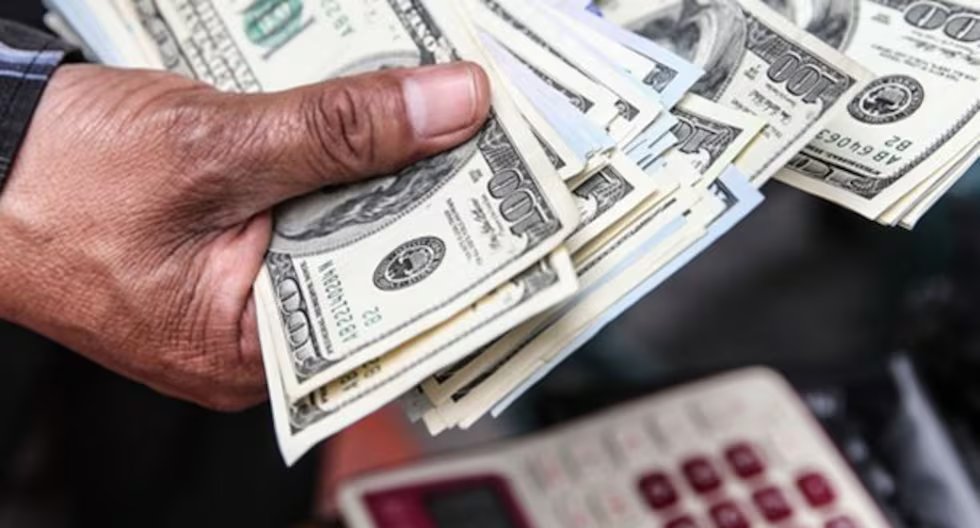
On Tuesday the dollar closed at S/3,394 according to the Central Reserve Bank of Peru (BCRP). During the exchange session, the exchange rate fluctuated between S/3.38 and S/3.40. While on Wednesday the dollar climbed to S/3.44, and until around 1 pm, it had risen by more than 1.49% compared to the previous day’s close, according to Bloomberg.
In the local market, the MSCI nuam Peru General indicator fell from 54,198.18 points on Monday to 54,015.53 points this Tuesday and the MSCI nuam Peru Select Capped 15% went from 1,398.51 points to 1,383.78 points at the close of Tuesday. This Wednesday, the Lima Stock Exchange (LSE) shows negative indicators at the beginning of today’s session, in a context in which Wall Street presents mixed indices.
The General Index of the Lima Stock Exchange (LSE) falls 3.10%, going from 54,015 to 52,339 points.
LOOK | Mining concessions, Reinfo and paperwork: what actions does mining expect from the new Government?
Marco Contreras, head of analysis at Kallpa SAB, commented that the market has been internalizing the partial electoral results, waiting to know the candidates who will go to the second round.
Along these lines, Leonardo Baptista, head of Advisory at Sura Investments, maintained that the market remains cautious in the context of the vote count.
“Although there is already a clear leadership in first place, second place is still in dispute between several candidates, which generates caution in the markets,” he said.
Contreras mentioned that there are indicators such as the ISH MSCU Peru and global ETF (EPU) where a fall has been reflected this Tuesday. According to Baptista, there was a slight correction of approximately 0.5% in this indicator.
LOOK | Wall Street closes in green ahead of a possible new round of negotiations between the US and Iran
In turn, Luis Falen, professor at the Faculty of Economics and Finance at the Universidad del Pacífico, mentioned that at the international level there were favorable causes, but that the local situation had greater weight in the exchange rate.
“The dollar as measured by the DXY index has retreated, Treasury bond yields have fallen and the price of oil has fallen. This scenario should have encouraged our currency to strengthen,” he explained.
José Silva, Senior Strategy Associate at Inteligo, added that this slight growth in the exchange rate is explained by the fear that there may be a candidate with ideas different from those of the free market advancing to the second round.
Baptista commented that the behavior of the dollar for the following days will depend on the final results of the first round. As uncertainty reduces, there would be clearer movements in the markethe added.
Specialists point out that a greater impact may be generated by advancing an anti-system candidate to the second round, on the exchange rate and the stock market.
LOOK | Jorge Chávez Airport prepares commercial expansion: new stores, brands and restaurants
Contreras pointed out that, as in other electoral periods, the market “corrects a little” when an anti-market candidate advances to the second round, while exchange rate movements will depend on the flow of the polls.
For its part, Falen added that the outlook for 2021 is different at the exchange rate level, because the sol had appreciated against the dollar prior to the electoral period. due to the weakness of the dollar internationally, the price level of commodities, the interest rate differential in Peru compared to the United States Federal Reserve, among others.
In turn, Silva and Baptista indicated that there is also a different international context than 2021, due to the presence of a bicameral system where there is a Senate that can serve as a counterweight to the government and moderate the market reaction.