Author: Kit Yuen
*All photographs by Kit Yuen – kityuen.co.uk @kityuen_
The first thing you notice in Dano is that it looks like a portal into the distant past. This wild and untamed village, isolated by the high mountains of Tusheti in Georgia’s north-eastern province, seems forgotten by all except God. You’d be forgiven for believing that you’d stepped into the feudal era, were it not for the solar panels leaning against ancient stone walls.
The next thing you notice is the eyes that have made peace with a loneliness known only in the high mountains. The proud faces of people have aged along with their stone ruins. Their hands are calloused from tending sheep and barbed fences, and their voices are hoarse from smoking, shouting, and loud singing during supras, feasts where love and anger take turns or happen all at once.
And there I sit at one of those supras, an overwhelmed Londoner armed with Google Translate and wondering whether I am in bigger trouble from gulping that eighth shot of Chacha down my throat, or from “accidentally” spilling it.
It’s the end of September, and at the end of the table, lit dimly only by a buzzing headlamp, I watch Bairam, the elder of the feast and most experienced of the shepherds. Each of his laughs brings out equal parts of joy and pain – he’d broken his rib yesterday. I asked him if he would still be able to drive the herd down the mountain to their winter pastures in Alvani, lower Kakheti. Having gained the experience last spring en route from Alvani to Dano, I offered to lead from the front this time.
“A dog doesn’t die from a limp,” Bairam frowns in response. It is a phrase I’d often heard from him before.

***
Levani “Bairam” Tataraidze can easily be recognised from afar by his slow, hunched limp as he labours across the landscape. He is sometimes wrapped in a Nabadi, a sheepskin overcoat used by shepherds since antiquity. His weathered face, etched with a distant, pensive expression, is full of contours and grey hairs. He takes his nickname – “Bairam” – from a Muslim festival, yet he is anything but festive. The shepherd is more stubborn than his goats, which we’d chase up the length of Kakheti last spring til our voices and legs gave out.
But beneath his temper and weariness lies a gentle, kind, devoutly religious man who dutifully leads his flock to better pastures. A “Good Shepherd” whose complexities I am determined to understand, despite the language barrier.

Born in 1965, Bairam grew up in the saddlebags of a donkey. “Our legs would go numb, we’d be crying,” he laughs. Bairam was no stranger to hardship and discomfort. There were no roads into Tusheti back then, and annual sheep migration between winter and spring pastures was a 200-kilometer journey taken on foot with supplies, young lambs, and children all strapped to donkeys and horses.
Raised by a family of shepherds who had passed down the profession for five or more generations, he had already taken part in transhumance when he was too small to even walk.

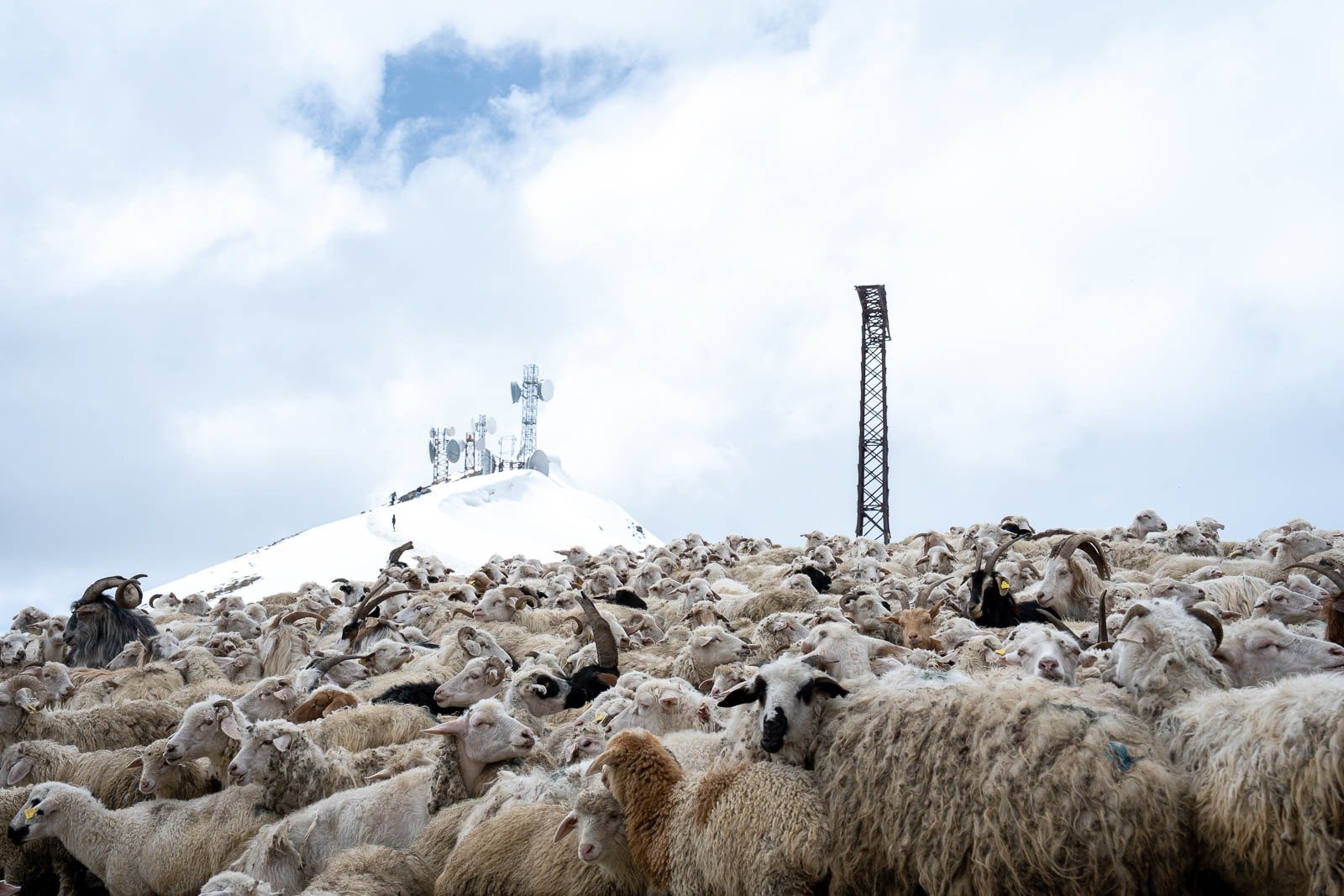
Transhumance is the semi-nomadic pastoral practice of seasonal livestock migration. Unchanged through centuries, it is a lifestyle with dwindling practitioners who stubbornly choose to hold onto this simple yet difficult life, which has more in common with our shared nomadic ancestors than us, the city dwellers. The mountains act as a natural barrier to social and technological changes, so the impassable cliffs of Tusheti have for centuries insulated the shepherds from the never-ending political upheaval of the rest of Georgia.
The herds are driven to the lowlands in September for winter pastures. With spring, they return to fresh mountain grass. The journey from Vashlovani, Georgia’s far east, to Dano spans 250 kilometers and takes 10 days. It crosses the notorious Abano pass, known as one of the most dangerous roads in Europe.

***
Bairam jokes about tourists looking for museums in his village. “Look, the entire Dano is a museum!” he laughs.
Among the stone dwellings, pagan monuments still stand faithfully. Bairam, a devout Christian, crosses himself before the crucifix, yet on the same day, leaves coins to the pagan Gods. But stubbornly clinging to pre-Christian, ancient traditions whose purposes lie half forgotten reveals a rebellious spirit more than a conservative one.

The local architecture and folklore, too, tell stories of battle and rebellion.
Nestled among these dwellings are ancient defensive towers, erected centuries ago to repel invaders. “Tushetians are always the first standing on the front lines,” the old shepherd says. “We are known across Georgia as fierce warriors”.
It’s easy to assume that locals owe their strong features, work ethic, and lively spirits to these harsh landscapes. But Bairam offers a more complex explanation.
“They don’t really know when people started migrating into Tusheti, but people moved from the valleys centuries ago to protest landowners and rulers.” These outlaws and bandits, once seeking freedom from the kingdom to make their own way from the law, would go on to become its fiercest defenders.
That reputation earned them the favour of the Kakhetian kings, who granted them lands around Alvani, a valley some 100 km across the pass. From the 16th to the 19th centuries, the valley would evolve from plain fields used for winter pastures into a permanent residence for many Tush.

***
Life in the mountains is fraught with danger. Bears and wolves frequently sneak into campsites, taking off with lambs. The weather and the pass often kill many. Each loss means fewer funds to care for the herd and survive the year.
The first night I met the shepherds back in spring, I lay drunker than I’d ever been within an hour. The stars spanned across the night sky faster than usual. I was later woken up by sheep nibbling on me, to Bairam’s restless shadow dancing by the campfire, occasionally casting his torch to watch for bears and escaped lambs.

It was not until Abano Pass came into sight the next afternoon that I learned what had kept the worried shepherd up all night. Spring had come late this year. Landslides were sweeping across the path ahead, and the snow on the infamous pass was still two meters high, covering the only route into Tusheti. The two hired hands, who had driven ahead to set up campsites with their tractor, carrying supplies and sheep too weak to walk, had to turn back, while I and the two Tataraidzes, Bairam and his cousin Misho, loaded the baggage onto our backs and a single donkey.
The shepherds, usually loud and animated, now fell silent.
Where one sheep panics, the entire herd follows to certain death. One lamb had already been swept off the pass by raging rivers from the late snowmelt. Misho, the headstrong owner of the herd, had erupted furiously, screaming at the gods as it fell into the abyss.
I’d asked Bairam if he could cross the icy pass, noting his hobbled footsteps.
“A dog doesn’t die from a limp,” he frowned with determination. It was the first time I’d heard the phrase, but with no internet signal, I couldn’t translate it then.


***
By his adolescence, Soviet-era infrastructural changes had begun to penetrate Bairam’s seclusion. A road into Tusheti was built in the 1980s, and many shepherds quickly traded their horses for tractors. Traditional farming methods were abandoned; scythes were left to rust as winter supplies could now be bought in the lowlands. Traditions were traded for convenience. The herds swelled, and the shepherds thrived.

Soon, however, those same roads would carry Bairam to lands far more distant. In the late Soviet years, the young Georgian was conscripted and deployed to Hungary to enforce the communist regime in Europe.
But greater changes awaited him as he found himself back home. In the late 80s, the national liberation movement took force in Georgia, and by 1991, the country regained independence. Having found himself a stranger in an unfamiliar homeland, Bairam had to rediscover what it meant to be Georgian.

***
Bairam remembers the dark and lawless years that followed. Before long, he found himself once again shepherding, struggling to make ends meet, only this time, it had become even harder. The Mkhedrioni, a paramilitary group that had taken over the country, roamed the regions and robbed its population. Shepherds were no exception: Bairam recalls how he and his father, in their most difficult year, were attacked and held at gunpoint by the group members. They’d lost everything, their entire herd, and had to start over, bankrupt.
Political instability and a lack of state support took their toll, and herd numbers in Tusheti fell from 120,000 to 20,000. Things looked bleak, were it not for the support of their community.

***
I quickly became familiar with Dano’s supras. Our table – sometimes stretching from six in the morning til 3 am the next night, interrupted only by herdwork and afternoon naps, was a modest one. It held bread, tomatoes, garlic, melon, and unlimited alcohol. Sometimes a respectfully prepared lamb, too.
The toasting was endless, and wine inevitably revealed raw emotions, often loud and volatile. “Believe it or not, they are talking about love,” I watched in disbelief as half the village held Bairam’s cousin back from striking him. Whatever the actual story, Misho’s panduri demands attention and diffuses tension.
The Tush love to sing – about love, homeland, and conscription to foreign lands. Stories of their ancestors and the dreams of the living blur indistinctly into song, and music is unlike anything I’ve encountered before. At times, their voices rise thunderously across the valley; at others, they carry a fragile, almost unbearable tenderness. The music here feels profoundly liberating, allowing these weathered shepherds, for a fleeting moment, another medium to express their restrained emotions of longing, regret, and passion for love.

***
Change is disruptive and often comes at a cost. In Georgia, climate change, political change, modernization, and globalization have all arrived at once, leaving locals struggling to keep up. The shepherds claim climate change has not affected their lives much, yet they acknowledge that things are different. “The seasons come at slightly different times, but regardless, the herd moves when the weather dictates.”
This year’s unexpected snowmelt and landslides are hard to ignore.
“Winters are not as harsh as before, though recently there was a year where the snow was waist-deep. The weather has changed a lot. What’s bad is that rain for the crops has become much rarer,” they say.

***
Overgrazing and land degradation have become a concern, despite herd sizes now 85% smaller than in Soviet times. The political situation does not help. In lower Kakheti, the land-lease system dictates herd sizes – small herds are unprofitable, and large herds are incentivised, further degrading soil health. Throughout the world, farmers begin to realise the destruction brought by modern industrial farming and re-embrace traditional methods, advocating sustainable practices that allow the land to recover and rewild.
The shepherds say that the state offers no support for costs such as mandatory vaccinations and that promised funding never reaches them. They say that incentivisation of larger herds is orchestrated by those linked to legislators, alongside export restrictions which suppress prices, and with them, the historically rebellious mountain communities.


When asked about the future of shepherding, Bairam gives me a bitter look of uncertainty. “The world is changing quickly, and we just try to keep up with it. We work and struggle, and they make decisions that make it harder for us. We deserve better.”
Uncertainty brings emigration. Bairam’s three daughters all live abroad in Europe and the U.S., as economic opportunities for women in Tusheti are limited. The men who stay struggle to find partners and to pass down their knowledge. The shepherds have sworn not to allow any of their children to follow in their pastoral footsteps, knowing that there is an easier life elsewhere. What troubles Bairam is the thought that their traditions, deeply cherished by mountain folk, may now abruptly disappear.

***
Bairam’s face had been carrying its all-too-familiar brooding expression during the supra. He’d stayed like this for some time, settled so deeply into his chair that he seemed like part of the furniture itself. His frozen presence defies the turbulent life around him.
As the dust of the past slowly settles, the world that emerges outside is barely recognisable from the shepherd’s humble beginnings. In a modern, globalised Georgia, embroiled in political turmoil and shaped by forces beyond its control, shepherds like him struggle to find a place for themselves and have no other choice but to accept change and adapt. If the planned guesthouses are built, Dano, always true to itself, may someday indeed become a mere museum of what it once was.
In times marked by hope and promises, but also turmoil and uncertainty, Bairam turns to what is familiar, holding onto the stability of his heritage and tradition. The sheep, drink, storytelling, and music continue to connect him and others to the grounding legacy of his ancestors. Support from the local community becomes a powerful means of navigating change and reinforcing identity.

***
Tomorrow, we’ll begin driving the sheep back down the mountain.
Back at the September supra, I repeat Bairam’s saying – “a dog doesn’t die from a limp” – reassuring that my own bruised hip (and ego), and his unruly horse that kicked me the day before as we transported cheese, won’t bring a premature end to their centuries-long tradition. Levani looks up, and his laugh brings him back to us as the creases in his brows evaporate.
“A dog doesn’t die from a limp,” he agrees. He raises his glass for another toast, and we all follow suit. We plan to start the journey at dawn, and why not bless the road with five more glasses?
“Long live the shepherds, the farmers, and all those who labor hard and strive. To those with tough lives and tough mindsets, who struggle but fight to keep their identity and way of life.”