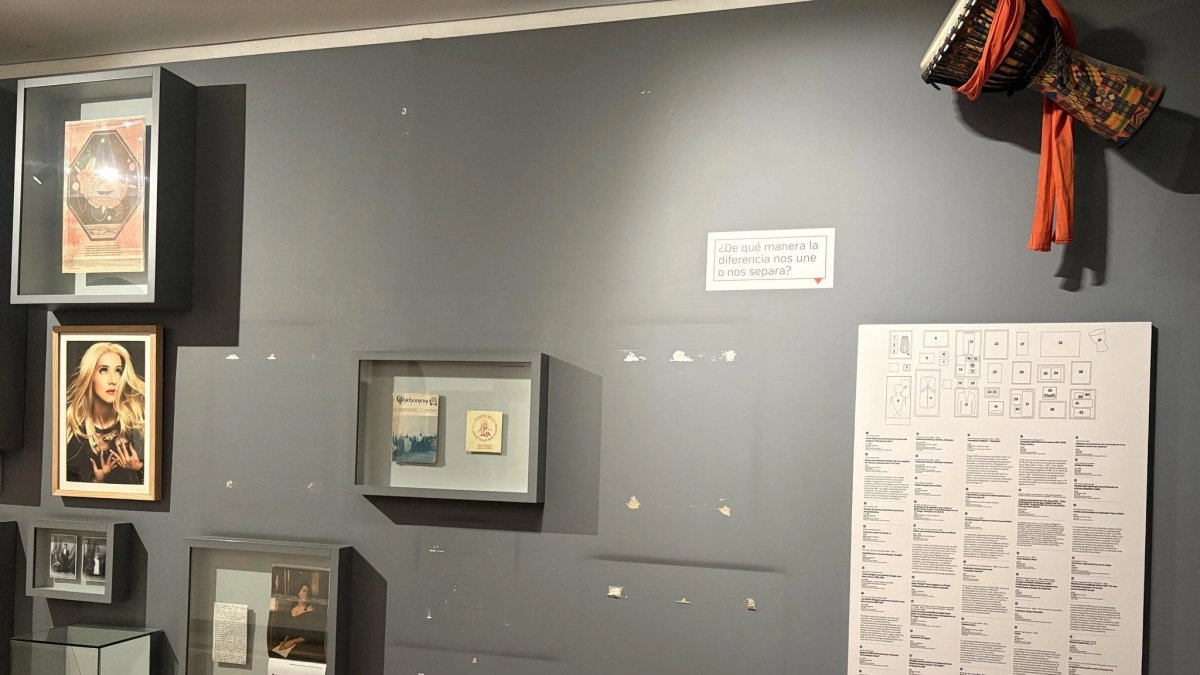
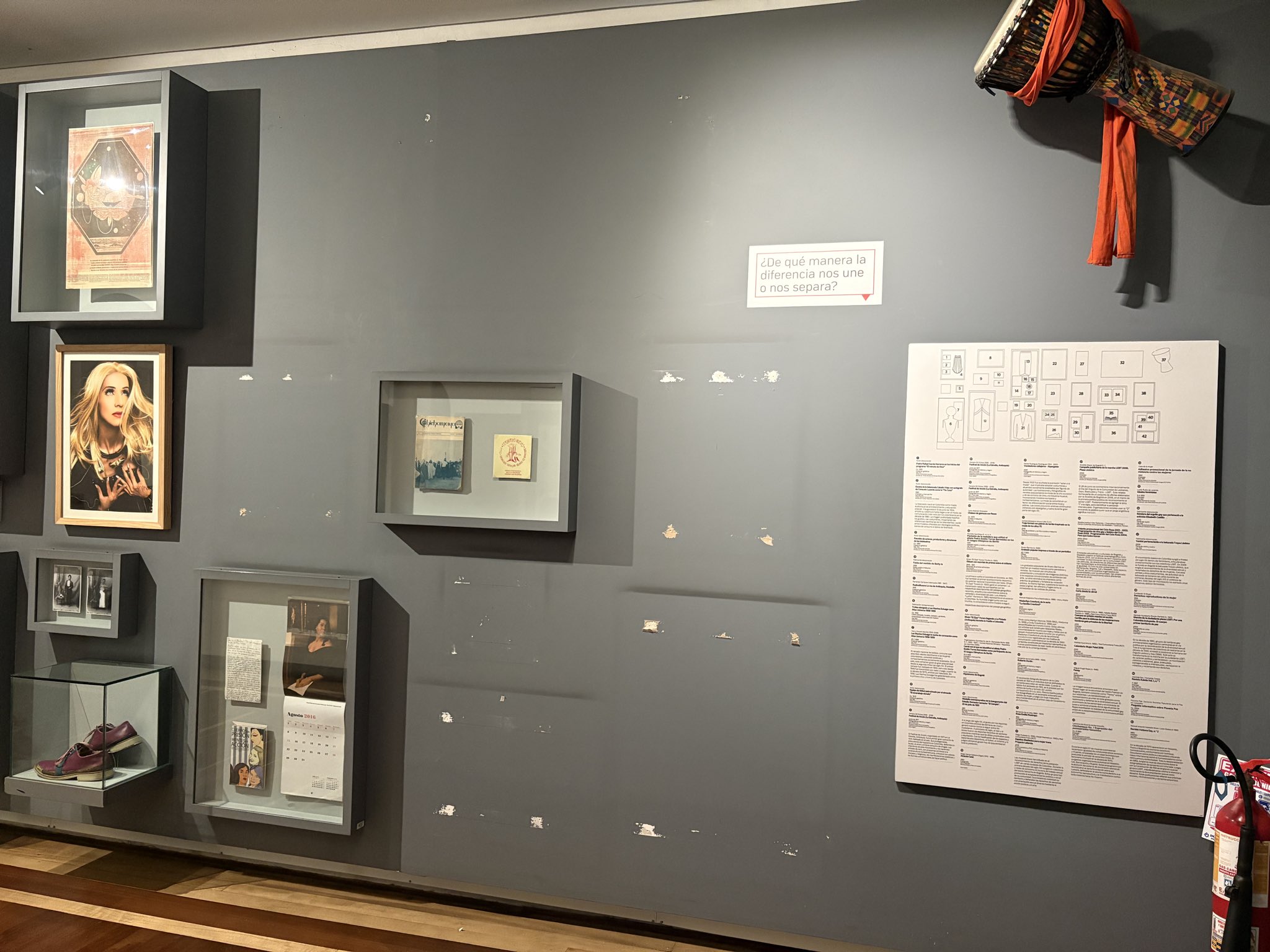
The walls of the second floor of the National Museum, in Bogotápreserve the marks of what hung on them: the rectangles left by the paintings and the signs with their descriptions. At least 30 posters, photographs and objects were removed from three rooms. They were pieces about the history of the LGBTI and feminist movements, the victims of political violence against the Patriotic Union (UP) and the Peace Agreement.
READ ALSO
The clearing took place on Thursday, October 15, the same day that President Abelardo de la Espriella officially visited the Ministry of Culture and presented it as the epicenter of a “cultural counterrevolution.” There he spoke of “an open, determined and patriotic fight against wokism”, to which he attributed the purpose of transforming the moral, cultural and social foundations of the West and of perverting values, family tradition and national identity.
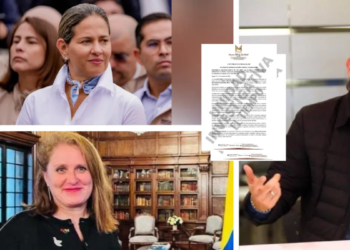
During that visit he announced that the Ministry of Culture, Arts and Knowledge will be renamed the Ministry of Culture and Heritage, and ordered Minister Paola Holguín to remove from public spaces representations that he considers an exaltation of terrorism. He expressly mentioned Carlos Pizarro. Until now, the exact number of withdrawn works or the reasons for the decision have not been confirmed, although this coincided with the presidential announcements.
‘Make society’ was the most affected room. From there came at least ten objects about LGBTI history and feminist movements: the gay pride flag that belonged to the activist Elizabeth Castillo, the poster of the advertising campaign of the 2006 LGBT march, of a lesbian nature, a printout on reproductive rights from the Sí Mujer Foundation, Humberto Rincón Perfetti’s photograph of the full citizenship march “For an inclusive Colombia” and a copy of number 2 of the magazine La Ventana Gay, by Manuel Antonio Velandia and León Zuleta, an Antioquian activist murdered in 1993.
In front of that room The presidential campaign poster of Bernardo Jaramillo Ossa, UP candidate, also disappeared. murdered in Bogotá on March 22, 1990 by paramilitary groups, in alliance with sectors of the State. At his side was that of Carlos Pizarro, commander of the M-19 who led the demobilization of that guerrilla and was assassinated on April 26 of the same year. Both came out of an exhibition with more objects about the political violence of the 80s and 90s.
In the center there was a wall dedicated to the nation’s demand, which went “From the 1991 Constitution to the 2016 Peace Process.” Everything that hung there was dismantled, including the pen made from a bullet with which the Peace Agreement with the extinct FARC was signed in 2016 and the card of the Seventh Ballot, the social movement that promoted the National Constituent Assembly of 1991. The same thing happened in the “Memory and Nation” room, right in front, where almost all the photographs from the diversity wall, dedicated to rethinking the cultural, social and political diversity of the country, were removed.
What the law and experts say
The discussion has a legal starting point. The General Culture Law, 397 of 1997, establishes in paragraph 4 of its article 1: “In no case will the State exercise censorship over the form and ideological and artistic content of cultural achievements and projects.” This rule coexists with the Government’s powers to formulate policies, establish priorities and promote certain programs.
There is also a precedent: Sentence SU-626 of 2015, on the exhibition “Hidden Women”, by María Eugenia Trujillo, at the Santa Clara Museum. The Constitutional Court He then defended freedom of artistic expression against those who sought to prevent the exhibition because they considered it offensive to their religious beliefs. and recalled that museums are not spaces of unanimity and that the State has obligations of neutrality regarding artistic content. This time, however, it was not an individual who went to court: the president himself announced a withdrawal order.
Elkin Rubiano, director of the Art History program at the Jorge Tadeo Lozano University, points out: “The episode is worrying for several reasons. The first is the direct intervention of political power over an institutional guardianship. The second is the speed with which the decision was executed. And the third, possibly the most important, is that there are rules that regulate the activity of museums, the protection of heritage and the powers of public officials. A presidential order cannot annul these provisions.”
Regarding the “Make Society” room, he adds: “We must remember that the Make Society room was not an improvised exhibition. Its script was revised in 2019, during the government of Iván Duque, through a document of more than two hundred pages and with the participation of four curatorial committees. This allows us to discard, from the outset, the idea that it was simply an exhibition designed to promote the interests of the previous government. It was the result of a process of research, selection and construction of a museological story that had gone through different administrations.”
And, for Rubiano, what is under discussion is not that a room changes: “Of course, museums can modify their exhibitions. No curatorship should be considered definitive and all historical interpretation is open to revision. The problem is not that a room can be transformed, but how, why and under what procedures it is transformed. A curatorial review requires research, argument, professional deliberation, and public justification. “None of this can be replaced by the disagreement of a ruler with certain historical figures or events.”
Rubiano adds a point about internal procedures: “There is another issue that should not go unnoticed. Public museums have policies and procedures for the management of their collections. The Museum Collections Policy of the Ministry of Culture, approved in 2017, establishes that the movement of pieces in and out of the museum must be determined and authorized by the management, together with the corresponding curator and the collection management coordinator. It also requires keeping the location record updated, documenting changes in the state of conservation and ensuring that the objects are handled by trained personnel.
The academic also dwells on the presidential argument about Pizarro: “This interpretation confuses two different operations: representing an event historically and celebrating it politically. A presidential campaign poster for Carlos Pizarro is not equivalent to a tribute to M-19. It documents, among other things, the transition of an armed organization towards electoral participation and the assassination of a presidential candidate after his demobilization. In the same way, Bernardo Jaramillo Ossa’s poster allows us to understand the violence exercised against the Patriotic Union and against political participation in Colombia.”
Cristina Lleras, who was curator of art and history at the National Museum, remembers a previous episode: “About 25 years ago, when the director of the National Museum at that time was Elvira Cuervo de Jaramillo, the National Museum did a large national survey in which thousands of Colombians and a journalist participated. At that time the conversations were taking place in Caguán. It was asked if Tirofijo (Manuel Marulanda, then leader of the FARC) gave his towel as a donation to the National Museum, if it would receive it. And at that moment the director of the museum said yes because Tirofijo, whether we like it or not, is a historical figure of the country.It was taken out of context and there were very strong attacks against Elvira claiming that she was making an apology for the guerrilla. Now we return to something very similar. Carlos Pizarro León Gómez and Bernardo Jaramillo are historical figures that we cannot deny.”
The position of the minister
The Minister of Culture, Paola Holguín, stated his vision of the museum: “The National Museum is one of the most important cultural centers in the country. It is the first institution of this type in Colombia and one of the oldest in America, whose purpose is to reflect the soul of the Nation. The National Museum, as part of the State, has the purpose of preserving, restoring, protecting and socializing our culture. Its institutional vocation does not consist of serving as an instrument of political indoctrination, a focus for the dissemination of biased versions of our history, much less as a means of multiplying the government agenda.”
And he added: “The National Museum cannot be a space of apology for crime or revictimization, it has to observe the rights of victims to truth, justice, reparation and non-repetition.” According to the minister, it is also “a space for all Colombians, which must ensure, among others, the fundamental rights of children, which are prevalent according to article 44 of the Constitution, and, therefore, must protect them from access to sensitive material.”
Regarding what is coming for the rooms, the minister stated: “The museology and curatorship of the different spaces in charge of the Ministry are being evaluated and redesigned to fulfill the mission of safeguarding, researching, conserving and disseminating the cultural, historical and artistic heritage of the Nation, serving as spaces for memory, identity and social transformation.”