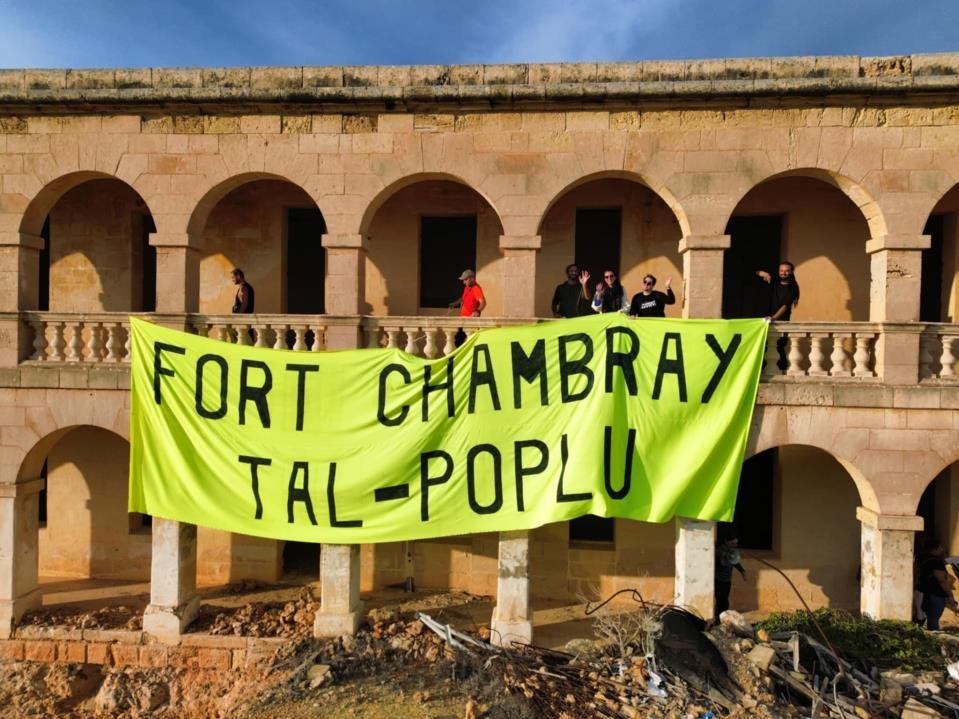
Din l-Art Ħelwa, the lead appellant against the development permits at Fort Chambray, expressed its utter dismay and indignation at the decision just handed down by the Environment and Planning Review Tribunal (EPRT). It called for the resignation of the Superintendent of Cultural Heritage who is responsible for the latest “heritage catastrophe”.
By confirming the permits that allow the dismantling and demolition of most of the historic British Barracks and the construction of a massive development inside the fort’s walls, the Tribunal has dealt a grievous blow to Malta’s military and architectural heritage, the NGO said in a statement
This decision is an insult to the very concept of European heritage protection. It comes barely two months after the British Barracks at Fort Chambray were included in Europa Nostra’s prestigious list of the 7 Most Endangered Heritage Sites in Europe for 2026 – a nomination submitted by Din l-Art Ħelwa itself.
That listing was an urgent red flag from the continent’s largest heritage network, warning that this unique site faced “imminent and irreversible damage”. Today, the EPRT has chosen to ignore that warning and sanction the very destruction the European heritage community is rallying to prevent.
The tragedy unfolding at Fort Chambray is not sudden – it is the result of two decades of deliberate neglect and institutional failure. In 2005, when the rest of the fort and its buildings were scheduled as Grade 1 and Grade 2 monuments, the Planning Authority and the Superintendent of Cultural Heritage inexplicably excluded the British Barracks from protection.
This gaping omission left the Barracks legally vulnerable to exactly the kind of predatory development we are now witnessing. More recently, when Din l-Art Ħelwa said it urgently requested an emergency conservation order for the Barracks – a last-resort tool to halt imminent destruction – both the Planning Authority and the Superintendent once again ignored the request, effectively green-lighting the developer’s plans.
Once again, the Superintendent of Cultural Heritage played a decisive role in steering this permission towards approval, DLH said. Rather than acting as the guardian of our irreplaceable cultural assets, the Superintendent appears to have acted as a rubber‑stamp for the Planning Authority and the developer’s ambitions.
This is not an isolated lapse – it is a pattern of failure spanning nearly two decades, from the 2005 scheduling omission to the recent refusal of an emergency order, culminating now in the effective sanctioning of the mutilation of the only 19th century British Barracks on the island of Gozo.
Din l-Art Ħelwa said it holds the Superintendent directly responsible for this latest heritage catastrophe. By failing to schedule the Barracks when the SCH had the chance, by ignoring an emergency conservation order request, and by failing to object substantively to the development permit, the Superintendent has betrayed the public trust and the very purpose of the office.
“We therefore call unequivocally for the immediate resignation of the Superintendent of Cultural Heritage. His continued tenure is incompatible with the protection of Malta’s cultural heritage.”
We also place on record our profound disappointment with the Planning Authority, which once again prioritised commercial gain over historical preservation.
Din l-Art Ħelwa said it is now studying the full text of the EPRT decision and will pursue every available legal and administrative avenue to prevent the destruction of Fort Chambray and the the British Barracks.
Executive President of Din l-Art Ħelwa Patrick Calleja said “Instead of safeguarding our cultural heritage, the Superintendent of Cultural Heritage chooses to author obituaries justifying its demise. How is it that the heritage watchdog for Europe, Europa Nostra, issues a severe warning for the British Barracks at Fort Chambray and lists it as one of the 7 most endangered heritage sites in Europe, and our Superintendent for Cultural Heritage remains mum? The nation is being misled and this is unacceptable.”