Text Tascha Avleoo
Image: Gallery Eygi Du
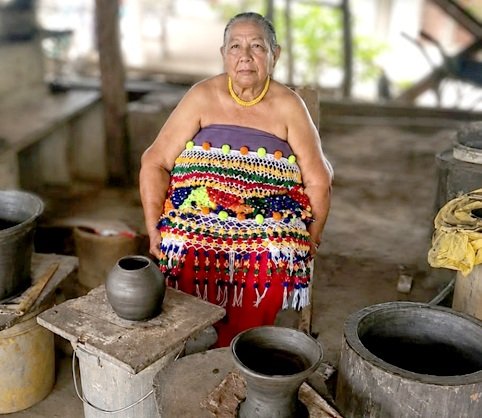
PARAMARIBO — “The step up from crafts to art was intimidating. But we wouldn’t give up. We would just eat bread with peanut butter until we reached the luxury sandwiches,” says art expert and gallery owner of ‘Galleri Eygi Du’, Carla Tuinfort. She is talking about her friend and fellow art lover, renowned Kaliña ceramicist and potter Cornelly Aloema. Last Thursday, she shed her earthly body… And as Tuinfort puts it: ‘and sought out the heavenly domain’. Aloema (77) died in hospital after a short illness due to pneumonia.
Beyond tradition
The artist came from Galibi in Marowijne, but she settled with her husband Thomas Sjinga in 1975 on the Onoribo plantation in Para. She was discovered there by the then – now deceased – artist/philosopher Luciël Becker, who brought her work into the spotlight in the Wild Coast Art art gallery, named after Becker’s own philosophy on Surinamese art and development.
“She brought with her the knowledge of her ancestors. She went beyond tradition and dared, with me and Becker, to go for a more artistic elaboration of the heritage that she proudly propagated,” sighs Tuinfort.
As an adult indigenous woman, Aloema mastered traditional pottery making, such as the watrakan to keep water cool, the sabera to drink from, or to store things. “But also the samakuto kasiri to ferment and the prapi for bathing or storing things.” Under the influence of Wild Coast Art, she learned new forms and applications of pottery.
Technology
“She made very large decorative vases, which made her famous. Cornelly was skilled at working clay, an intensive process in which clay is mixed with special tree bark and resins. And in order to create color shades in her decorative vases, she managed to turn various plant juices completely manually into the clay, which gave them more refined new shapes.”
As an adult indigenous woman, Aloema mastered traditional pottery making, such as the watrakan to keep water cool, the sabera to drink from, or to store things.
The artist did not have a modern oven. Baking was also done in a more traditional way. After drying, all products were baked in an open wood fire, as natives of the Amazon have always done. “She would sit in her open workplace, kneading and shaping, with a serious face. And it was a conversation between her hands and the clay, to shape it into special things that make people very happy to have them in their home.”
Inspiring
Tuinfort calls Aloema’s work inspiring. “A new generation of indigenous potters has emerged among the Caribbean, Arawaks and Wayana. They saw its development and also the commercial value of the heritage. It even led men to successfully practice this original women’s work.”
Tuinfort mentions the names of Alfons Sjinga, Wilfred Majoeram, Imro Kana and Leo Toenae as well-known native potters. Aloema’s work has had a permanent place in exhibitions at Art Gallery Wi Eygi Du since 1979.

She was awarded the Honorary Order of the Palm by President Ronald Venetiaan. In 2023 she received an award from the Foundation Grani Fiti Yu Moy Misi.
Aloema can be described as ‘a true icon of contemporary Surinamese art.’ “Cornelly, has been there since the beginning and thought the name for the gallery, ‘Eygi Du’, was appropriate, but also an understanding and motivation for her work and existence as a proud Kaliña. She believed that indigenous people deserved a much better and stronger reputation in Surinamese society and Surinamese development. And with her work, she wanted to be that example,” concludes Tuinfort.-.