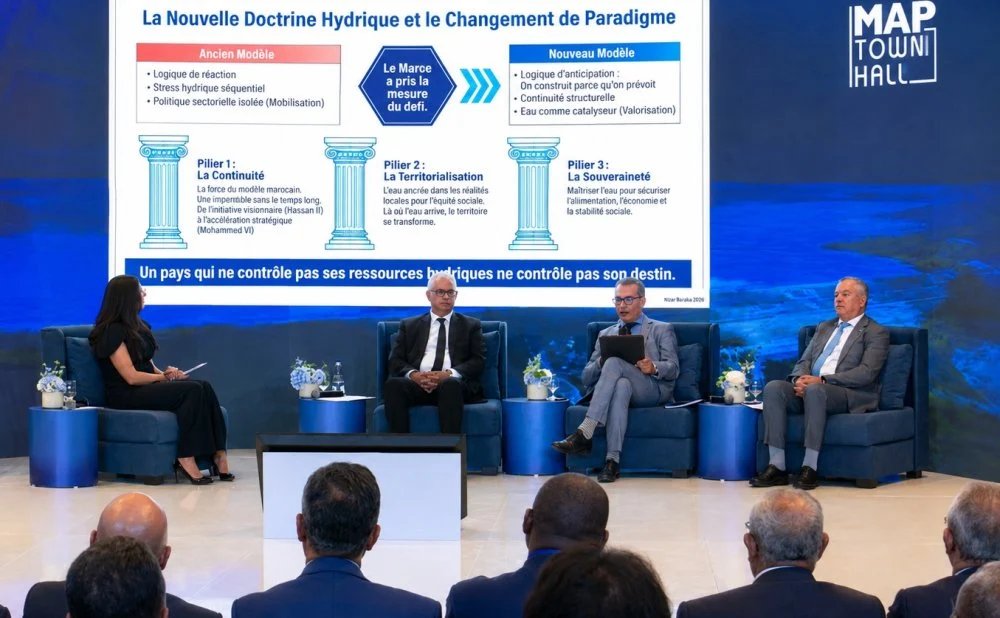
Faced with the intensification of water stress, the succession of years of drought and the acceleration of the effects of climate change, the Morocco continues to overhaul its water policy around a long-term vision that places water security at the heart of the national project. This is the message carried Nizar Baraka during the second edition of MAP Town Hallorganized Wednesday in Rabat under the theme “The Royal Vision of Water: foundation of water sovereignty and territorial equity”. For the minister, the water policy national policy is no longer solely about the management of a natural resource. It now constitutes a real project of national sovereignty and sustainable development. “Guaranteeing water means guaranteeing Morocco’s ability to choose its own destiny,” he said, taking up one of the central ideas of the Royal vision in matters of water. According to him, this vision is based on an ambition which goes far beyond the creation of hydraulic infrastructure. It aims to guarantee every citizen, wherever they live, sustainable access to water, while reducing territorial disparities and strengthening the Kingdom’s resilience in the face of climate change.
A strategy structured around five pillars
The minister detailed the five main axes which today structure the water policy national.
• The second axis concerns strengthening the country’s water resilience. This orientation is reflected in particular by the development of a national industrial ecosystem around desalination and water professions. The objective is to consolidate “Made in Morocco”, encourage technological transfer, support applied research and train the skills necessary for future challenges.
• The third pillar aims to ensure territorial equity. Interconnections between hydraulic basins and “water highways” now make it possible to transfer resources to areas most exposed to water deficit, thus strengthening national solidarity.
• The fourth axis concerns the sustainability of resources. It is based on responsible management based on water savings, the preservation of groundwater, the reuse of treated wastewater, the protection of ecosystems and the safeguarding of water heritage for the benefit of future generations.
• Finally, the fifth axis makes water an instrument of diplomacy and cooperation. Thanks to the expertise acquired over the decades, Morocco intends to strengthen its role as a reference partner in the sharing of know-how and capacity development, particularly in Africa.
Dam policy, historical pillar of water security
At the heart of this strategy is the policy of damspresented by Nizar Baraka as one of the main levers of water sovereignty of the Kingdom. Morocco today has 156 large dams with a total storage capacity of 20.8 billion cubic meters. Fourteen additional large dams are currently under construction, while a program to build 155 small dams is planned by 2028. The minister recalled that eight large dams were completed between 2021 and 2026, strengthening a hydraulic heritage which has progressed by more than 62% since 1999.
These infrastructures play a central role in securing the supply of drinking water and irrigation water. Thanks to the precipitation recorded this year and the works put in place across the Kingdom, Morocco currently has an average visibility of at least two years in terms of water security. This policy is part of a logic of anticipation. As Nizar Baraka pointed out, the Kingdom has chosen “anticipation rather than reaction,” making long-term planning a guiding principle of its action.
Desalination, a new driver of the national water mix
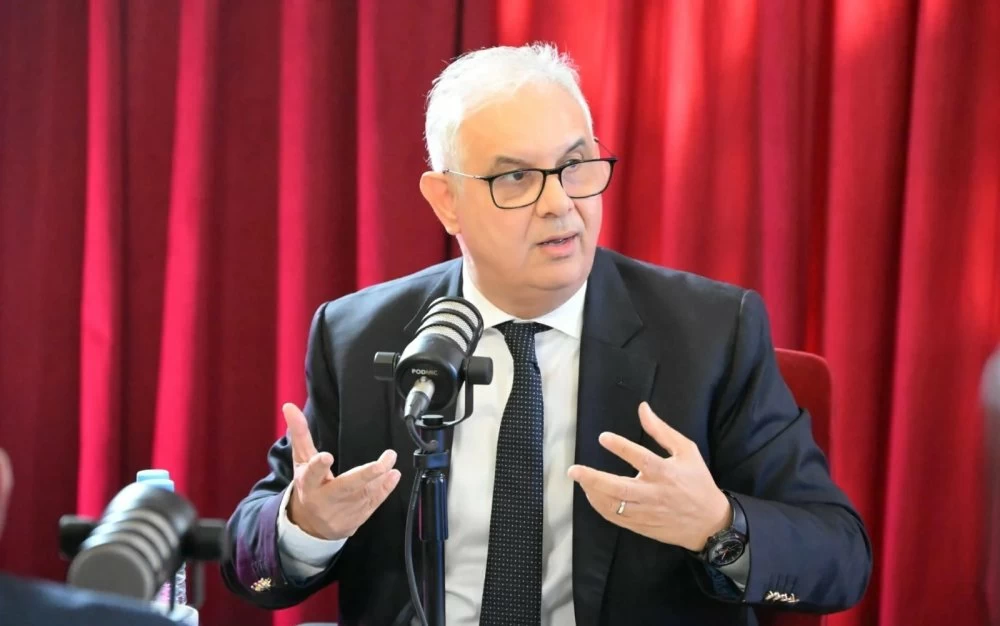
The other major pillar of this strategy is the increasing use of unconventional resources. Morocco today has 17 desalination plants operational, compared to only 9 in 2021. Their annual capacity increased from 46 million to 410 million cubic meters. This dynamic should accelerate in the coming years with seven new stations planned for 2030, as well as several extensions of existing sites. The stated objective is ambitious: to increase national capacity to 1.7 billion cubic meters per year and cover 60% of the Kingdom’s drinking water needs thanks to desalination. The ongoing projects in Casablanca and Dakhla, as well as the extensions planned in Safi, Jorf Lasfar, Agadir and Tarfaya, illustrate this rise in power. For the minister, desalination now constitutes one of the main tools for adapting to climate change and sustainably securing the resource.
Water highways serving territorial solidarity
Beyond the mobilization of new resources, the Morocco strives to better distribute the available water. THE interconnections between hydraulic basins already allow significant transfers. The North-South system can thus ensure an annual transfer of up to 400 million cubic meters, while the Oued El Makhazine-Dar Khrofa interconnection allows an additional transfer of 100 million cubic meters per year. These infrastructures, called “water highways”, constitute a major tool of territorial justice. They make it possible to supply both large urban centers and rural centers facing increasing pressure on resources. This logic of territorial solidarity is also found in the Integrated Territorial Development Programs (PDTI), presented as a new development framework aimed at ensuring equitable access to water and strengthening the coherence of public policies.
Concrete progress in the territories
The results highlighted during this meeting demonstrate the extent of the progress made. THE rate of access to drinking water in rural areas increased from 14% in 1994 to 98.8% in 2025. More than 13.5 million rural inhabitants are now served, while 11,065 douars and 93 rural centers have benefited from supply programs. In the agricultural sector, nearly 1.6 million hectares are irrigated. The Kingdom has already equipped 850,000 hectares with localized irrigation, exceeding the intermediate objective set at 350,000 hectares for 2027. The reuse of treated wastewater is also progressing. Current capacity reaches 52.6 million cubic meters per year, with a target of 100 million cubic meters from 2027, mainly for watering green spaces.
A new generation of water policies
For the Kingdom, the challenge is no longer just to respond to the emergencies of the present. It is now a matter of sustainably preserving the water capital national and to prepare future generations to live in an environment marked by increasing pressure on water resources.
The key figures of the Moroccan water model
• 20.8 billion m³ of storage capacity.
• 14 large dams currently under construction.
• 155 small dams planned by 2028.
• 75.7% average filling rate of dams as of June 1, 2026.
• 17 operational desalination stations.
• 410 million m³/year of desalination capacity currently.
• 1.7 billion m³/year targeted by 2030.
• 98.8% access rate to drinking water in rural areas.
• 13.5 million rural people served.
• 850,000 hectares equipped with localized irrigation.
• 52.6 million m³/year of wastewater reused, with a target of 100 million m³ in 2027.
• 400 million m³/year of transfer capacity via North-South interconnections.
• 143 billion DH mobilized as part of the National Drinking Water Supply and Irrigation Program 2020-2027.