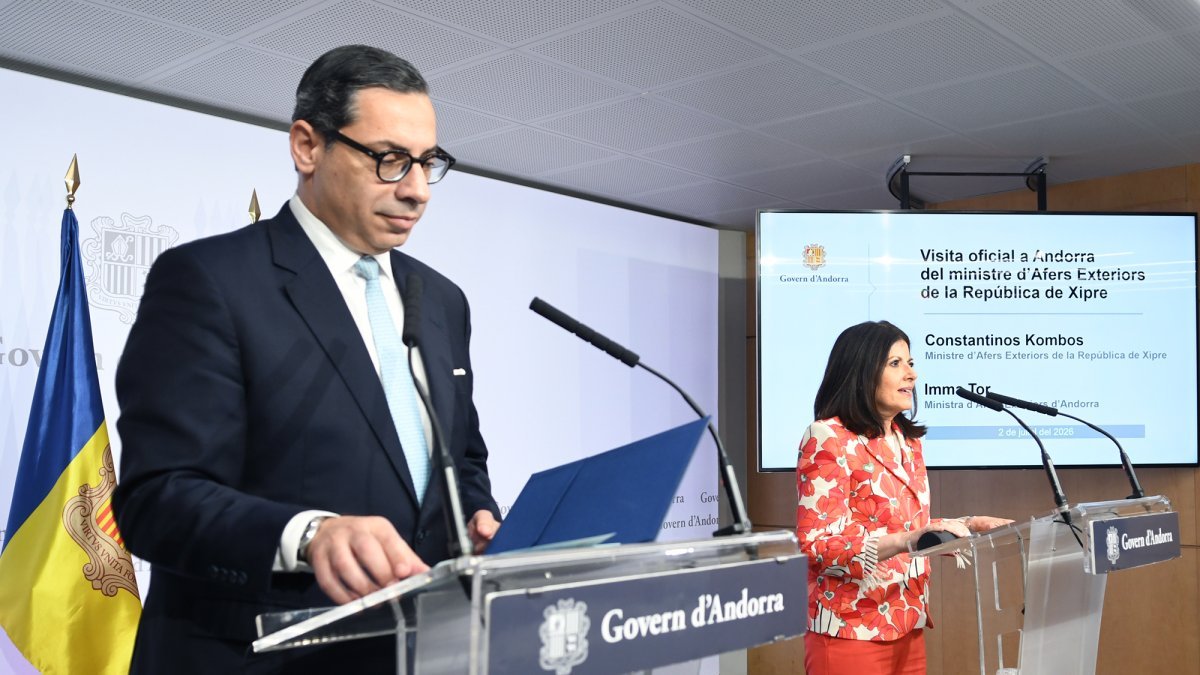

The Minister of Foreign Affairs of Cyprus – which until two days ago was the country that held the rotating presidency of the Council of the European Union -, Constantinos Kombos, has assured that the association agreement between the European Union and Andorra remains a file with real possibilities to prosperalthough it is currently blocked by a lack of consensus among member states, notably Bulgaria, which is keeping the affair blocked due to its private disagreements with San Marino.
Kombos explained that during the six months of the Cypriot presidency the agreement was one of the political priorities and that, despite the various international crises that marked this period, the Council kept the dossier “high on the agenda”.
“We ensured both political momentum and technical work so that the agreement was present in all relevant meetings and working groups”has affirmed. According to the Cypriot leader, it was also confirmed “a positive climate” between member states regarding the content of the agreementdespite the fact that some differences persisted that prevented the necessary consensus from being reached.
Kombos has revealed that during the presidency he had several contacts with the parties involved, including a visit a few weeks ago to San Marino, with the aim of trying to unblock the discrepancies before the end of the Cyprus mandate. Although it has not been possible to close the file, has expressed confidence that the process can culminate successfully under Ireland’s presidency. “The file no longer depends on the Cypriot presidency, but is in the very capable hands of the Irish presidency,” he said, adding that Cyprus will continue to work closely with Europe to assist with the continuation of the proposal.
MEMORANDUM
As part of Combos’ visit, a memorandum was signed that gives continuity to the one signed in 2024 and will serve to further strengthen bilateral relations between the two states. The one signed this morning is about education, youth and sports. In education, it allows the exchange of knowledge and practices between teachers and those responsible for educational systems; in youth, it encourages cooperation between youth organizations; and in sport, it gives continuity to the commitments made in the Small States Games, strengthening the links between federations. It also opens the door to expanding cultural cooperation, especially in shared intangible heritage, such as construction in dry stone, thus consolidating a more structured bilateral relationship with exchanges already underway in the institutional and diplomatic sphere.