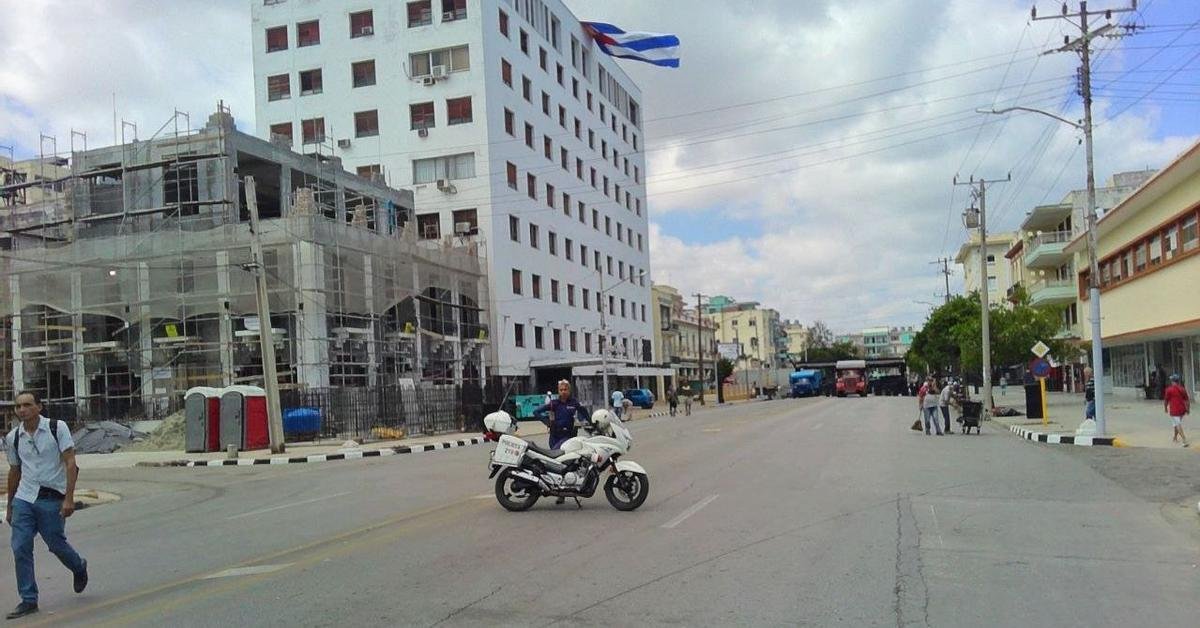
Havana/The Cuban regime, aware of the little internal support it receives, seems determined to spend every last drop of fuel on acts of reaffirmation and propaganda. This Thursday he did it again on the historic corner of 23 and 12, in El Vedado, where Miguel Díaz-Canel led the commemoration for the 65th anniversary of the proclamation of the socialist character of the Revolution.
The official figure was more than 50,000 attendees, a number that the propaganda apparatus wanted to present as proof of strength. But even accepting that fact, the image turned out rather lackluster. It is barely a quarter of the more than 200,000 people that, according to official figures of the time, the Castro regime managed to mobilize in that same place in 2002.
The comparison does not favor the Government. In a country exhausted by blackouts, inflation and emigration, the capacity for mobilization no longer impresses as before. This time, furthermore, the contrast was even more visible due to the absences. In the gallery, the only historical one alongside Díaz-Canel was José Ramón Machado Ventura. Neither Raúl Castro nor Ramiro Valdés were present, two names that for decades functioned as emblems of continuity and control. The image that 23 and 12 left was that of a liturgy that was increasingly older, more bureaucratic and less epic.

/ Capture/Presidency Cuba
The harshest data of the day, however, was not in the stands but in the electrical part. While the official apparatus was mounting another dawn of slogans, the Electrical Union predicted for April 16 a deficit of 1,872 MW during peak hours. The State mobilizes dozens of buses, trucks, police and loudspeakers to celebrate socialist resistance while millions of Cubans prepare for another night in the dark.
Díaz-Canel spoke for twenty minutes, dressed in olive green and with a small flag in his left hand, which he waved almost mechanically during each pause, waiting for the applause. He once again insisted that “the main cause of our problems is the genocidal blockade of the United States Government”, a formula that in the official discourse seeks to close down any serious examination of the inefficiency, improvisation and failure of the model. The phrase sounds increasingly hollow on an Island where power has been monopolizing all the resources of the economy for more than six decades and where the crisis can no longer be explained by Washington alone.
He also appealed to an inventory of achievements that today seems remote, almost ghostly, for a good part of Cubans. He spoke of literacy campaigns, of the social advancement of the children of workers and peasants, of shoe shiners sent to space, of social justice and of a society where “man is brother and not wolf of man.” All of this was presented as irrefutable proof of socialism, but heard in the Cuba of 2026 – with hospitals without supplies, relegated schools and professionals fleeing en masse – the argument sounds more like a rhetorical relic than a description of the present.
/ 14ymedio
Perhaps the most contradictory passage was his attempt to vindicate socialism based on the cases of China and Vietnampresented as examples of dazzling development. The mention has something of an involuntary confession. Because if these countries exhibit growth, openness and dynamism, they have done so precisely after embracing broad market mechanisms, attracting foreign investment and making more flexible economic dogmas that in Cuba continue to be treated almost as articles of faith. Invoking them as showcases of socialism without recognizing that turn is another way of manipulating history.
Furthermore, the tone of a besieged square was not missing. Díaz-Canel affirmed that Cuba must be ready to face “serious threats, among them, military aggression,” and concluded with one of the most bellicose phrases of the day: “Here, as the song says, we are going to give fire.” The slogan may draw applause among the disciplined, but it says a lot about a power that, even in the midst of material collapse, continues to bet on an increasingly less credible martial theatricality.
The act of 23 and 12 was, in the end, a display of strength in a weakened country and an appeal to nostalgia in a society that is losing faith at an accelerated rate. Castroism still manages to mobilize its followers, but each act of reaffirmation seems less like a demonstration of support and more like an exhibition of wear and tear. And the numbers, this time too, work against them.