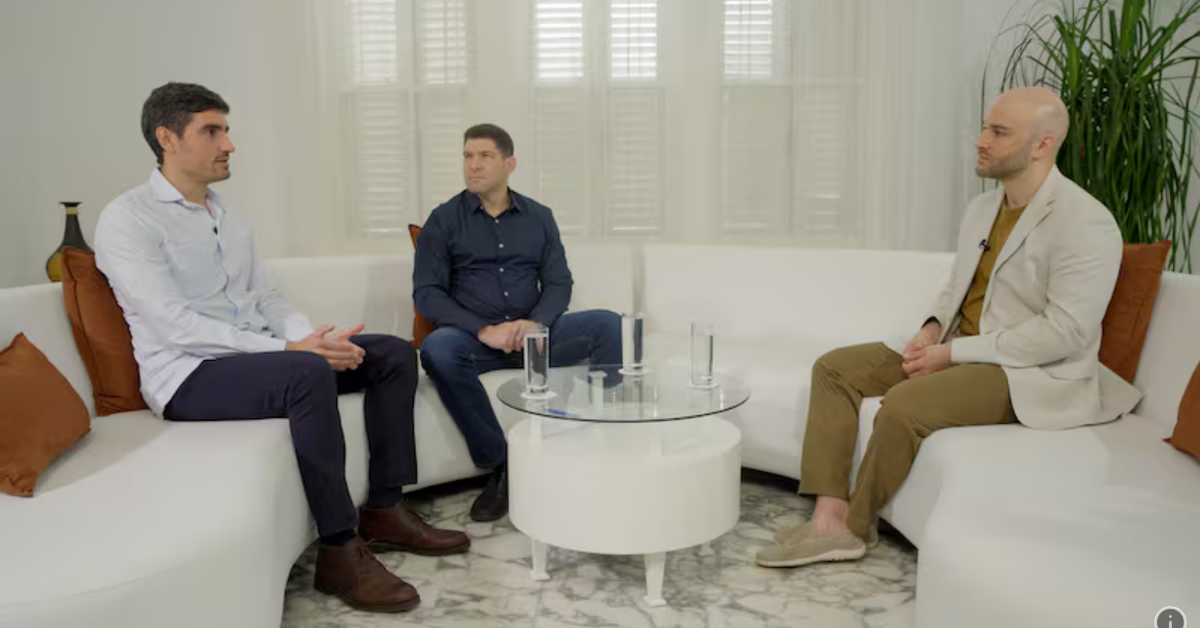
Madrid/The first interview granted to an international media by Raúl Guillermo Rodríguez Castro, grandson of the old general and known as El Cangrejo, was for The National, a prestigious newspaper in English edited in Abu Dhabi, but the intervention has not been very up to par. The most interesting thing that the supposed interlocutor contributes in the Havana negotiation with the United States is a criticism of the orthodox faction of the regime, against which – he believes – the current Government must fight. “99% of people want change, but the main opposition comes from traditionalists within the political class,” he maintains.
The interviewin which Carlos Luis Jorge Méndez, Vice Minister of Foreign Trade and Foreign Investment, also participates, is almost actually context to say that both – who are part of a younger generation – have signed several memoranda of understanding with the Emirati group Ali Abdulla Bin Haidar. The media maintains that the consultant and executive director of this super luxury company located in Dubai – owned by the businessman of the same name –, the Egyptian Ahmed Faisal, has become a discreet intermediary between Cuba and the Gulf countries.
“In tourism we have two memorandums of understanding. In aviation, in health and pharmaceuticals, one in each sector,” says Faisal. “We have three others in process related to minerals, mining and fertilizers; one more for tourism; another for ports; and another for fishing,” added the consultant, whom Cuban officials call – says the media – “the architect” and who described the moment as “historic” due to the number of agreements for a “post-sanctions” Cuba.
Cuban officials call Faisal “the architect,” who described the moment as “historic” due to the number of agreements for a “post-sanctions” Cuba.
Exactly that’s what everything depends on. The Cuban regime has already announced its battery of measures to open the economy, but it is not known what the reaction of the White House will be, on whom almost everything depends. Because with the sanctions in force, any business is still penalized.
The most striking agreement is precisely one that directly appeals to faith that the United States will accept the proposed scenario. Ali bin Haidar, president of the group, has signed a letter of intent with the Cuban Government to acquire – although the law only allows, and the regime has stressed this, to lease – land in Cayo Santa María for the construction of a luxury tourist complex. According to the newspaper, the project could be called Trump Island if negotiations with the president’s organization – from which it is deduced that they have them – are successful. Although there is no signed agreement as such, there are sketches, they claim, with two towers and golden domes.
Another agreement cited is the one that the Egyptian group Mag has signed with the state mining company Commercial Caribbean Nickel SA (CCN), a Cajálbana exploitation, in Pinar del Río. The company will send a technical team to evaluate geological resources and infrastructure and meet with officials regarding the creation of a joint venture if everything prospers. Nickel also appears as a source of interest in the article.
“If sanctions are lifted, Cuba will need substantial investment in many sectors,” says Mohamed Atta Gad, president of Mag. “In many ways, it is an untapped market with enormous potential.” The manager highlights something that, if true, is an anomaly: the flexibility and fluidity of the procedures with the Cuban side. “The only major obstacle is the American sanctions,” he concluded.
The National He affirms that there have also been meetings with the oil and gas sectors, in addition to taking, the Cuban side, a guarantee: the continuity of medical cooperation with Qatar, Saudi Arabia and Kuwait.
“We find ourselves in a particularly special moment because these transformations have accelerated,” says Vice Minister Méndez to The National. “We are promoting greater participation of the private sector in the economy, not only by opening more activities to private initiative and promoting foreign investment in practically all sectors, but also by creating a more favorable and internationally competitive business environment,” he insists.
Of course, being careful to make it clear, through a linguistic acrobatics, that this is not a betrayal of the principles of the Revolution. “I would like to clarify that we are not privatizing the economy. What we are doing is giving greater participation to the private sector in the economy, practically in all sectors.” The official stated that the system is not going to change, only the economy is going to be “modernized.”
Regarding another relatively uncomfortable question, compensation for confiscations in the 1960s, the vice minister opened up to an agreement without mentioning – like his bosses previously – compensation for damages from the embargo.
The National He explicitly asks about the future of Gaesa, the military conglomerate that controls a very high percentage of the Island’s economy, but Méndez avoids answering. “We do not believe that the issue is to review any particular business group or entity,” he answers. Regarding another relatively uncomfortable question, compensation for confiscations in the 1960s, the vice minister opened himself to an agreement without mentioning – like his bosses previously – compensation for the damages of the embargo. “We are willing to seek an agreement… that is satisfactory for all parties, considering both the foreign companies that were in Cuba and were nationalized, and also seeking agreements that are acceptable for Cubans who at some point emigrated from the country,” he said.
The official also spoke about practical measures, from the one-stop shop to complying with other international standards, but the grandson, despite getting the attention, only managed to fall into commonplaces. “We are a group of young leaders who today have high responsibilities in the direction of the Cuban Government under the leadership of Army General Raúl Castro Ruz and President Miguel Díaz-Canel Bermúdez, accompanied by a large group of colleagues of different ages and generations, all with their eyes set on a central point: the well-being of the Cuban people,” he said, and spoke of his mission being to quickly integrate the reforms.
The National It makes an x-ray of the country and its problems, draws the inflationary panorama and incorporates graphics into the information, in addition to having the opinions of several political scientists and economists, some of them closely linked to the regime. But in the end it leaves an essential reflection. “On the streets of Havana, where the peso is devalued daily and power outages can last up to 22 hours, the execution of these plans will be the biggest challenge. Whether the agreements being signed now become the basis for true opening will depend on decisions made far beyond Cuba’s borders. As one anonymous businessman said: ‘If they don’t do this, this country will sink like never before.'”