Madrid/Chavismo could have ended in many ways: defeated at the polls, displaced by a negotiated transition, reformed from within, or buried by a coup d’état or a conventional foreign invasion. Any of these outcomes would have left its leaders with an argument to save the remains of their battered honor. But history had something crueler in store for them. After a quarter of a century vociferating against imperialism, the Bolivarian revolution ended up begging for its survival at the feet of Donald Trump.
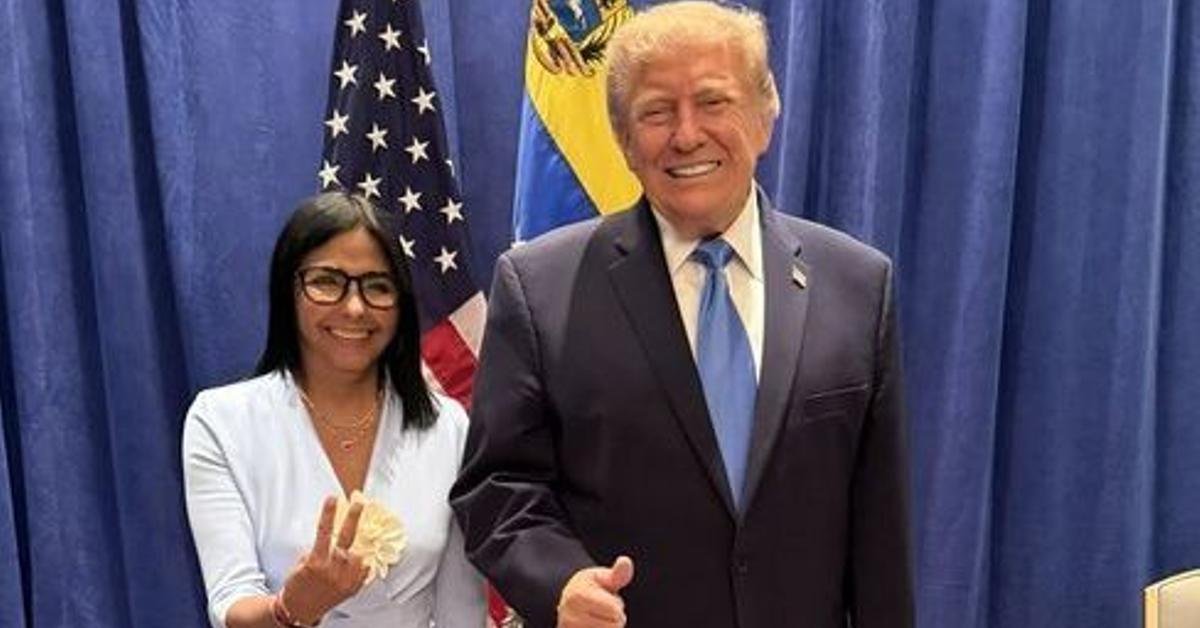
There was Delcy Rodríguez, in New York, turned into the uncomfortable guest at the party, but willing to swallow the last remains of her pride in exchange for keeping the president’s dress. That revolution that promised to bring the empire to its knees discovered, in the most humiliating way, whose knees they were.
The genuflection has provoked an attack of indignation in the Castro regime. The Cuban Minister of Economy, Joaquín Alonso Vázquez, ruled that “Betrayal only has one name: betrayal”, a phrase in the style of “Raúl is Raúl” or “technique is technique.” Ramón Labañino, one of the five spies, he was sorry to see a friend “kneel and betray.” The Spanish propagandist Ana Hurtado wrote: “Judas Iscariot will always be a pale apprentice.” Even came to recognize that the oil dispossession of the United States would not have gone so far with María Corina Machado in power.
How much does this lady know us? Is there a Delcy Rodríguez among us?
So much indignation hides, however, a less confessable fear. Cuban leaders have also spent decades – many more – proclaiming that they will never negotiate their principles. But now “sister” Venezuela has just demonstrated that the most solemn convictions are surprisingly flexible. What is disturbing in Havana may not be seeing the acting president kneeling in front of Trump, but rather looking in the Venezuelan mirror and asking quietly: how much does this lady know us? Is there a Delcy Rodríguez among us?
Revolutions are not defined by the positions their leaders hold, but by what they promised to be. And the Fifth Republic, the one that Chávez gave birth to with the 1999 Constitution and his promise of refoundation, rested on three pillars. Let’s review the damage inventory.
First: the supposed sovereignty. Whoever spent 25 years making anti-imperialism his cornerstone, in reality always depended on Washington’s sneezes. And today that dependence has been completely stripped bare. A sovereignty that needs the approval of the enemy is always a sovereignty on parole.
Second: oil. It was “the weapon of the revolution” and now they give it away like a family jewel in a pawn shop. The price boom allowed Chávez to finance social programs, expand spending and project influence. A good part of the Pink Tide – left-wing Latin American governments – used the Venezuelan tap to fuel their own power ambitions. But when international conditions changed, a model that confused temporary abundance with sustainability became visible.
Third: leadership. In July 2024, the National Electoral Council declared Maduro the winner without publishing the disaggregated results, and the Carter Center concluded that the process did not meet electoral integrity standards. Diosdado Cabello had sworn that they would not leave power “neither by hook nor by crook.” Then January 3, 2026 arrived, and Cabello discovered that the bad times were worse than he imagined. The United States captured Maduro and his heirs did not lift a finger to defend him: they began to negotiate for their own skins.
Repression is the last thing that dies in an authoritarian regime
However, the numbers already made it clear that the petro-socialism of the 21st century had been a disaster. According to the IMF, real GDP fell more than 75% between 2013 and 2021. And the contraction began before the sanctions of 2017 and 2019. Attributing everything to the “economic war” is equivalent to declaring innocent any government that knows how to point the index finger at an external enemy.
At the end of 2025 there were around 7.9 million Venezuelan refugees and emigrants. And that petro-socialism, conceived to “overcome capitalism,” today seeks American investment as the only lifeline.
Let’s add: a Chavismo without legitimacy of origin, without sovereignty, without oil income as its own lever and without a leadership that does not depend on Washington’s permission. What remains of the Fifth Republic? Just the name, like the sign that the premises keep when they have changed ownership.
It will be objected that the device is still standing. It’s true. International organizations warn that the new stage has not dismantled the repressive mechanisms inherited from Maduro. But that confirms the thesis instead of denying it. When a system can no longer offer a project or prosperity, it is left with machinery. Repression is the last thing to die in an authoritarian regime.
There are also uncomfortable questions for Washington. The United States captured Maduro and chose to negotiate with central figures in his Government, while Edmundo González Urrutia continues to demand recognition of the 2024 results and Machado cannot even return. It is easier to pressure an opportunistic leader without legitimacy, like Rodríguez, than to obtain the same from someone with the internal leadership and international recognition of Machado. It is always easier to plunder a moribund and cornered dictatorship than an established democracy. And in the context of the war against Iran, it is clear that the priority is oil, democracy can wait.
On the social networks of the Cuban ruling party, some once again bring up the 32 Cubans who died trying to protect Maduro. They forget, however, that Havana repeatedly denied the presence of its military in Venezuela and that it only recognized their existence when they were already corpses. To expect Castroism to break diplomatic relations with Delcy Rodríguez’s Venezuela would be to ignore the nature of parasitic dictatorships, such as the Cuban one.