A person entered the lush Victorian-style greenhouse and noticed smell of rotten eggs. Another said the smell reminded her of dissecting a dead bird A third compared it to the smell of a stinky diaper drying in the sun.
“I expected it to smell bad, but it really smelled like rotten meat,” said Nyx DelPrado, a freshman at Mount Holyoke College, who visited the greenhouse Talcott this week to see a corpse flower bloom. “His name is apt,” DelPrado added with a laugh, his nose wrinkled, adding that it reminded them of the smell of a dissection.
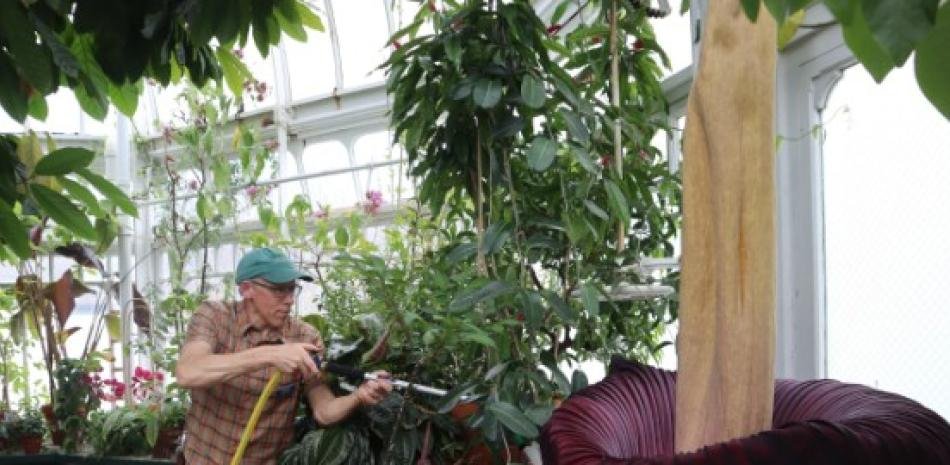
The corpse flower, or Amorphophallus titanum, is a rare tropical plant known for its foul odor. Native to the rainforests of Sumatra, it blooms infrequently and only briefly, releasing a pungent aroma that mimics decaying meat and attracts pollinators such as flies and beetles. Nicknamed “Pangy,” the plant first flowered in the Mount Holyoke College in 2023, and its recent appearance has once again attracted crowds eager to witness—and smell—this ephemeral spectacle.
What appears to be a single flower is actually a huge inflorescence, a cluster of numerous tiny flowers at the base of a tall central column called a spadix, surrounded by a deep purple velvety spathe. Although the imposing inflorescence withers after a few days, the same plant survives underground and can bloom again in later years.
A repellent odor designed to attract
Tom Clark, director and curator of the Botanical Gardens of the Mount Holyoke College, He said the plant’s infamous odor serves an important evolutionary function and has inspired a wide range of descriptions by visitors.
“Some people who have come since have described the smell as overpowering, overpowering, like garbage — it’s overwhelming,” Clark said. “But that smell has a reason. It’s there to attract the pollinatorsparticularly flies.”
It is difficult to predict when the corpse flower, since it usually appears after years of lethargy. Over the past six weeks, Pangy grew rapidly, sometimes several centimeters a day before splitting open. The flower finally opened on Monday night, and he and other employees were met with its intense aroma when they arrived at work the next day.
“As we walked in the front door, we could smell it,” he said. “As we walked back to the greenhouse where it grows, the smell was getting stronger and stronger. It was just overwhelming, literally unbearable, to be there with that plant. If you didn’t know this plant and you walked into the greenhouse, you would say, ‘What died here?'”
From shock to amazement
“I didn’t know what the name meant. I thought it would smell like a corpse, but I don’t know what a corpse smells like,” said Maheen Siddiqi, a Mount Holyoke student, laughing after waiting in an increasingly long line of people waiting to smell the flower. “And I smelled it and it smelled like rotten or sulfur eggs or something like that.”
Student Bryn Wickere commented that the smell was less intense than she expected. Still, Wickere described the towering flower as “magnificent,” noting its deep color and velvety texture.
“I actually expected the smell to permeate the entire room, but it was more noticeable as I got closer to it,” Wickere said.
Others found it The smell is more familiar than shocking.
“I would say it smells a little bit like a compost heap, kind of like the smell of a working farm,” said Mount Holyoke senior Caroline Murray. “I’m from Vermont, so I’m very used to the smell of the farm and the manure.”
The spectacle attracted visitors from near and far, including Michael Breton, who drove two hours and took a day off work to see the bloom after having been following news about it for years.
“If you see a news story from two days ago, it is no longer available, so hurry up,” he said. He compared the smell to “a stinky diaper that’s been out in the sun,” adding that despite the smell, the plant was “bright, beautiful and colorful. It’s a beautiful plant.”
A fleeting flowering, an enduring mission.
Clark said the bloom highlights the broader mission of the Talcott Greenhouse, which he called a “plant museum” that houses about 2,000 plant species, a small fraction of those among 350,000 and 400,000 plant species which are estimated to exist throughout the world.
He called the event a “special opportunity” to show visitors the diversity of the plant world and some of the amazing adaptations species have to survive in their environment in unique ways.
By midday Tuesday, the smell had begun to dissipate as the greenhouse’s vents opened, offering visitors an experience less intensealthough equally memorable. After the brief flowering period, the plant will gradually deteriorate until it collapses. Since corpse flowers cannot self-pollinate, seeds will only form if pollen is available from another giant arum.
For Mount Holyoke junior Namuuna Negi, the ephemeral nature of the bloom added value to the experience.
“I think it’s because of its impermanent nature. People like to be aware of what’s going on,” Negi said. “If they hear that something is going to disappear soon, they want to go see it before that happens so they can talk about it later.”