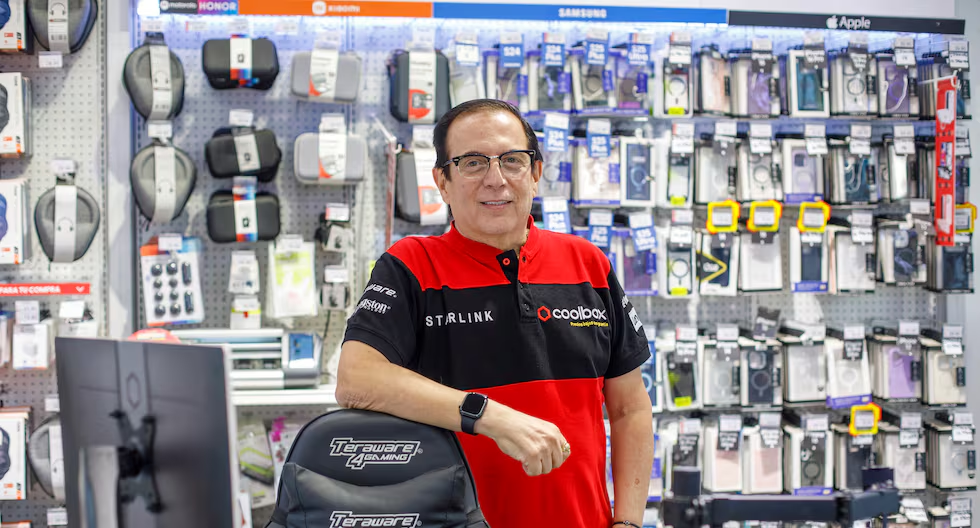
– How has Coolbox’s performance been and how has it been transforming its business in recent years?
We are very strong. In fact, we have had an important evolution that is reflected in sales. In 2014 we stopped being a distributor of RadioShack, which went bankrupt that year, there we decided to build a brand that is ours and we can define the future and the pace of the brand as a ‘convenience store’. And it was in 2018 that we decided to become a specialized retail technology business, it worked well but it was from 2021 onwards that we did extremely well and strengthened our strategy aimed at proximity to the customer with omnichannel and satisfying their demand.
That is why we have focused a lot on capillarity, last year we closed with 140 stores and this year we will open 33 more stores, with which we hope to close with 173 stores. and further development of the online channel.

– How much does the online channel represent for Coolbox today?
Coolbox’s online business represents about 15% of sales, and if we look at all digital channels they represent 25% of the company’s sales. The curious thing is that since last year we see that 80% of orders are collected in stores. We believe this is because they prefer to go to nearby stores to have it instantly. This has meant that we have a very fast delivery strategy, with the promise of being able to collect the product in 18 minutes.
-How is Coolbox’s performance this year with that strategy and how much does it project to close the year?
Our projection for the year 2026 is to grow 19%, but already in the first quarter we have been growing 26%, so the projection could fall short. We are growing because we have understood our consumer and explored a lot about what they will require. We are a Peruvian company increasingly specialized in technology retail.
-How do you see the competition in this specialized technology sector in Peru?
We have leadership in technological specialization in retail, it is a complex and highly competitive market, we have very good and professional competitors.

– Nowadays, in addition to competition in physical stores, there is also competition from global marketplaces. Is the competition for Coolbox more intense now?
Yes, I’m sure that’s the case. We have a much more informed consumer than before, with access to different retailers, to the digital channel. This has meant that companies have to be much more efficient in their processes and competitive to satisfy consumer needs. Margins have been decreasing in the market and we have all had to adapt to that.
– Being a specialized retailer, what conditions should your stores have today? Is there a greater focus on customer advice?
We put a lot of effort and prepare our sales teams a lot so that they are correctly trained in all market trends and advise the client to propose solutions to their problems and how to make their lives easier with technology. Although the consumer is much more informed than before, there are always much more technical things that are difficult for the client. Today we have more than 1,000 collaborators.
– You mentioned that you aim to open 33 new stores, where will they be located and how much do you plan to invest for this?
Now we are growing mainly in stand alone stores, since there are not so many new shopping centers. This year we have opened five stores and each of them required between US$150 thousand and US$200 thousand of investment. This year, we are going to invest almost US$6 million in the 33 new stores.
“We are going to invest US$6 million in opening 33 stores this year.”
– Are they your own stores or do you also see the franchise model or another growth model?
Our model is 100% operated by us, we open and manage the stores.
– What are the segments you are targeting the most and what products have the highest rotation in your stores?
Most categories have been growing, but the ones that are now standing out are tablets, they have a very strong niche with double-digit growth. The gamer segment also continues to expand. As new categories, a couple of years ago we incorporated satellite antennas for internet connection such as Starlink, with which we have a 70% market share, which has significant demand. Also in headphones and Apple accessories, we have more than 50% of the imports of Apple accessories in Peru.
And we are exploring what new categories we can incorporate, for example, virtual reality glasses or exoskeletons, which are coming very soon. We are soon starting the sale of these products, which are additional elements that one puts on the body, that help athletes improve their performance or walk more stable, trekking, elements that help human movement.
– How much will they be selling for?
They should be here in the next 30 days. It is going to be the incorporation of technology into daily life. Exoskeletons are super new and we are going to have them here in Peru. Helps for several things, for walking, knee pain, for everyday life.

– Will you aim to grow this portfolio in Peru?
Yes, the idea is always to see the latest technologies to bring them here. Whether it will sell a lot or a little, we don’t know, but we do think that our consumers deserve the opportunity to be in contact with innovative technologies. Today society is asking for things faster and faster.
– What is the average ticket that exoskeletons have on the market?
When a new product comes out the prices are always much higher and then they go down. Initially they will be around US$600. But the years will pass and it will become more widespread.
– In an interview he commented that one of Coolbox’s objectives was to be able to offer accessible technology for the middle class. Is that still the premise?
Yes, but more than defining a class, we think that the Peruvian consumer deserves to have access to first-class technology, to products, to the latest technological launches that occur in the world.
– Within Coolbox do you also have your own brands or exclusive brands?
We work with renowned trademarks, we are authorized Apple distributors. What’s more, 50% of the cell phones we sell are Apple brand. There is a huge consumer preference for these products. We have JBL, Sony, Starlink, among other commercial brands and we also develop our own brands, important because it allows us to deliver high quality products to the consumer at more competitive prices. We have teams that handle development and custom manufacturing for private label products. We are going to continue promoting it.
“Yes, there is going to be pressure (on prices). So far, we have not increased any prices, nor have we received any price increases from the manufacturers. Next week, I don’t know. When that kind of thing happens, some distribution channels are interrupted.”
– How is the issue of costs coming about as a result of the conflict in the Middle East that has impacted the price of the dollar, oil and chips? How does it affect the technological outlook in the coming months?
It is a bit uncertain what is going to happen, the impact it will have or the duration. We know that there is a conflict in the Middle East and that is making oil supplies difficult, especially for many Asian countries, which include China, which is the world’s largest manufacturer of technology products. There is an impact on investment in freight, that may have an impact, but we do not know the magnitude of what is going to happen.
– What actions are they taking?
As a company we are worrying about advancing purchases to have more inventory and survive any peak or valley in supply. In addition, there is a global shortage of chips also due to the hyperdevelopment of artificial intelligence in many places in the world, which means that the few chip factories are at full capacity and there is definitely an increase in prices in the world market, For example, laptops, which may now be cheaper than in a month or two months.
– Is it something that is already perceived today?
Yes, in commercial brands, but they are already strategies of global brands. In the case of own brands, we order manufacturing, in China there has been a small impact on freight, but it is something that we have still absorbed and we are maintaining our prices for the moment. How long? Don’t know.
– There is cost pressure right now for the technology sector.
Yes, there is going to be pressure. So far, we have not increased any prices, nor have we received price increases from manufacturers. Next week, I don’t know. When these types of things happen, some distribution channels are interrupted.
– Do you feel immediately in Latin America?
I think this is immediate, we are in a totally globalized world. Commercial brands have their factories, their supplies in China, in India, they see the moment in which they feel the impact and define it on a global level. In the case of own brands, we are seeing that freight rates are rising, but it is not something that would require making a price adjustment now but we will see.
Marcelo Bazán, general manager of Coolbox, tells us what this path was like for the company, which at the time represented the defunct RadioShack in the country, as well as its strategy to have a capillarity of 140 stores in Peru and 10 in Mexico. (Photo: César Campos)
/ CESAR CAMPOS NUCLEO-PHOTOGRAPHY > CESAR CAMPOS
– Do you plan to incorporate new brands or new products?
We are well covered with global brands. We handle on average about 2 thousand SKUs (products) in stores and more than 10 thousand on the web. And we have our Coolbox marketplace with more than 300 sellers of technology products alone.
– Is Coolbox planning to make the international leap?
Yes, a year ago we began the presence of Coolbox stores in Mexico. We have eight stores in Monterrey and two stores in Guadalajara. We have done very well, learning a lot about a new market. This is a long-term project, it is a giant country. Our specialized retail model works very well.
– Among the 33 stores that will open this year as Coolbox, are any more included in Mexico?
No, it is only for Peru.
Marcelo Bazán, general manager of Coolbox, comments on the new technological products that will arrive in Peru.
/ CESAR CAMPOS NUCLEO-PHOTOGRAPHY > CESAR CAMPOS
– Are you planning to open more stores in Mexico?
We have opened 10 stores in one year, so this 2026 we have decided to stop a little to consolidate and in 2027 we continue to grow.
– What attracted you to the Mexican market?
It is a little further away, but it is a much more attractive market, much larger, there are more opportunities to develop and grow.
– How much do you project the Mexico operation will represent in the next 5 years?
Our goal is that in the next 5 years the billing of Mexico approaches the billing of Peru.
– How much do you expect to bill this year as Coolbox?
We estimate it to be S/545 million in Peru alone.