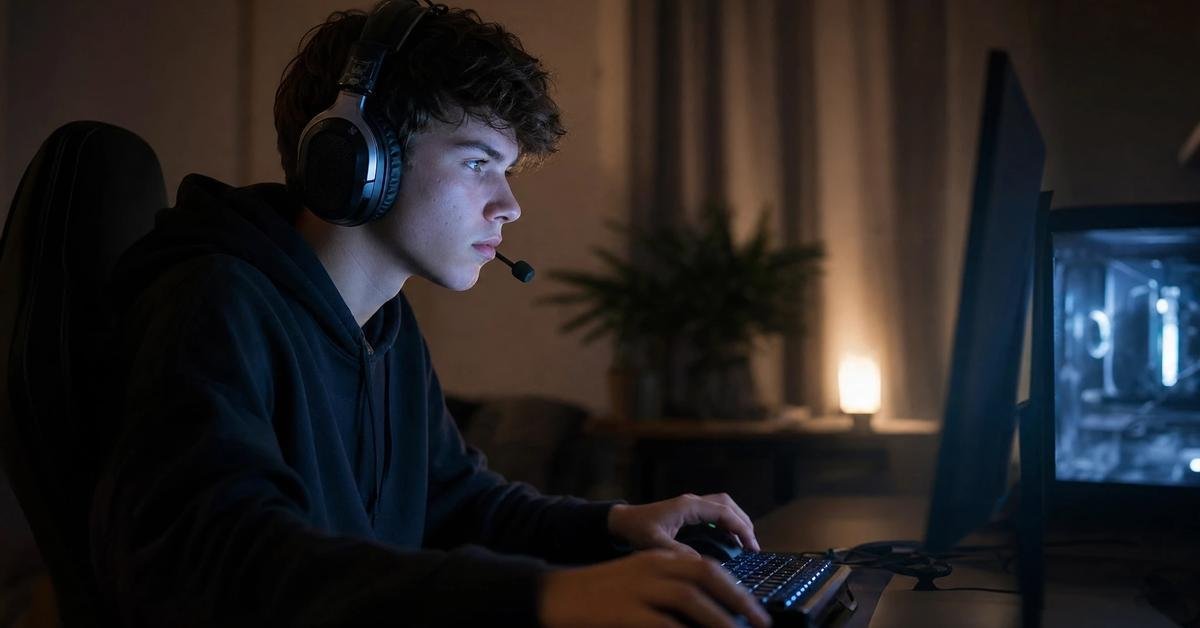
Playing online in Cuba is an act of resistance. While the world talks about million-dollar leagues, here a tournament can depend on whether there is power that night. And yet, the scene grows.
More and more young people on the island are devoting hours to competitive video games, from Dota 2 to Clash Royale, despite a technological ecosystem that seems designed to stop them. The phenomenon is no longer marginal: there is structure, history and a gamer community that organizes itself despite everything.
This text goes through that pulse: the technical barriers, the role of the ADEC, the disciplines that move Cuban players and the little money that supports electronic sports on the island.
The current pulse of competitive video games in Cuba
Cuba has an active esports scene, with regular tournaments, national qualifiers, and players competing outside the country. It’s not a million-dollar industry, but it’s real.
The Cuban Esports Sports Group, known as ADEC, functions as the backbone of that organization. It coordinates tournaments, defines rankings and gives visibility to disciplines that were previously played only in cybercafés.
What is striking is the contrast: while the Cuban digital infrastructure is among the slowest on the planet, competitive gaming continues to add players. Passion compensates for what the internet connection does not offer.
The technical barriers that Cuban gamers face
Bandwidth and blackouts: the silent enemy
In May 2026, the Speedtest Global Index measured an average speed in Cuba of just 7.21 Mbps, the lowest in Latin America. In fixed broadband, Ookla ranked the country as the worst in the world, with only 3.04 Mbps in January 2025.
Blackouts make everything worse. ETECSA recognized that 47.5% of mobile base stations and 56.5% of cabinets are out of service during outages, and that the network cannot last more than 24 hours without electricity.
In April 2026, after a total blackout, internet traffic fell 65%, with Havana below 1 Mbps. For those looking for online competitions, this means very high ping and disconnections mid-game.
Restricted access to Steam and PlayStation Store
Buying on platforms such as Steam or PlayStation Store from Cuba continues to be an obstacle, given the limited access to payments in freely convertible currency and the recharge limits in CUP.
How players resolve these limitations
- Third-party accounts abroad to purchase games or load digital wallets.
- Informal stores that resell libraries or already activated accounts.
- The Weekly Package and community Wi-Fi networks to download installers and patches without depending on official bandwidth.
ADEC: from 2007 to 2026, a scene that becomes professional
Key milestones year by year
The ADEC was born in 2007 as an amateur group, when the first Cuban clans began to organize homemade strategy and first-person shooting tournaments.
Over the years it went from local meetings to an electronic sports calendar with a national qualifier and participation in regional events, including references to the Central American and Caribbean Games as a competitive horizon.
Legal and institutional framework of esports in Cuba
Institutional support remains limited, without a specific esports law, although state media such as Granma already recognize the activity as a legitimate sporting phenomenon.
Active competitive disciplines: comparison by tournament and level
Dota 2 and the national ranking
Dota 2 dominates the Cuban PC gaming scene. The ADEC maintains a national ranking that orders Cuban players according to their performance in internal tournaments.
Clash Royale and Mobile Legends
On mobile phones, Clash Royale and Mobile Legends attract players without access to powerful consoles, taking advantage of the lower data consumption compared to other titles.
Pokémon VGC and SimRacing
Pokémon VGC adds competitors loyal to the team format, while SimRacing grows among those looking for high-level PC gaming simulation.
FIFA/EA Sports FC and Call of Duty
FIFA, now EA Sports FC, and Call of Duty are mostly played on consoles, including PlayStation 5 where hardware allows. Outside the island, titles like World of Warcraft also attract Cuban players in the diaspora.
In international competitive shooters, the gap between those who play fair and those who use external software generates constant friction. Platforms like battle log They sell these types of advantages for titles like Gray Zone Warfare, foreign to the Cuban scene but present in the global debate on online competitive integrity.
Who pays for the party? Financing, sponsorships and awards
Nobody gets rich competing in Cuba, at least not yet. The esports scene is moving forward without a solid sponsorship model behind it.
Teams, sponsors and prizes esports Cuba
Cuba esports awards are usually symbolic: recognition, some merchandise or access to international tournaments. Teams rarely have fixed sponsors and depend on fees or contributions from their own members.
Institutions like the ADEC manage part of the logistics, but external financing remains scarce compared to what leagues from other countries in the region move. Some specific tournaments, such as the Free Skies Championship, have served as a showcase to make the Cuban scene visible to audiences outside the island, although without the financial support of large brands.
Are there Cuban players who make a living from esports?
The short answer is no, not on a sustained basis. Some prominent Cuban players manage to travel to regional tournaments thanks to specific support, but living exclusively from competitive gaming remains the exception, not the norm.
How to start competing if you are a new player in Cuba
Entering the competitive scene does not require fancy equipment. It requires patience, a stable connection when possible and a desire to learn the rules of the local game.
Requirements, minimum age and tournament registration
Most of the tournaments organized by the ADEC require prior registration, an active account on the game platform and, in some cases, a minimum age depending on the category. National qualifiers are usually announced weeks in advance on community channels and Telegram groups.
For newcomers, it is most practical to first join the local gaming community before signing up for a large tournament. There you learn the real schedules, not the official ones, and how to avoid scheduled blackouts.
The role of Joven Club and the University of Computer Sciences
The Young Computer and Electronics Clubs continue to be, for many, the first contact with organized PC gaming, offering rooms with equipment and, sometimes, a more stable connection than at home.
The University of Computer Sciences, the UCI, functions as a technical hotbed: a good part of the Cuban players with a competitive profile in Dota 2 and other strategy titles pass through its classrooms or its internal tournaments.
Arcade Cuba and cybercafés in front of the organized scene of ADEC
Not all gaming in Cuba goes through tournaments and rankings. There is another layer, more informal, that also sustains the gamer culture on the island.
Playing in physical spaces vs. compete online
Arcade-type venues and internet cafes offer something that many homes don’t have: a decent connection and up-to-date consoles, including a PlayStation 5 in the best-equipped places. There it is played for fun, without the pressure of a national qualifier.
The organized scene of the ADEC, on the other hand, requires consistency, registration and measurable results. They are two different ways of experiencing competitive video games in Cuba, and many players move between both depending on the day.
How many similar establishments exist in the country?
There is no official figure published on how many spaces of this type operate on the island today. What is clear is that they are concentrated in the main cities, where the internet connection, although limited, is less hostile than in rural areas.
Gamer community, Cuban developers and the video game ecosystem
Behind every tournament there is a community that sustains the ecosystem even when the infrastructure fails. And that community no longer just plays: it also produces.
ConWiro, Global Game Jam and the local industry
Events like ConWiro bring together fans and creators around gaming, while Cuban participation in the Global Game Jam has served as a platform for Cuban developers to show their own prototypes to an international audience.
The video game industry in Cuba remains small, but active. Institutions such as the ICAIC have shown specific interest in crossovers between animation, narrative and interactive development, an area yet to be fully explored on the island.
Streaming and gamer culture on the island
Streaming faces the same enemy as online competitions: scarce bandwidth and unpredictable blackouts. Even so, some creators manage to broadcast games and build an audience, feeding a gamer culture that grows despite adverse conditions.
The other side of the board: when the advantage is purchased online
Where there are online competitions, there are also those who seek unfair advantage. In international competitive shooters, third-party software (aimbots, ESP, wallhacks) circulates easily, although its use violates the rules of each platform and is not exempt from sanctions or legal risk depending on the jurisdiction.
Cheats and third-party software in competitive shooters
For cuban players With limited connection, competing clean is enough of a challenge. The technical gap facing the scene esports on the island contrasts with a global market where fair play continues to be the basis of any tournament Serious.