
Most of us here on Dominica would be familiar with the Dominican owl. Some of us may have seen one of those birds of prey in a church building, or would have heard one screech, or seen one move stealthily as it flew past overhead.
Our owl goes by two local names. Kwéyòl speakers call this species ‘chawan’, while folks in the Kòkòy-speaking communities of Marigot and Wesley call this bird ‘jombie bòd’ (jumbie bird). The bird is one of our resident breeders, which means that it resides and breeds on Dominica.
What a healthy diet!
The owl is a nocturnal predator, meaning that it hunts for prey at night. Its diet includes – but is not limited to – bats, rats, mice, large insects, lizards, and several species of birds – including migratory species.
Some time in the late 1990s, while the Portsmouth Roman Catholic Church with its iconic steeple was still standing, now retired forestry officer and local bird enthusiast, Bertrand ‘Dr. Birdy’ Jno. Baptiste, a French ornithologist from Guadeloupe, and yours truly visited a Dominican owl’s nesting area in the steeple of that church. After climbing a rickety ladder to get up into the steeple, our mission was to investigate what an adult
owl, which had made the steeple its home and nest site for several years, had been feeding upon. We teased open several regurgitated owl pellets, and found the skeletons of bats, rats, large insects and several birds. The adult peered down at us from above and never made a sound while we conducted our business.

Change in common name
Up until recently, the owl here was commonly known simply as the barn owl with the scientific name Tyto alba. But the barn owl had a very extensive range and was described as “the most widespread owl species in the world”.
That species’ range included Africa, Asia, Australia, Europe, the Caribbean, and the Oceanic Islands where it was introduced for rodent control. With such a wide distribution also came variations in appearance. The owls in the Lesser Antilles had mostly dark brown plumage and a dark face, while those in other parts of its range had a whitish face outlined by an orange ring (the facial disc), and the rest of the plumage was not
half as dark as those from the Lesser Antilles. And so, the taxonomists assigned the barn owl in the Lesser Antilles to new species status with its own common name – the Lesser Antilles barn owl – and scientific name Tyto insularis. This species is sometimes referred to as the Grenada owl, and it is restricted to the islands of Grenada, St. Vincent, the Grenadines and Dominica.
Wink at the latest addition to Dominica’s endemic birds
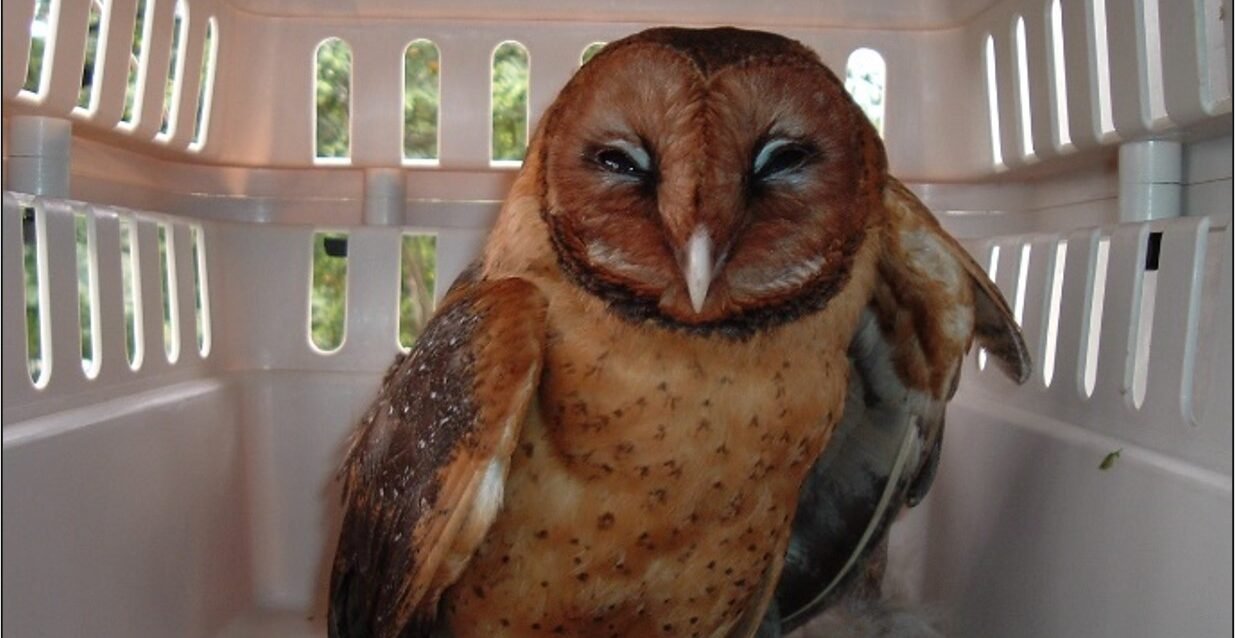
Closer examination of the Lesser Antillean barn owl revealed that there are sufficient differences between the owls on Dominica and those on Grenada, St. Vincent, and the Grenadines to separate ours from those on the other Windward Islands. Our owl is now regarded as a subspecies of the Lesser Antillean barn owl and is restricted only to Dominica! It has been assigned a new scientific name, Tyto insularis nigrescens, whereas those on Grenada, St. Vincent, and the Grenadines go by the scientific name of Tyto insularis insularis.
So, with the recent elevation of our owl’s status to that of an endemic sub-species, ‘Chawan’ joins the Sisserou Parrot (Amazona imperialis), Jaco Parrot (Amazona arausiaca), and the Kalinago Wren (Troglodytes martinicensis) – known locally as òsiyòl and siyòl – on Dominica’s growing list of endemic bird species, meaning that those birds are found on the Nature Isle and nowhere else on Earth.

A Few Facts Worth Noting About Dominica’s Barn Owl:
1. Church buildings, warehouses, etc. are favourite hideouts for some of Dominica’s owls.
2. Dominica’s owls sometimes compete with other birds for nesting sites. Some years ago, an owl took over a parrot nest, high up on a tree in the rain forest in the Mone Diablotin National Park, and would even occasionally ‘enjoy the scenery’ during daylight hours. (See photo above)
3. Barn owl chicks are white, and as they age, the brown feathers appear.
4. Owls in general – including the Dominica barn owl – have the ability to turn their head almost 270 o, i.e., a full three-quarters of a circle. An extraordinary feat indeed!
5. There is local superstition associated with the vocalization (screeching) of an owl in a village – or even in a town. When that happens, some persons believe that an elderly person in that community will soon go to the Great Beyond.