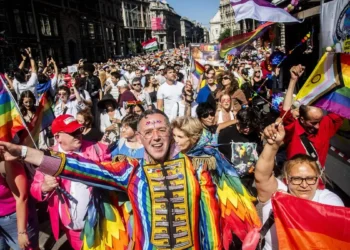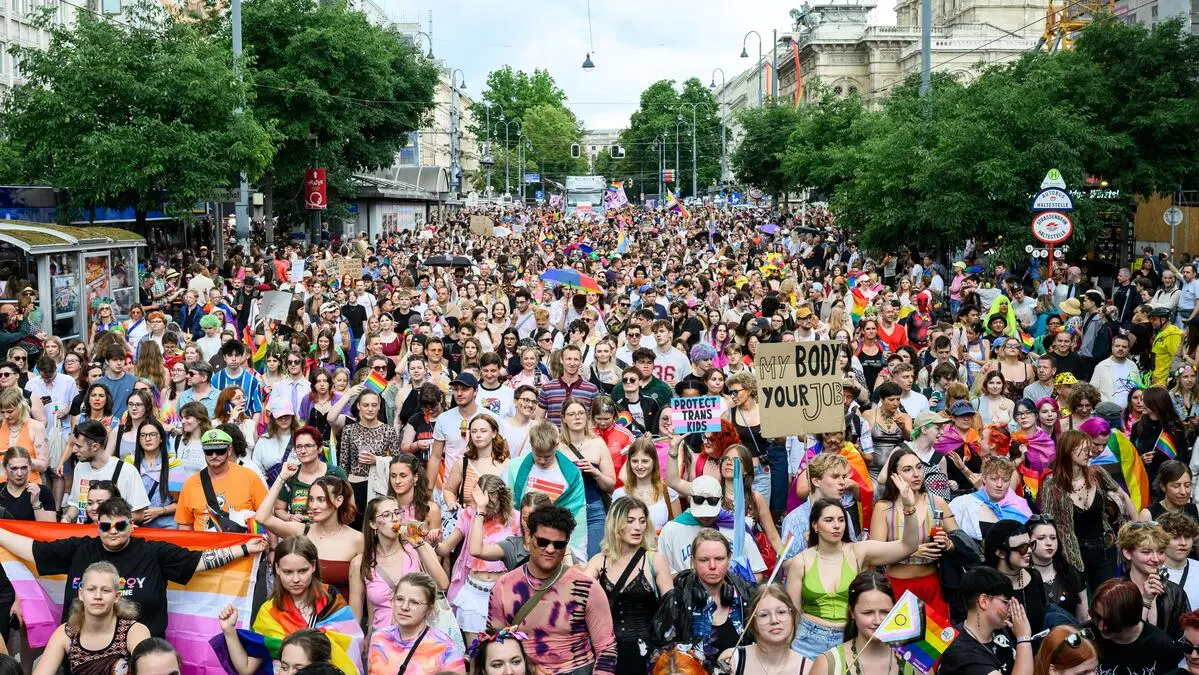
Stephanie says she has been looking forward to this day for a year. Count the months, the weeks, the days. The lawyer from Vienna, who specializes in real estate law, is there with a few friends and colleagues, one in jeans and a T-shirt, one in just shorts and a hat, one in a miniskirt and top, one in a rainbow-colored bikini. She herself is wearing a short black dress, her partner, a company spokeswoman, is wearing a similar dress in turquoise. The dark-looking make-up of the two probably falls into the Gothic category.
“The feeling of being part of something that belongs to me, but that is bigger than me, is hard to describe,” she continues, crying out briefly as she hears “Flowers.” Miley Cyrus heard from one of the many loudspeakers. The rainbow parade, which did not start at 12 o’clock but 20 minutes later due to a cloudburst, is now at the level of the Stubenring in front of Parliament. “This feeling is a form of belonging that is most closely equated with cultural identity. You feel good without knowing exactly why. It is an instinct, an inner voice, a gut feeling.”
What’s strange about this feeling is that she doesn’t actually have to hide or pretend in everyday life, “but speaking as I want, moving as I want, dressing as I want, dancing as I want, and all that in the midst of people with whom I feel a connection and by whom I feel understood, that only happens here,” says the woman in her thirties. And thus summarizes what is the essence of the Pride parade, which set an example for equality and acceptance with more than 300,000 participants on Saturday. This, let’s call it, “Pride attitude to life” is omnipresent. And combines a good mood with a political message, a party with a demonstration, exuberance with thoughtfulness.
Katharina Kacerovsky-Strobl, the organizer of the event, also attaches importance to this differentiation Vienna Pridewhich is celebrating its 30th anniversary this year and this time is taking place under the motto “Visible since 1996”. “The parade was and is a political demonstration and a liberation festival,” she tells the “Presse”. However, this claim does not contradict a “huge party, colorful and happy”. She therefore expects all people who do not belong to the LGBTIQ+ community but still take part in the rainbow parade to respect and support the character of the demonstration. Of course they are all welcome, but the serious, socio-political aspect should also be neglected, she says and points to another point where there is often a need for clarification, namely child protection.

Many of the participants held up signs with messages to underline the demonstration nature of the parade. APA/Max Slovencik
This is repeatedly brought forward by opponents of Pride in order to discredit their concerns. Specifically, the accusation is that attempts are being made to introduce young people to a queer lifestyle in schools or youth clubs or to get them excited about this lifestyle. Which of course is not the truth and is certainly not the intention of Pride. It’s just about protecting queer young people from bullying and conveying to them and those around them that it’s okay to be queer. The focus is on education and awareness, nothing else. Nobody wants to turn heterosexual young people into queer young people. That is not possible either. If something like this were possible through outside influence, it would also have to work in the other direction, which is also not possible.
“Why I’m here today? Because I want to show solidarity with the LGBTIQ+ community. Even if I’m not part of the community,” says Mehmet. The dance teacher came from St. Pölten. “On the train to Vienna, I was insulted homophobically twice and had to endure several disparaging looks because I only wore shorts and had the rainbow colors painted on my face. For me, this was further confirmation that Pride is still needed and that its concerns and messages are not obsolete,” says the 27-year-old. And pays a compliment to a man next to him who is lavishly dressed and made up, and he responds with a hug. “Believe” is booming from the speakers in the background Cher.
The demonstration procession with hundreds of thousands of people is currently pulling up at the Schottentor and is approaching the Pride Village at Rathausplatz in sunshine and pleasant temperatures. We will be here later Conchita and JJ two song contest winners will also appear. Many of the participants hold up signs. “We give stages diversity,” one reads. “Trans Lives Matter” and “I am not an Evolutionary Mistake” on two others. Yet another holds up a sign that says “Ban conversion therapy.” The ban on such therapies is one of the community’s most important demands. According to reports, the federal government wants to present a corresponding law before the summer. However, protection against discrimination in the private sector – not just in the professional context – did not make it into the black-red-pink government program, although the SPÖ has been advocating for it for years.

The song contest winners Conchita and JJ at their performance in the Vienna Pride Village on Saturday evening. APA/Max Slovencik
30 years of the Rainbow Parade showed “how much our community has achieved through visibility, protest and political pressure – and how much still lies ahead of us,” says Ann-Sophie Otte, chairwoman of the Hosi (Homosexual Initiative) Vienna. However, the community still expects effective protection, including consistent measures against hate crime and an absolute ban on the conversion therapies in question. “These practices are inhumane, can be classified as torture and have no place in a modern constitutional state. We finally expect concrete steps instead of mere promises. The government must finally move from announcements to action.”
Conchita and JJ have now also taken action. With their performances late on Saturday evening in the Pride Village, the ESC winners provide the emotional highlight of a long day. The town hall square is completely full at this point, and shortly after 6 p.m. it is reported that there is no more space for any more visitors who want to come to the Pride Celebration. Those who made it experience two musicians in a great mood who not only exude a touch of song contest, but also use their performance to show that love is a force of nature. No matter in what form. “Pride was never just a party, Pride was always a protest,” says Katharina Kacerovsky-Strobl in conclusion. “And proof that love and solidarity are stronger than any form of destruction.”