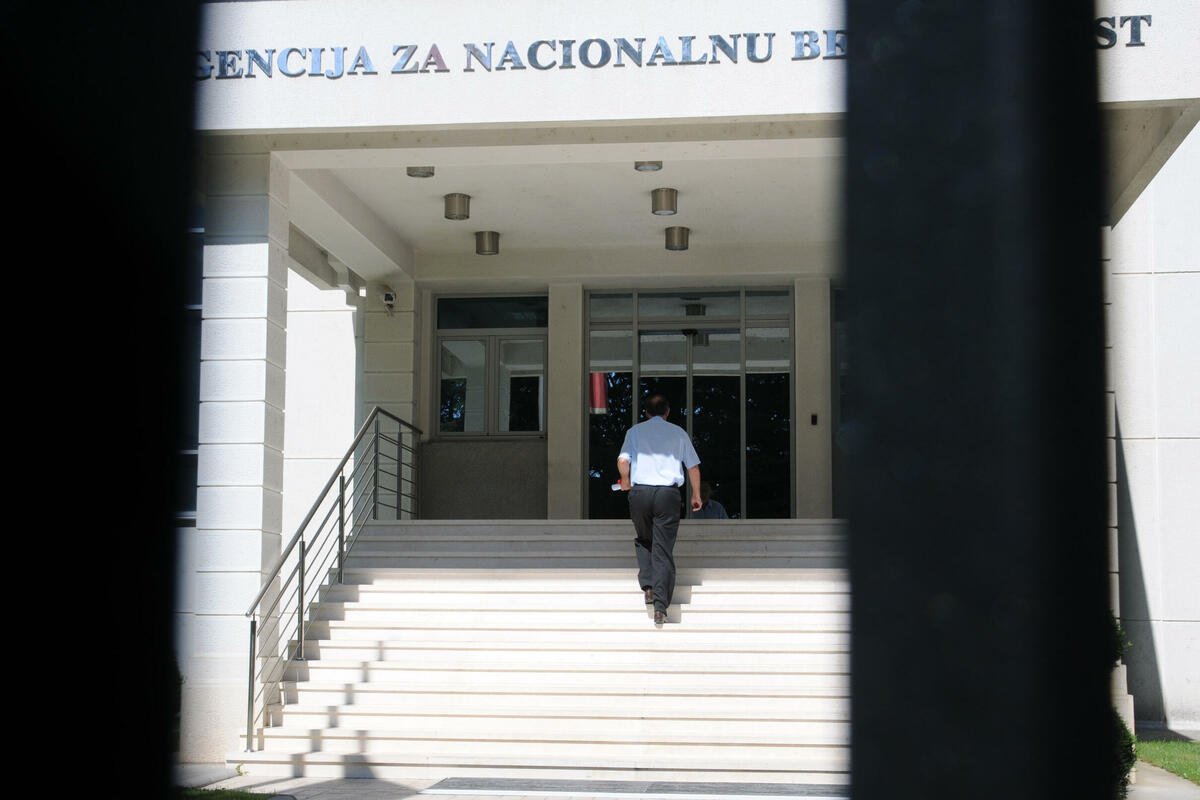
Illustration, Photo: Boris Pejovic

15.06.2026. 11:41 a.m
The reaction of the National Security Agency (ANB) to the text of the Center for Investigative Journalism of Montenegro (CIN-CG) about the allegations of employees who filed a criminal complaint with the Special State Prosecutor’s Office due to suspicions of illegal surveillance again shows a pattern in which they respond to claims that were not presented in the text, instead of essential issues of public interest.
This is what CIN-CG said in response to ANB’s reaction, emphasizing that no one claimed in their text that it was a “wiretapping system”, and that the essence of the text was not in the eavesdropping of communications, but in the claims of some ANB employees who suspect that certain software solutions enable the monitoring of the location and movements of officers, including periods when they are not at work.
CIN-CG’s response is transmitted in its entirety:
“The reaction of the National Security Agency (ANB) to the text of the Center for Investigative Journalism of Montenegro (CIN-CG) entitled: “Watch out, it is being recorded: Employees of ANB filed a criminal complaint with the SDT due to suspicions of illegal surveillance” again shows the pattern we have already seen. Namely, instead of answering essential questions of public interest, the public is offered a polemic with claims that were not even stated in the text.
CIN-CG did not state anywhere that the software solution in question is a “wiretapping system”, nor did it claim that ANB is illegally wiretapping its officials. This is precisely why a significant part of ANB’s reaction is a response to an allegation that was not published. It creates the impression that there is a discussion about something that is not the topic of the research, while key questions remain unanswered.
The essence of the text of the CIN-CG was not in the interception of communications, but in the fact that some of the employees filed a criminal complaint with the Special State Prosecutor’s Office (SDT) because, as they themselves claim, a certain software solution made it possible to monitor the location and movements of all employees, including periods when they are not at work. ANB did not give a clear and unambiguous answer to those allegations.
Also, CIN-CG did not dispute, nor does it dispute, the right of ANB to protect official telephones, applications, communication channels and confidential data. Every security service has the right and obligation to take measures to protect against device theft, unauthorized access, installation of risky applications, system compromise and data leakage. There was no dispute about that in the text.
However, the institution’s right to protect official devices does not automatically mean the right to monitor the movement of employees outside of working hours, nor does it remove the need for public responses when the employees themselves express suspicion that certain measures have exceeded legal limits. This is exactly the question that was raised by CIN-CG and which ANB did not clarify in its response.
Instead of disputing the facts from the research, ANB is again trying to discredit the journalist’s work by suggesting that the public has been misled. However, the simplest way to show that the public has been misled would be to refute the specific allegations with facts. However, no such denial was offered in response.
Therefore, questions remain open: whether there was a possibility of monitoring the location of the employee, under what conditions it was used, whether it included a period outside working hours and why the employees believed that there were elements for filing a criminal complaint with the SDT. These are questions that arise from published research and are of undoubted public interest.
The public does not expect ANB to reveal operational secrets, but to answer legitimate questions about the legality of the institution’s actions. As long as one responds to claims that have not been published, and not to those that have, the impression remains that one is arguing with constructions, while avoiding the essence of the problem.
The practice of ANB to ignore specific journalistic questions of CIN-CG and then react only after the publication of the texts, trying to discredit the journalist’s work and argue about something that was not even the subject of our research, is particularly worrying,” CIN-CG stated.
Download the application and follow the news


FOLLOW US ON

News