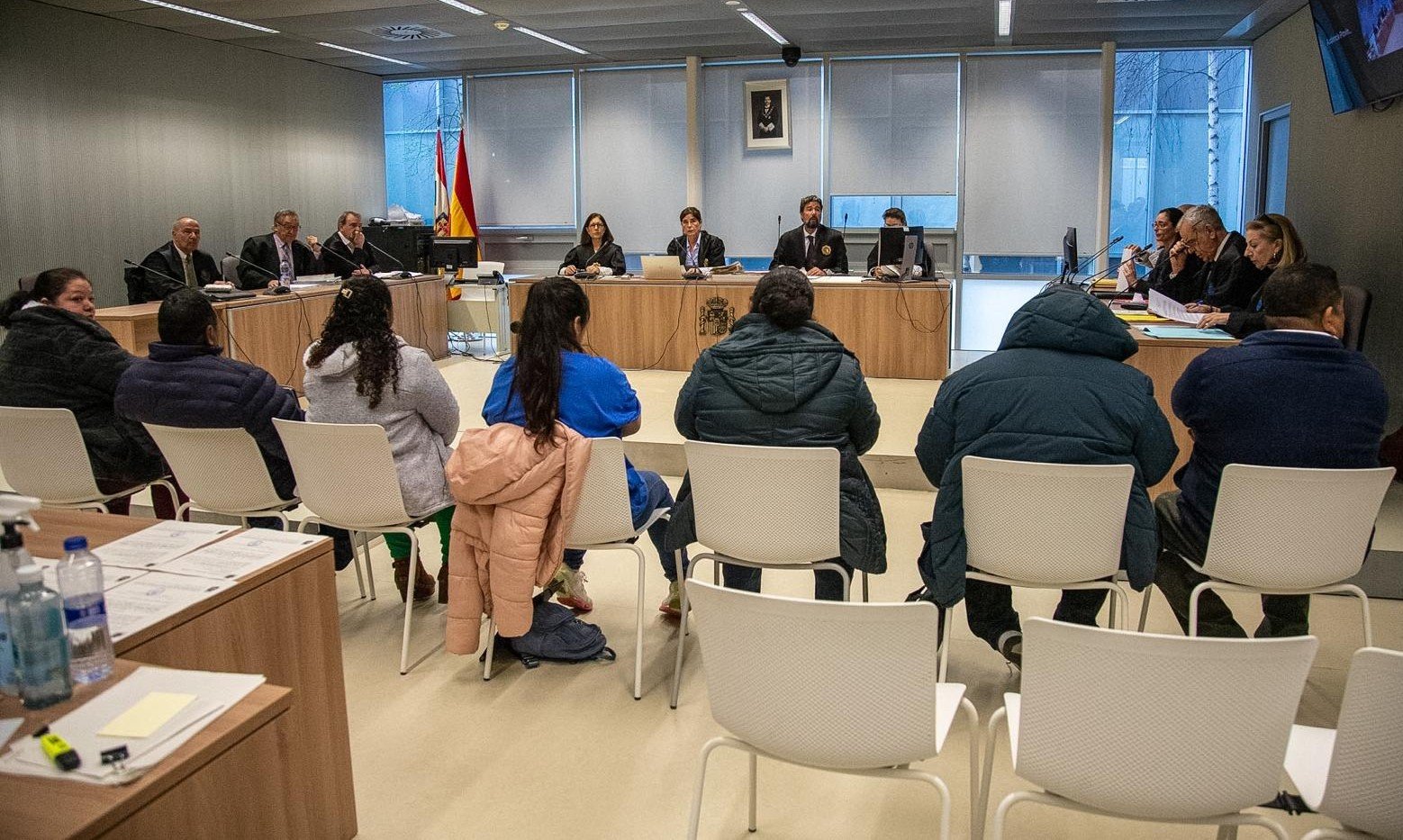
A family of seven Nicaraguans, originally from Chinandega, was accused in La Rioja, in northern Spain, of the crimes of human trafficking, integration into a criminal group, and money laundering. If found guilty, most face sentences of between four and six years in prison.
The seven Nicaraguans—who are free— They appeared before a court on Wednesday, March 25, 2026, waiting to reach an agreement with the victims and the Prosecutor’s Office, but since it was not possible, they were summoned for a trial in February 2027.
The accused Nicaraguans are: (in this note they are identified with pseudonyms)
- Francisca; identified as “most responsible”.
- Sarahidentified as another “most responsible.”
- Leticia. The three are sisters.
- Sandro, couple Leticia.
- Fernandocouple of Sarah.
- Teresaniece of Francisca.
- orlandoson of Francisca.
The investigations against this alleged trafficking network began in May 2019, and the catches in August of that same year.
Additionally, in September 2019 the authorities spoke with Josefaa Nicaraguan who is considered one of the first victims of the network. The woman, who at that time lived in Zaragoza, said that she worked for five years taking care of the children of Sarahwho lived in Spain.
Everything changed for her at the beginning of 2017, when Sarah He returned to Nicaragua to take his children and sister Francisca to live with her in Spain. When Josefa expressed her anguish at being unemployed, Sarah He offered to travel with her, with the expectation of getting her a job caring for the elderly. Josefa I did not have the money to buy the air ticket, nor to show financial sufficiency to the Spanish immigration authorities, but Sarah solved both problems.
More than 50 women in three years
Until then, everything is fine. The problem started later, when Sarah He charged him what he had spent on her. Although for those dates that ticket should not have cost more than 800 euros (approximately $880 at that time), Josefa He claims that he ended up paying 5,473 euros (more than 6,000 dollars). Almost seven times more.
There are indications that the accused transported more than 50 women over three years. All from Chinandega, generating income that could add up to 750,000 euros (about $825,000).
When interviewed, Josefa She expressed that she did not feel that she had been exploited at work. On the contrary, she pondered the “benefits” that the trip meant for her and her family. He only complained that they “charged him so much money” for a plane ticket.
Those who did appear aggrieved were Regina and Svetlanawho presented testimony. Reginaas complainant. Svetlanaonly to answer questions that allowed the investigation to advance, but without daring to file a complaint.
Red operated in two Spanish provinces
There is a third sister in this story: Leticia. Research shows that Leticia and Francisca They reside and operate in a town called Alfaro, with the support of Sandracouple of Leticia. For its part, Sarah and her husband, named Fernandooperate in the province of Huesca. From there, both groups would have extended their action to neighboring provinces such as Navarra and Zaragoza.
After interviewing the three women, court orders were issued to tap the suspects’ phones, which allowed them to build the case that is now being heard in the National Court. This allowed us to conclude that there may be around 53 victims, of which just over 40 are identified by full name and Nicaraguan passport number.
There is no certainty about the exact number of women who were taken to Spain as part of the operation. It is inferred that the total would be higher, considering that there are up to three years of activity between the first known case and the time of the arrest of the accused.
Modus operandi of the accused
The premise is that the business idea arose when Francisca and Sarah —who arrived in Spain in 2014 and 2015, respectively— detected that there was a demand for personnel capable of caring for the sick and the elderly.
They would have then begun to look for women in Chinandega, with the alleged support of their mother – whose name is not mentioned – which began the transfer of up to fifty women. The cost of the ticket, and the loan of 1000 euros to each of them, was borne by the sisters.
Once they had passed the immigration check, the women had to return the money and hand over their passport as a guarantee that they would pay the loan, the amount of which they established between 5,500 and 6,000 euros.
“From that moment on, their situation in Spain is irregular, this being another element of threat and control used by the alleged perpetrators, as evidenced during the telephone interventions carried out, recording conversations in which they recommend that the victims not wander through public areas so as not to be detected and identified,” they point out.
Thousands of euros sent to Chinandega
Much of that money went to a person in Nicaragua. The records of several remittance companies that collaborated in the investigation show that many of the shipments were made in the name of Ricardo. In total, almost 75,200 euros (just under $83,000) were sent to him.
Although it is unknown who this person is and his relationship with the three sisters, it is suspected that he is the father of another of the accused, named orlando. He is the son of Franciscaand bears the surnames of her and Ricardo.
It is presumed that part of the money sent was used to buy airline tickets, and contribute the 1,000 euros that each woman had to present to the immigration authorities upon arriving in Spain. Another part of the money would have been used to buy farms, homes and other assets in Nicaragua.
After the parties did not reach an agreement at the court hearing on March 25, the defendants will have to wait eleven more months to find out what will happen to them. Unless their lawyers can agree before that date arrives. If found guilty, in addition to prison sentences, the defendants would have to return the illegal charges to the victims and pay compensation of 80,000 euros (about $92,800) to two of them.